
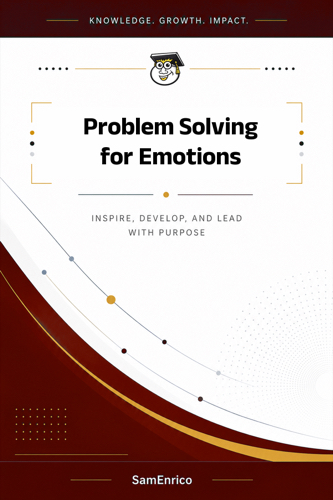
Problem Solving for Emotions Audiobook
Step by step DBT method to address emotion trigger
Step by step DBT method to address emotion triggering problems directly.
Formats
Free sample
Chapter 1: Riding the Wave--You are driving home after a long day at work. Your shoulders are tight, your jaw is clenched, and you haven't eaten since noon. As you merge onto the freeway, another driver cuts you off without signaling. You slam on the brakes. Your heart pounds.
Your face flushes. And before you can think, your hand is on the horn and the words "ARE YOU KIDDING ME?" are flying out of your mouth.Thirty seconds later, the other car is gone. But you are not fine. Your heart is still racing. Your thoughts are spinning.
You replay the moment over and over: Who does that? What if I had crashed? I should have done something else. Why do I always overreact?That last question—Why do I always overreact?—is the most dangerous one you can ask yourself. Not because it's wrong, but because it leads to the wrong answer.
It leads to shame. And shame leads to more overreaction.Here is what is actually happening inside your body in that moment, and why no amount of "calming down" or "thinking positive" will ever work when you are already flooded.The Myth of Calming Down Let me tell you something that might surprise you. When you are in the middle of a strong emotional reaction—panic, rage, terror, despair—your brain is physically incapable of following the instruction "calm down." This is not a metaphor. This is not an excuse. This is neuroscience.Your brain has two major players in the emotion game.
The first is the amygdala, a small almond-shaped cluster of neurons deep in your temporal lobe. Think of your amygdala as a smoke detector. Its only job is to scan for threats and sound the alarm. The second player is your prefrontal cortex, the area right behind your forehead. Think of this as your fire chief.
Its job is to evaluate the alarm, determine if there is actually a fire, and coordinate a response.Here is the problem. When your amygdala sounds the alarm—when it detects a threat, real or imagined—it floods your body with stress hormones: adrenaline, cortisol, noradrenaline. These hormones do two things. First, they prepare your body for fight or flight: increased heart rate, rapid breathing, tunnel vision, diverted blood flow to your large muscles. Second, they literally reduce blood flow to your prefrontal cortex.
Your fire chief gets less oxygen. Your logical brain starts to shut down.In other words, the very state you need…
This is the end of the free sample. Get the Audiobook to keep going. Buy now
About this book
Details
- Author
- Collado Zelda
- Publisher
- SamEnrico
- Language
- English
- Genre
- Non-Fiction, Self-Help, Problem Solving
- Released
- 2026-06-09
- Pages (approx.)
- 155
- Available as
- eBook, Audiobook

Listen in the VoxFlicks app
Audiobooks and audio dramas wherever you go. Sign in with your SamEnrico account and press play.
More by Collado Zelda
 Eye Emergency First Aid KitCollado Zelda$11.99
 ER Nurse Burnout Prevention GuideCollado Zelda$11.99
 Meditation For Better Sleep CompleteCollado Zelda$11.99
 Sunken Submarine Rescue TalesCollado Zelda$11.99
 The Waco Gas MasksCollado Zelda$11.99
 Anubis Jackal GodCollado Zelda$11.99
 Palace For Grocery ShoppingCollado Zelda$11.99
 Exercise For Burnout RecoveryCollado Zelda$11.99
 The Deep Blue Code: How the Ocean’s Secrets Cracked the InternetCollado Zelda$11.99
 Jazz & the Jinn: Harlem's Hidden MysticsCollado Zelda$11.99
 Anubis' Unseen Scales: The Weighing of the Modern SoulCollado Zelda$11.99
 The Dancer's Guide to Ballroom DanceCollado Zelda$11.99
You may also like
 Define Problem Statement WorkshopNichols Curtis$11.99
 The Interruption MVP MethodLyon Camellia$11.99
 Pain Point Innovation GuideHagan Davina$11.99
 The Struggle Is Data GuideBattle Kirby$11.99
 Problem Solving DBT WorkbookCriswell Violette$11.99
 Problem Solving VisualizationWeeks Jamar$11.99
 Problem Framing WorkshopDancy Rosario$11.99
 Group Creative Problem Solving HandbookOliveira Mardell$11.99
 Problem Solving DreamsSchmid Ray$11.99
 Collaborative Problem SolvingGilson Dara$11.99
 Collaborative Problem Solving HandbookCross Lisa$11.99
 TM Obstacle TroubleshootingRubio Carly$11.99