
Non-FictionSelf-HelpProblem Solving
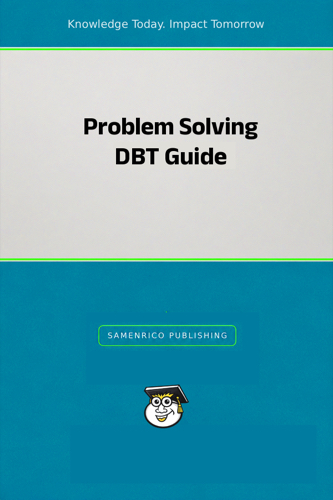
Problem Solving DBT Guide eBook
Solve emotional problems step by step using this e
by Grant Andres
Solve emotional problems step by step using this emotion regulation skill.
Formats
Free sample
Chapter 1: The Solving Trap--–- Emma stared at her phone for forty-seven minutes. The message was brief: “We need to talk.” Three words, sent by her boss at 6:15 PM on a Friday. By 6:16, her heart was racing. By 6:18, she had cycled through five possible catastrophes: she was being fired, her project was being killed, her boss was angry about the typo in Tuesday’s report, a coworker had complained about her, or—the worst one—she had done something terrible and didn’t even know what it was.By 6:30, Emma had drafted four responses and deleted them all. By 7:00, she had texted three friends: “What do you think this means?” By 7:30, she had decided to quit before she could be fired.
By 8:00, she was scrolling job listings. By 9:00, she had convinced herself that her entire career was a failure.At 10:00 PM, her boss sent a second message: “Sorry for the cryptic text earlier. Just wanted to chat about the promotion you’re up for. No rush—Monday is fine.”Emma had spent nearly four hours solving a problem that did not exist.This is not a story about Emma. This is a story about every person who has ever received an ambiguous text, a delayed response, a neutral facial expression, or a vague comment—and then spent hours, days, or weeks trying to “fix” something that was never broken.
This is a story about the central contradiction that defines emotional problem solving: when people face their most serious emotional problems—rage, despair, panic, anxiety, shame—they are least capable of solving them.The very emotions that scream “DO SOMETHING NOW” are the same emotions that destroy your ability to do the right thing.Let me name this contradiction. I call it The Solving Trap.The Paradox of Emotional Problem Solving The Solving Trap works like this: You feel bad. The feeling creates an urgent action urge. The urge tells you to solve the problem immediately. So you start solving.
But because you are in an emotional state, your solving is narrow, reactive, and biased toward short-term relief. You choose the wrong solution, or you solve the wrong problem entirely. The problem gets worse. You feel worse. So you try harder.
And the trap tightens.This book exists to get you out of that trap.Before we go any further, let me tell you what this book is not. This book is not about calming down in the abstract. It is not about positive thinking. It is not about ignoring your emotions or pretending everything is fine. And it is certainly not about suppressing how you feel so you can be more “productive.” There are plenty of books that offer those things.
This is not one of them.This book is about one specific skill from one specific type of therapy—Dialectical Behavior Therapy, or DBT. Within DBT, there is a module called Emotion Regulation. Within Emotion Regulation, there is a skill called Problem Solving. That skill is what this entire book teaches. Nothing more, nothing less.But here is what that skill can do: it can take you from the chaos of Emotion Mind—where problems feel like monsters and solutions feel like desperate grabs—to the clarity of Wise Mind, where you can see what is actually happening, what actually needs to be done, and whether doing anything is even necessary.The rest of this chapter will teach you the foundational concepts you need to understand before you learn the 7-step protocol in Part II.
Specifically, you will learn about Action Urges (why your brain screams at you to do things that make problems worse), the Three States of Mind (where you are solving from), and the simple pause that breaks the Solving Trap open.But first, we need to understand how you got into the trap in the first place.Why Your Brain Lies to You When You Need It Most Your brain is not broken. In fact, your brain is working exactly as it evolved to work. The problem is that it evolved for a world that no longer exists.Imagine, for a moment, that you are a hominid living on the African savanna 200,000 years ago. You are walking through tall grass when you hear a rustling sound. Your body immediately changes: heart rate increases, breathing quickens, pupils dilate, blood rushes to your large muscle groups.
Your brain generates an action urge: run. You run. You survive. The system works perfectly.Now imagine you are Emma, staring at a three-word text message from your boss. Your body does the same thing: heart rate increases, breathing quickens, pupils dilate, blood rushes to your muscles.
Your brain generates an action urge: solve this now. But there is no predator in the grass. There is no immediate physical threat. The “solution” your brain is urging—frantic action, defensive responses, catastrophic thinking—does not help. It makes everything worse.This is the fundamental mismatch.
Your emotional brain cannot tell the difference between a lion and a text message. It cannot tell the difference between being excluded from the tribe (a death sentence 200,000 years ago) and being excluded from a group chat (annoying but not fatal). It cannot tell the difference between a physical threat and a social threat, between a real problem and an interpreted problem, between something that requires immediate action and something that requires patience.The result is that your brain generates Action Urges that are perfectly calibrated for survival threats and almost perfectly useless for modern emotional problems.Let me list the most common Action Urges and why they backfire:Fear urges escape. When you feel fear, your brain wants you to run, hide, avoid, withdraw, or numb yourself. In modern life, this means canceling plans, avoiding difficult conversations, quitting jobs prematurely, leaving relationships at the first sign of conflict, drinking too much, scrolling endlessly, or staying in bed.
Each of these actions provides short-term relief. Each of them makes the underlying problem worse over time.Anger urges attack. When you feel anger, your brain wants you to confront, blame, punish, accuse, raise your voice, or get revenge. In modern life, this means sending that email you will regret, saying things you cannot take back, escalating conflicts, burning bridges, or stewing in resentment. Each of these actions feels justified in the moment.
Each of them damages relationships and closes off solutions.Shame urges hide. When you feel shame, your brain wants you to disappear, avoid eye contact, apologize excessively, isolate yourself, or self-harm. In modern life, this means not speaking up in meetings, not asking for help, not admitting mistakes, not applying for jobs or promotions, and rejecting connection before others can reject you. Each of these actions protects you from momentary exposure. Each of them prevents growth and repair.Sadness urges withdraw.
When you feel sadness, your brain wants you to slow down, retreat, conserve energy, and avoid stimulation. In modern life, this means staying home, stopping your routines, neglecting hygiene, pushing people away, and ruminating on loss. Each of these actions is understandable. Each of them deepens depression and prolongs suffering.Guilt urges repair. When you feel guilt, your brain wants you to apologize, make amends, confess…
This is the end of the free sample. Get the eBook to keep going. Buy now
About this book
Details
- Author
- Grant Andres
- Publisher
- SamEnrico
- Language
- English
- Genre
- Non-Fiction, Self-Help, Problem Solving
- Released
- 2026-06-06
- Pages (approx.)
- 148
- Available as
- eBook, Audiobook

Read better in the ZLOADR app
Your eBooks on your phone or tablet. Sign in with your SamEnrico account and start reading.
More by Grant Andres
 Complex Carb List GuideGrant Andres$11.99
 Supply Chain Pandemic Resilience PlanGrant Andres$11.99
 Visitation Room MemoriesGrant Andres$11.99
 DoorDash Dasher Rating GuideGrant Andres$11.99
 Grief and Regret After SpouseGrant Andres$11.99
 Email Inbox Weekly ReviewGrant Andres$11.99
 Bracing for Bus StopGrant Andres$11.99
 The Silent Hunt: The Great White Shark Invasion of 1916Grant Andres$11.99
 The Matchstick Conspiracy: Fire and Fraud in Victorian LondonGrant Andres$11.99
 How to Produce Wheelbarrow PartsGrant Andres$11.99
 First 24 Hours After Office FloodGrant Andres$12.99
 A Collector's Handbook to the Morris IiGrant Andres$11.99
You may also like
 Hong Kong Handover 1997Dunn Johnnie$11.99
 Zumba For Postnatal Recovery CourseNeal Christian$11.99
 Zumba for BeginnersLadner Nikia$11.99
 YouTube Comment Mining GuideHumes Pandora$12.99
 Worry Box MeditationCarlin Rudy$11.99
 Workplace Stress MeditationNguyen Lynn$11.99
 Workplace Stress and Sleep RepairHawley Ivory$11.99
 Workplace Perfectionism CureDelaney Jeffry$11.99
 Workplace Injustice Anger GuideWallen Isabelle$11.99
 Work Addiction and Burnout LinkGreenwood Ester$11.99
 Women in Yoga and WellnessBeattie Galina$11.99
 Women in Stand Up ComedyChun Evangeline$11.99