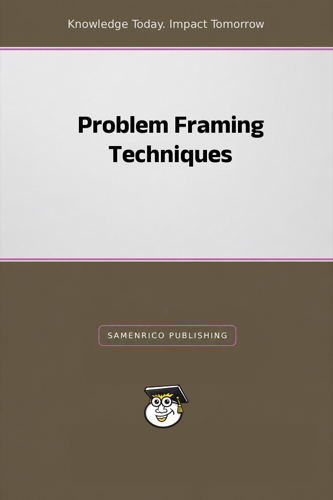
Problem Framing Techniques Audiobook
Reframe challenges for better solutions using this
Reframe challenges for better solutions using this design thinking guide.
Formats
Free sample
Chapter 1: The Million-Dollar Mistake--It was 3:47 PM on a Tuesday when Sarah, a senior product director at a mid-sized Saa S company, walked into the conference room where her team had been working for six months. They had built the thing. The dashboard was beautiful. The code was clean. The beta testers had signed off.
The only problem? Exactly one person wanted to use it. That person was Sarah.She had framed the problem as “enterprise customers need better visibility into their usage data.” So her team built a dashboard. What customers actually needed was trust in their data sources—a problem no dashboard could solve. Six months.
Four engineers. Two hundred thousand dollars. All solving the wrong question elegantly.This book is the apology for that dashboard. And it is the toolkit to make sure you never build your own version of it.The Solution Bias: Why We Jump Before We Look There is a neurological addiction hiding in every conference room, every whiteboard session, every strategy offsite. It is the overwhelming, almost irresistible urge to answer a question before understanding it.
Call it the Solution Bias.The Solution Bias feels productive. When someone says “our sales are falling,” the bias screams: “New pricing model! Better leads! More training!” It feels good to have an answer. It feels competent.
It feels like progress.But here is the trap: the speed of your answer is inversely correlated with the quality of your question.Consider a study published in the Journal of Behavioral Decision Making. Researchers gave teams a complex problem and measured two things: how quickly they proposed solutions, and how well those solutions worked. The teams that proposed solutions in the first five minutes were 73% more likely to have missed a critical variable than teams that spent thirty minutes just defining the problem. Speed felt like competence. It was actually the opposite.The Solution Bias has three engines:Engine One: Social Pressure.
In a meeting, silence is uncomfortable. The person who speaks first is often rewarded, regardless of what they say. So we speak. We propose. We solve.Engine Two: Organizational Incentives.
Nobody gets promoted for saying “I need to understand this better.” Promotions go to the person with the three-point plan, the five-step strategy, the bold vision.Engine Three: Cognitive Ease. Our brains prefer the familiar. A bad solution to a known problem feels safer than a good solution to…
This is the end of the free sample. Get the Audiobook to keep going. Buy now
About this book
Details
- Author
- Silvers Marin
- Publisher
- SamEnrico
- Language
- English
- Genre
- Non-Fiction, Self-Help, Problem Definition
- Released
- 2026-06-06
- Pages (approx.)
- 134
- Available as
- eBook, Audiobook

Listen in the VoxFlicks app
Audiobooks and audio dramas wherever you go. Sign in with your SamEnrico account and press play.
More by Silvers Marin
 Loneliness After Moving Back HomeSilvers Marin$11.99
 Time Saving Kitchen HacksSilvers Marin$11.99
 P 8 Poseidon PilotSilvers Marin$11.99
 The Immigrant AI PioneerSilvers Marin$11.99
 Medication For Seasonal DepressionSilvers Marin$11.99
 Nutrition For ConcentrationSilvers Marin$11.99
 Grit for Remote WorkersSilvers Marin$11.99
 The Vanishing Witness: How Lucky Luciano’s Informant Disappeared ForeverSilvers Marin$11.99
 The Phantom Bank Robber of Buenos Aires: The Untouchable Outlaw of the 1920sSilvers Marin$11.99
 How to Become a Pug-mill-operator HelperSilvers Marin$11.99
 A Collector's Handbook to the Marendaz 70, 13Silvers Marin$11.99
 How to Produce Vibration Exercise MachinesSilvers Marin$11.99