
Non-FictionInformativeEducational
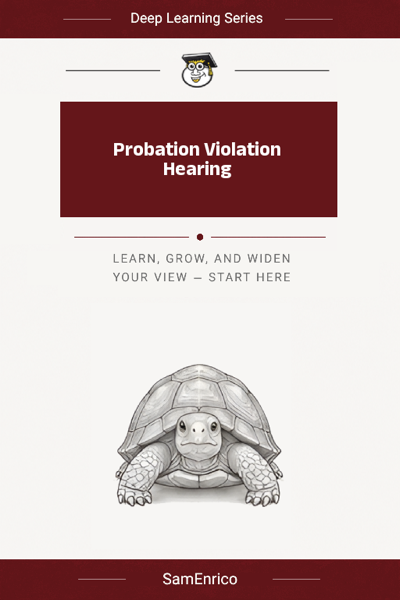
Probation Violation Hearing eBook
A Coursebook on Probation Violation Hearing
A Coursebook on Probation Violation Hearing
Formats
Free sample
Chapter 1: The Conditional Liberty...--–- Imagine you are standing before a judge. You have not been accused of a new crime. No victim has stepped forward. No jury has been summoned. Yet the judge is about to decide whether you will walk out of the courtroom a free person or be led away in handcuffs—not because of what you did yesterday, but because of what you failed to do last week.
You missed an appointment. You forgot to pay a fee. You tested positive for a substance you have struggled to avoid for years. And now, the full weight of your original sentence, suspended on the promise of good behavior, hangs over your head like a blade on a fraying rope.This is the probation violation hearing. It is one of the most common yet least understood proceedings in American criminal justice.
More than 250,000 such hearings occur every year across the United States—far more than felony jury trials. Yet most people, including many criminal defense attorneys, walk into these hearings armed only with assumptions borrowed from criminal trials. Those assumptions are wrong. And when they are wrong, people go to prison.The purpose of this book is to ensure that does not happen to you or your clients. But before we can talk about strategy, evidence, motions, or appeals, we must first understand the foundational concept upon which the entire probation system rests.
That concept is conditional liberty.The Birth of Conditional Liberty For most of American legal history, probation was considered a privilege, not a right. The government could grant it as an act of grace, and the government could revoke it arbitrarily, without notice, without a hearing, without any of the procedural protections we associate with criminal justice. A probationer who violated a condition—any condition, no matter how trivial—could be sent to prison without ever being given a chance to explain, to present evidence, or even to know exactly what he was accused of doing wrong.This changed in 1972 with a case that had nothing to do with probation at all. The case was Morrissey v. Brewer, and it involved a man named John Morrissey who had been paroled from an Iowa prison after serving time for a property crime.
His parole was revoked after a summary proceeding that gave him no opportunity to contest the allegations against him. The Supreme Court took his case and, in a unanimous decision, fundamentally rewrote the rules.Chief Justice Warren Burger, writing for the Court, rejected the "privilege" framework outright. Parole, he wrote, is not a gift the government bestows conditionally. It is a "conditional liberty" to which the parolee retains a protected interest. The distinction matters enormously.
A privilege can be taken away for any reason or no reason at all. A conditional liberty can be taken away only through due process of law.The Court then enumerated the minimum due process protections required before parole could be revoked: written notice of the claimed violations, disclosure of the evidence against the parolee, an opportunity to be heard and to present evidence, the right to confront and cross-examine adverse witnesses (unless good cause is shown), a neutral hearing body, and a written statement of the findings and the reasons for revocation. The Court also required a preliminary hearing within a reasonable time after arrest to determine whether probable cause existed to believe a violation had occurred.One year later, in Gagnon v. Scarpelli, the Court extended the same protections to probation revocation. The legal distinction between parole and probation, the Court held, made no difference for due process purposes.
A probationer's conditional liberty was entitled to the same protections as a parolee's.The Hybrid Proceeding Here is where confusion often sets in. A probation violation hearing is not a criminal trial. If you walk into one expecting the rules of a criminal prosecution, you will lose before you begin. But it is also not a civil hearing. If you treat it as a minor administrative matter, you will also lose.The probation violation hearing is a hybrid proceeding, sui generis—a creature of its own kind.
It borrows elements from criminal law, civil procedure, and administrative law, but it follows the strict rules of none. Understanding this hybrid nature is the first key to effective advocacy.Consider the burden of proof. In a criminal trial, the prosecution must prove guilt beyond a reasonable doubt—the highest standard known to the law. In a probation violation hearing, the government need only prove a violation by a preponderance of the evidence—more likely than not, anything over fifty percent. This is the same standard used in civil negligence cases.
It is a remarkably low bar, and it changes everything about how you prepare and present a defense.Consider the right to a jury. In a criminal trial, the defendant has a constitutional right to a jury of his peers. In a probation violation hearing, there is no right to a jury. The judge alone decides both whether a violation occurred and what the consequences will be.Consider the rules of evidence. In a criminal trial, hearsay is presumptively inadmissible.
Witnesses must generally appear in court, take an oath, and submit to cross-examination. In a probation violation hearing, reliable hearsay is routinely admitted. Police reports, lab results, written witness statements, and even anonymous tips may be considered by the judge. The confrontation right, while not extinguished, is substantially limited.Consider the right to counsel. In a criminal trial, an indigent defendant has an absolute right to appointed counsel if imprisonment is a potential consequence.
In a probation violation hearing, the right to appointed counsel is discretionary. Under Gagnon, counsel must be appointed only when the probationer is unable to present a defense without counsel and there are substantial reasons justifying counsel—a standard that has been applied unevenly across the country.These differences are not technicalities. They are fundamental features of the proceeding that shape every strategic decision. If you represent a client in a probation violation hearing as if it were a criminal trial, you will fail to object to admissible hearsay because you assume it is excluded. You will waste time preparing for a jury that does not exist.
You will focus on reasonable doubt when the government only needs preponderance. You will assume counsel is automatic when it is not.The High Stakes of Conditional Liberty The concept of conditional liberty sounds abstract, but its consequences are brutally concrete. When a probationer is found to have violated a condition, the judge has broad discretion to impose a range of consequences. At the low end, the judge may continue probation with no changes—rare, usually reserved for the most trivial violations. At the moderate end, the judge may add new conditions (curfews, electronic monitoring, treatment programs), extend the probation period, or impose intermediate sanctions like community service or day reporting.
At the severe end, the judge may impose a short jail sanction (typically thirty to ninety days) followed by reinstated probation, or revoke probation entirely and order the probationer to serve the original sentence.Full revocation is, in effect, a second sentencing. The probationer stands before the same…
This is the end of the free sample. Get the eBook to keep going. Buy now
About this book
Details
- Author
- Paulson Eulalia
- Publisher
- SamEnrico
- Language
- English
- Genre
- Non-Fiction, Informative, Educational
- Released
- 2026-06-02
- Pages (approx.)
- 143
- Available as
- eBook, Audiobook

Read better in the ZLOADR app
Your eBooks on your phone or tablet. Sign in with your SamEnrico account and start reading.
More by Paulson Eulalia
 HIIT for Dance FitnessPaulson Eulalia$11.99
 WhatsApp Notification Overload FixPaulson Eulalia$11.99
 Freelancer Self WorthPaulson Eulalia$11.99
 Moxibustion Heat TherapyPaulson Eulalia$11.99
 Blood and Mistletoe: The Druids' Last StandPaulson Eulalia$11.99
 How to Become a Patch SanderPaulson Eulalia$11.99
 How to Produce ChalkboardsPaulson Eulalia$11.99
You may also like
 Hong Kong Handover 1997Dunn Johnnie$11.99
 Zumba For Postnatal Recovery CourseNeal Christian$11.99
 Zumba for BeginnersLadner Nikia$11.99
 YouTube Comment Mining GuideHumes Pandora$12.99
 Worry Box MeditationCarlin Rudy$11.99
 Workplace Stress MeditationNguyen Lynn$11.99
 Workplace Stress and Sleep RepairHawley Ivory$11.99
 Workplace Perfectionism CureDelaney Jeffry$11.99
 Workplace Injustice Anger GuideWallen Isabelle$11.99
 Work Addiction and Burnout LinkGreenwood Ester$11.99
 Women in Yoga and WellnessBeattie Galina$11.99
 Women in Stand Up ComedyChun Evangeline$11.99