
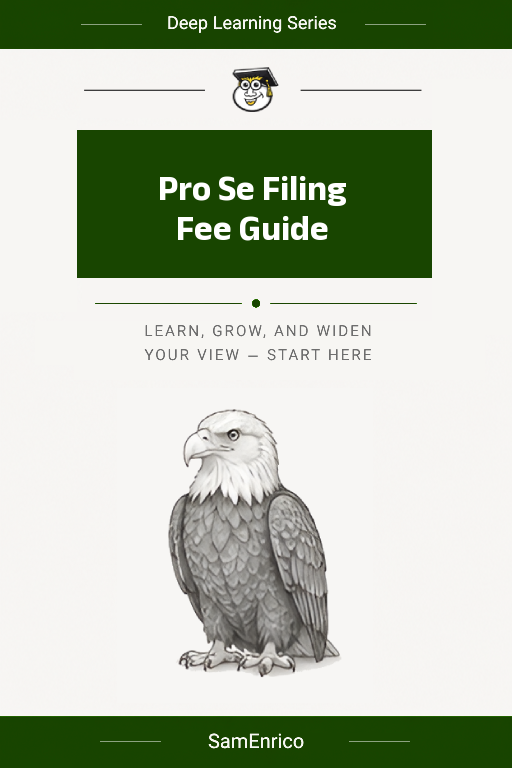
Non-FictionAnnual CheckupPro SeDIY
Pro Se Filing Fee Guide eBook
File patents and trademarks without attorney inclu
by Vigil Jack
File patents and trademarks without attorney including lower fees and pro se assistance programs.
Formats
Free sample
Chapter 1: The Micro Entity Loophole...--The first time you see the USPTO fee schedule, it feels like a cruel joke. A utility patent application costs 1,600justtofile.Thatisbeforethesearchfee,beforetheexaminationfee,beforetheissuefee,andbeforeyoueventhinkaboutmaintenancefees.Forasoloinventorworkingoutofagarage,aretiredengineerwithacleveridea,oraparentwhoinventedabetterbabybottlewarmerduringnaptime,1,600 just to file. That is before the search fee, before the examination fee, before the issue fee, and before you even think about maintenance fees. For a solo inventor working out of a garage, a retired engineer with a clever idea, or a parent who invented a better baby bottle warmer during nap time, 1,600justtofile.Thatisbeforethesearchfee,beforetheexaminationfee,beforetheissuefee,andbeforeyoueventhinkaboutmaintenancefees.Forasoloinventorworkingoutofagarage,aretiredengineerwithacleveridea,oraparentwhoinventedabetterbabybottlewarmerduringnaptime,1,600 is real money. It is rent.
It is a car payment. It is three months of groceries. But here is what the patent attorneys will never tell you when they send you that 12,000quote:youprobablydonotowe12,000 quote: you probably do not owe 12,000quote:youprobablydonotowe1,600. You probably owe 400.Andifyouarefilingaprovisionalpatent,youowe400. And if you are filing a provisional patent, you owe 400.Andifyouarefilingaprovisionalpatent,youowe70.The difference between 1,600and1,600 and 1,600and400 is not a discount.
It is a revolution. It is the difference between "I can't afford to protect my idea" and "I filed my patent application this morning." The tool that makes this possible is called the Micro Entity status, and it is the single most important concept in this entire book. If you understand nothing else about the patent system, understand this: the United States Patent and Trademark Office has already built a financial bridge for low-income and small-scale inventors. They just do not advertise it very well. Your job is to walk across that bridge.The Three Tiers of USPTO Fees: A Tale of Three Inventors To understand Micro Entity status, you must first understand the three-tier fee structure that governs everything at the USPTO.
Think of it as an airline with three classes of service, except the first-class passengers pay ten times more for the exact same seat.Tier One: Undiscounted (Large Entity) – This is the default rate. Large corporations with more than 500 employees pay 100% of the published fee. For a utility patent filing, that is 1,600.Foraprovisionalpatent,itis1,600. For a provisional patent, it is 1,600.Foraprovisionalpatent,itis320. For a trademark application filed through TEAS Standard, it is $350 per class.
Very few individual inventors ever need to pay these rates, yet many do, simply because they never bother to check a box on a form.Tier Two: Small Entity (50% off) – If your company has fewer than 500 employees, or if you are an individual inventor who has not assigned your rights to a large corporation, you qualify for Small Entity status. This cuts every fee in half. That 1,600utilityfilingbecomes1,600 utility filing becomes 1,600utilityfilingbecomes800. The 320provisionalbecomes320 provisional becomes 320provisionalbecomes160. The 350trademarkbecomes350 trademark becomes 350trademarkbecomes175 if you use TEAS Standard, but as we learned in Chapter 2, you will be using TEAS Plus for $250 anyway.
Small Entity is the default for most independent inventors, but it is not the best deal.Tier Three: Micro Entity (75% off) – This is the holy grail. Micro Entity status reduces USPTO fees by 75% for qualifying inventors. The 1,600utilitypatentfilingdropsto1,600 utility patent filing drops to 1,600utilitypatentfilingdropsto400. The 320provisionaldropsto320 provisional drops to 320provisionaldropsto70. The 800searchfeedropsto800 search fee drops to 800searchfeedropsto200.
The 400examinationfeedropsto400 examination fee drops to 400examinationfeedropsto100. Across the entire lifecycle of a patent, from filing to issuance to maintenance, the difference between Large Entity and Micro Entity can exceed $10,000. That is not a typo. Ten thousand dollars.Here is a real-world comparison. Sarah is a solo inventor who qualifies for Micro Entity status.
She files a utility patent application. Her costs: 400filingfee,400 filing fee, 400filingfee,200 search fee, 100examinationfee,and100 examination fee, and 100examinationfee,and400 issue fee, for a total of 1,100.Ifthepatentissues,shepays1,100. If the patent issues, she pays 1,100.Ifthepatentissues,shepays400 at 3.5 years, 800at7.5years,and800 at 7.5 years, and 800at7.5years,and1,200 at 11.5 years. Her total cost over 20 years is $3,500.James is also a solo inventor, but he never learned about Micro Entity status. He files the exact same patent application as a Small Entity (50% off).
His costs: 800filingfee,800 filing fee, 800filingfee,400 search fee, 200examinationfee,and200 examination fee, and 200examinationfee,and800 issue fee, for a total of 2,200.Hismaintenancefeesare2,200. His maintenance fees are 2,200.Hismaintenancefeesare800 at 3.5 years, 1,600at7.5years,and1,600 at 7.5 years, and 1,600at7.5years,and2,400 at 11.5 years. His total over 20 years is $7,000.Sarah paid half of what James paid. For doing the exact same work. For filling out the exact same forms.
The only difference is that Sarah knew about the loophole, and James did not. Do not be James.The Two Tests You Must Pass (No Exceptions, No Excuses)Micro Entity status is not a charity program. It is not a blanket discount for anyone who asks nicely. Congress created it with specific eligibility requirements, and the USPTO enforces those requirements strictly. You must pass two tests : the income test and the application history test.
Fail either one, and you cannot claim Micro Entity status. Claim it anyway, and you risk the nightmare scenario we will discuss later in this chapter.Test One: The Income Cap (Are You "Poor Enough" According to the Government?)The first test is financial. Your gross income, as reported on your most recent federal tax return, must be less than three times the median household income for the previous calendar year. The median household income is calculated annually by the Census Bureau and adjusted by the USPTO. For 2025 and 2026, the threshold is approximately 215,000to215,000 to 215,000to220,000 for a single filer.Let me be very specific about how this is calculated.
The USPTO looks at your gross income , not your adjusted gross income, not your taxable income, not your disposable income. Gross income is the number at the top of your 1040, before any deductions, before any exemptions, before any creative accounting. If you are married filing jointly, the USPTO uses your combined gross income. If you are single, they use your individual gross income.Here is where it gets tricky. The threshold is three times the median household income, but the median household income varies by state.
The USPTO does not use a state-by-state adjustment. They use a single national median. For 2026, that national median is approximately 72,000.Multiplybythree,andyouget72,000. Multiply by three, and you get 72,000.Multiplybythree,andyouget216,000. That means a single inventor earning up to 216,000grossincomequalifiesfor Micro Entitystatus.Amarriedcouplefilingjointlywithcombinedgrossincomeupto216,000 gross income qualifies for Micro Entity status.
A married couple filing jointly with combined gross income up to 216,000grossincomequalifiesfor Micro Entitystatus.Amarriedcouplefilingjointlywithcombinedgrossincomeupto216,000 also qualifies.But wait, there is a second financial path. If you cannot meet the income cap based on your personal gross income, you may still qualify if you are affiliated with an institution. Specifically, if you have assigned, granted, or conveyed (or are obligated to assign, grant, or convey) your patent rights to an institution of higher education (a university or college), you may qualify for Micro Entity status regardless of your personal income. This is a narrow exception designed for university researchers and graduate students. If you are not a professor or a student working under a university technology transfer agreement, this exception probably does not apply to you.
Stick with the income test.Test Two: The Four-Application Limit (The Rule That Catches Everyone)The second test is even more important, and it is the one that catches most inventors off guard. You cannot be…
This is the end of the free sample. Get the eBook to keep going. Buy now
About this book
Details
- Author
- Vigil Jack
- Publisher
- SamEnrico
- Language
- English
- Genre
- Non-Fiction, Annual Checkup, Pro Se, DIY
- Released
- 2026-06-01
- Pages (approx.)
- 141
- Available as
- eBook, Audiobook

Read better in the ZLOADR app
Your eBooks on your phone or tablet. Sign in with your SamEnrico account and start reading.
More by Vigil Jack
 The Remote Work Morning RitualVigil Jack$11.99
 The Middle Split TrainingVigil Jack$11.99
 Vegan Pregnancy Cravings GuideVigil Jack$11.99
 Dealing With Military DisappointmentVigil Jack$11.99
 Franchising Your Local Brand Across Borders PitfallsVigil Jack$11.99
 The Invisible Architect: How a Forgotten Engineer Saved Millions from DisasterVigil Jack$11.99
 The Great Train Robbery: The Untold Heist of the CenturyVigil Jack$11.99
 Understanding CryroglobulinemiaVigil Jack$17.99
 TaxidermyVigil Jack$11.99
 Cross Sell Script GuideVigil Jack$12.99
 How to Become a Scrap HandlerVigil Jack$11.99
You may also like
 Hong Kong Handover 1997Dunn Johnnie$11.99
 Zumba For Postnatal Recovery CourseNeal Christian$11.99
 Zumba for BeginnersLadner Nikia$11.99
 YouTube Comment Mining GuideHumes Pandora$12.99
 Worry Box MeditationCarlin Rudy$11.99
 Workplace Stress MeditationNguyen Lynn$11.99
 Workplace Stress and Sleep RepairHawley Ivory$11.99
 Workplace Perfectionism CureDelaney Jeffry$11.99
 Workplace Injustice Anger GuideWallen Isabelle$11.99
 Work Addiction and Burnout LinkGreenwood Ester$11.99
 Women in Yoga and WellnessBeattie Galina$11.99
 Women in Stand Up ComedyChun Evangeline$11.99