
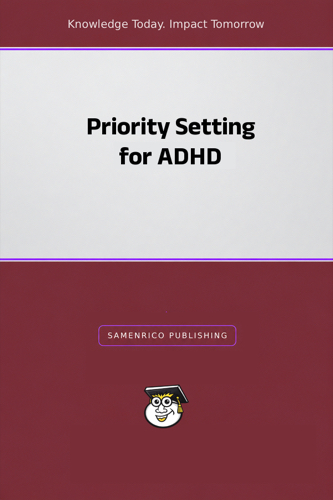
Priority Setting for ADHD eBook
Adapt Eisenhower and ABCDE for neurodivergent brai
by Minor Keira
Adapt Eisenhower and ABCDE for neurodivergent brains with focus challenges.
Formats
Free sample
Chapter 1: The Effort Trap--–- You have tried harder. You have tried harder than anyone without ADHD will ever understand. You have tried harder until your teeth ached from clenching your jaw at 2 a.m., staring at the same cursor blinking on the same blank document, willing yourself to type one single word. You have tried harder until the shame curdled into exhaustion, and the exhaustion curdled into a numb acceptance that maybe you are simply broken. And then, because you are not broken and you never were, you tried harder again the next morning.The cruelest lie productivity culture has ever told is that effort is the missing variable.
If you just try harder, the logic goes, you will overcome any obstacle. If you fail, it is because you did not want it enough. This lie is not merely unhelpful for the ADHD brain. It is actively destructive. It pathologizes a neurological difference and calls it a character flaw.This chapter is an intervention.
Before we can build a single functional priority system, we must first demolish the wreckage of every system that failed you because it assumed a brain you do not have. We are going to name the Effort Trap—the cycle of trying harder, burning out, feeling shame, and trying harder again. We are going to examine why the ADHD brain fundamentally cannot prioritize by importance alone, no matter how much effort you apply. We are going to introduce the two foundational concepts of this entire book: the Interest-Based Nervous System and Signal versus Noise Theory. And we are going to establish the first practical tool that actually works for your neurology: environmental engineering, which requires zero willpower and delivers immediate results.Let us begin by telling the truth about what happened every time you tried harder and failed.
It was not a failure of character. It was a failure of the tool you were given.The Anatomy of the Effort Trap The Effort Trap follows a predictable sequence. Learn to recognize it, because recognizing it is the first step to escaping it.Stage one is The Promise. You have a task that matters—filing taxes, writing a report, cleaning the garage, making a difficult phone call. It is important.
You know it is important. The importance sits in your chest like a stone. So you promise yourself that this time will be different. This time you will just sit down and do it. You will apply discipline.
You will power through.Stage two is The Stall. You sit down. The task is in front of you. And nothing happens. Your brain does not engage.
It slides off the task like water off wax. You check your phone. You get a glass of water. You reorganize your desktop icons. These are not distractions.
They are escape behaviors, and your brain is generating them automatically because the task produces no dopamine.Stage three is The Crunch. The deadline approaches. Panic rises. Adrenaline finally floods your system, and suddenly the task becomes possible. You complete it in a desperate rush at 11:47 p.m., or you do not complete it at all, and the consequences arrive.Stage four is The Shame Spiral.
You look back at the hours you spent stalling. You calculate how easy the task would have been if you had just started earlier. You conclude that you are lazy, undisciplined, or fundamentally flawed. You swear that next time will be different. And then the cycle begins again.Here is what the Effort Trap hides from you: at no point in this sequence was the problem a lack of effort.
You expended enormous effort. The effort went into the stall, the anxiety, the self-flagellation, and the eventual panic. The effort was not the missing ingredient. The missing ingredient was a task that generated the correct neurochemical conditions for initiation.Effort cannot create dopamine. Importance cannot create dopamine.
Only interest, novelty, challenge, urgency, and the anticipation of reward can create dopamine. You have been trying to squeeze water from a stone. The stone is not broken. You are using the wrong tool.The Interest-Based Nervous System Let me introduce a term that will appear throughout this book: the Interest-Based Nervous System, or INs. This is not a metaphor or a motivational slogan.
It is a description of how the ADHD brain actually prioritizes tasks at the neurochemical level.In a neurotypical nervous system, the executive functions of the prefrontal cortex can evaluate tasks based on long-term importance and translate that evaluation into action. The sequence looks like this: importance → intention → dopamine release → initiation. It is not always easy for neurotypical brains, but the machinery is wired in that order.The ADHD brain is wired differently. The dopamine release required for initiation does not follow importance. It follows interest, novelty, challenge, and urgency.
The sequence looks like this: interest/novelty/challenge/urgency → dopamine release → initiation. Importance enters the picture only after the task is already underway, if at all.This explains a pattern that every ADHDer knows intimately but has been taught to interpret as a moral failing. You can spend six hours researching the history of submarines—a topic you will never use, that has no deadline, that produces no tangible benefit—while a work report that will determine your quarterly bonus remains untouched. The submarine research produced dopamine. The report produced shame.
Shame is not a motivator. Shame is a freezer.It also explains why urgency works when importance does not. A deadline that is three hours away produces a spike of adrenaline and noradrenaline. These neurotransmitters can temporarily substitute for dopamine, providing the chemical conditions for initiation. This is why so many ADHDers describe themselves as “deadline-driven” or “crisis-dependent.” It is not that they love chaos.
It is that chaos is the only reliable source of the neurochemistry required to start.But living in perpetual crisis is like running a car on nitrous oxide. It works for short bursts, but it destroys the engine over time. The goal of this book is not to turn you into a crisis junkie—we will explore how to harness crisis energy without burnout in Chapter 3. The goal is to understand that your brain has a different operating system, and then to install new software that works with that system instead of fighting it.The Importance Fallacy Let me name a specific lie that has caused more suffering than almost any other: the belief that importance alone should be sufficient for action.This is the Importance Fallacy. It is embedded in every mainstream productivity system.
The Eisenhower Matrix ranks tasks by urgency and importance. The ABCDE method ranks tasks by importance, with A tasks being the most important. The Ivy Lee method asks you to list your six most important tasks. Every single one of these systems assumes that importance is a reliable engine for initiation.For the ADHD brain, it is not. Importance is an abstraction.
It lives in the future. It requires a brain that can feel the weight of future consequences as if they were present. The ADHD brain has time blindness—we will explore this in detail in Chapter 2—which means the future feels less real, less…
This is the end of the free sample. Get the eBook to keep going. Buy now
About this book
Details
- Author
- Minor Keira
- Publisher
- SamEnrico
- Language
- English
- Genre
- Non-Fiction, Self-Help, ADHD
- Released
- 2026-06-12
- Pages (approx.)
- 142
- Available as
- eBook, Audiobook

Read better in the ZLOADR app
Your eBooks on your phone or tablet. Sign in with your SamEnrico account and start reading.
More by Minor Keira
 Self Hypnosis for Learning HabitsMinor Keira$11.99
 Loving Kindness for Grief WorkbookMinor Keira$11.99
 Neurofeedback for AddictionMinor Keira$11.99
 Sound Meditation for BeginnersMinor Keira$11.99
 The Forgotten Aviator: The Psychological Toll of Africa's First Transatlantic Flight AttemptMinor Keira$11.99
 Operation Whiskey on the Rocks: The Untold Story of the Soviet Spy Who Vanished in IcelandMinor Keira$11.99
 Healthcare ConsultantMinor Keira$11.99
 Grant Reporting ComplianceMinor Keira$12.99
 Community to Paid GuideMinor Keira$12.99
 Understanding Deafness SymphalangismMinor Keira$17.99
 How to Become a Jacket PreparerMinor Keira$11.99
You may also like
 TM For ADHD FocusStanley Winifred$11.99
 Grit for Students with ADHDManning Bradley$11.99
 Food Addiction And ADHD GuideDaniels Leroy$11.99
 Breath Counting for ADHDLowry Crysta$11.99
 Anger and ADHD ImpulsivityRhodes Carmen$11.99
 ADHD Student Academic GuideLeone Olevia$11.99
 ADHD Procrastination ManagementEspino Becki$11.99
 ADHD Communication GuideDrake Kristen$11.99
 ADHD Child Rejection SensitivityQuezada Isis$11.99
 Weekly Review for ADHDGuinn Hiram$11.99
 Shopping Addiction and ADHDAtherton Suzann$11.99
 Parental Anger And ADHDBrogan Lekisha$11.99