
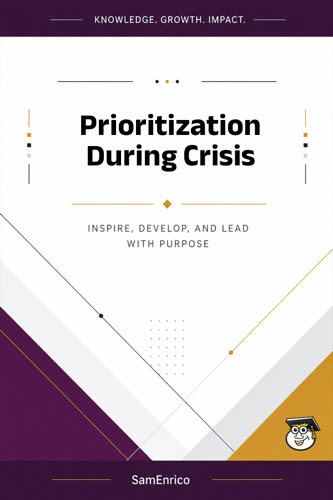
Prioritization During Crisis eBook
Teaches rapid sorting when everything seems urgent
Teaches rapid sorting when everything seems urgent.
Formats
Free sample
Chapter 1: The Noise That Kills--The room is on fire. Not metaphorically. Actually on fire. Smoke curls under the door, the fire alarm drills into your skull, and your phone vibrates against the table like a trapped insect. Seven unread messages.
Three missed calls. Someone is shouting your name from the hallway, and somewhere in this building—fifteen floors up, maybe, or in the basement—there is a person who will die in the next four minutes if you do not make exactly the right decision right now.But you cannot find them. Because your brain has been hijacked.You look at your phone. An email from your boss: "Call me when you get this." A text from your spouse: "Are you okay?!" A Slack message from a colleague: "What's the plan?" A voicemail from legal: "Before you do anything, we need to document—"The room is on fire. And you are reading email.This is not a failure of character.
It is not laziness or incompetence. It is a failure of biology. Your magnificent, evolution-honed brain was never designed for the modern crisis. It was designed for the prehistoric one: a rustle in the tall grass, a shadow on the savanna, a single loud noise in an otherwise silent world. In that world, the correct response to any stimulus was immediate, undivided attention.
The loudest noise might be a predator. The movement in your peripheral vision might be a threat. Your ancestors survived because they reacted to everything.You are their descendant. You have inherited their hypervigilant, noise-reactive, urgently-addled brain. And in the modern world, that brain will kill you.Not literally, most days.
But figuratively, constantly. It will make you answer email while a project collapses. It will make you join a conference call while a client walks out the door. It will make you write a status update while your team drowns. The loudest thing in your environment will always win your attention—not because you choose it, but because your biology chooses it for you.This chapter is about breaking that circuit.
It is about learning to see the difference between what is loud and what is important—and then having the discipline to act on that difference even when every instinct screams at you to do the opposite. By the end of this chapter, you will have a framework for instantly filtering the 90% of noise that masquerades as urgency, so you can focus on the 10% that actually determines whether you succeed or fail, survive or burn.The Most Expensive Phone Call in the World In 2017, a study published in the Journal of Patient Safety tracked decision-making patterns in six urban emergency departments. The researchers attached observers to ER charge nurses—the people responsible for triaging incoming patients and assigning them to beds. The goal was simple: understand how these nurses decided which patient to see first when every patient looked urgent.What they found was terrifying.The nurses spent an average of 47% of their time on tasks that had no measurable impact on patient outcomes. They answered phone calls from hospital administration asking for bed counts.
They updated whiteboards with patient names. They searched for misplaced supplies. They reassured family members who were not yet in crisis. They did all of this while patients in the waiting room deteriorated.One nurse, identified only as "Nurse 14," spent eleven minutes on a single phone call with the hospital's central bed management office. During those eleven minutes, a patient in Bed 3 went into cardiac arrest.
The patient survived—barely. But the nurse's own after-action report noted: "I heard the alarm from Bed 3 at minute three of the call. I assumed someone else would handle it."No one else handled it. Because everyone else was also on the phone.The researcher who led the study, Dr. Eleanor Park, summarized the finding in a single sentence that should be printed on the wall of every office, hospital, and command center in the world: "In a crisis, the human brain prioritizes the phone over the patient, every single time."Why?
Because the phone rings. The patient's heart monitor also rings, but the phone rings in a different way. It demands a response. It has social weight. It connects you to another human being who is expecting an answer.
The patient in Bed 3 makes a beeping sound—annoying, yes, but impersonal. The phone makes a sound that says, Someone wants you. Someone is waiting. Someone will be angry if you do not pick up.Your brain, still wired for the savanna, interprets the phone as a more urgent threat than the cardiac alarm. The cardiac alarm is just a pattern.
The phone is a person.This is the Urgency Trap.Defining the Urgency Trap The Urgency Trap is the cognitive bias that causes us to mistake noise for significance, volume for value, and social pressure for strategic importance. It has three components, each more dangerous than the last.First: Auditory dominance. The human brain processes sound faster than any other sensory input. A loud noise triggers an immediate fight-or-flight response, bypassing the prefrontal cortex entirely. By the time you consciously decide whether to answer the phone, your body has already reached for it.
You are not choosing to prioritize the call. You are reacting to it.This is not a metaphor. Functional MRI studies show that unexpected sounds activate the amygdala within 50 milliseconds—faster than the blink of an eye. The prefrontal cortex, responsible for rational decision-making, takes an additional 2.5 seconds to engage. In a crisis, those 2.5 seconds are the difference between life and death.
And you spend them reaching for the phone.Second: Social salience. Requests from other human beings carry emotional weight that impersonal tasks do not. When your boss asks for something, your brain releases a small amount of cortisol—the stress hormone. When a patient's monitor beeps, your brain does not. The biological response to a person is always stronger than the response to a thing, even when the thing represents a larger threat.This is why you will drop everything for a text message but ignore a system alert you have seen a hundred times.
The text message comes from a person. The system alert comes from nowhere. Your brain, still living on the savanna, cares more about the person than the pattern.Third: Urgency inflation. In a crisis, everything gets labeled urgent. People who would never describe a routine request as "urgent" suddenly use the word for everything.
This happens because urgency is contagious: when one person panics, everyone nearby catches it. The result is that the word "urgent" loses all meaning. It becomes a blanket label applied to every task, which means it helps you distinguish nothing.Think about the last time someone sent you an email marked "URGENT." How many of those actually were urgent? How many were simply important to the sender? The inflation of the word has made it useless.
In a genuine crisis, everyone is shouting "urgent" at once, and the signal is lost in the noise.Together, these three components create a perfect storm of misdirected attention. You end up spending your most precious resource—your cognitive bandwidth—on the loudest, most socially demanding…
This is the end of the free sample. Get the eBook to keep going. Buy now
About this book
Details
- Author
- Jameson Shirlene
- Publisher
- SamEnrico
- Language
- English
- Genre
- Non-Fiction, Self-Help, Crisis
- Released
- 2026-06-09
- Pages (approx.)
- 144
- Available as
- eBook, Audiobook

Read better in the ZLOADR app
Your eBooks on your phone or tablet. Sign in with your SamEnrico account and start reading.
More by Jameson Shirlene
 Caffeine Management Before PresentationsJameson Shirlene$11.99
 Pandemic Parental Anger LegacyJameson Shirlene$11.99
 Patty Hearst Kidnapping SagaJameson Shirlene$11.99
 Meth Skin Recovery GuideJameson Shirlene$11.99
 The Last Broadcast: The Mysterious Final Transmission of S.O.S. TitanicJameson Shirlene$11.99
 The Last Stand of the Minoan Bull-LeapersJameson Shirlene$11.99
 Warehouse StackerJameson Shirlene$11.99
 Understanding Bone Dysplasia Azouz TypeJameson Shirlene$17.99
 How to Become a Insulation-power-unit TenderJameson Shirlene$11.99
 Kenyan Remote Team CommunicationJameson Shirlene$12.99
 Alibaba Order Protection ClaimsJameson Shirlene$12.99
You may also like
 Hong Kong Handover 1997Dunn Johnnie$11.99
 Zumba For Postnatal Recovery CourseNeal Christian$11.99
 Zumba for BeginnersLadner Nikia$11.99
 YouTube Comment Mining GuideHumes Pandora$12.99
 Worry Box MeditationCarlin Rudy$11.99
 Workplace Stress MeditationNguyen Lynn$11.99
 Workplace Stress and Sleep RepairHawley Ivory$11.99
 Workplace Perfectionism CureDelaney Jeffry$11.99
 Workplace Injustice Anger GuideWallen Isabelle$11.99
 Work Addiction and Burnout LinkGreenwood Ester$11.99
 Women in Yoga and WellnessBeattie Galina$11.99
 Women in Stand Up ComedyChun Evangeline$11.99