
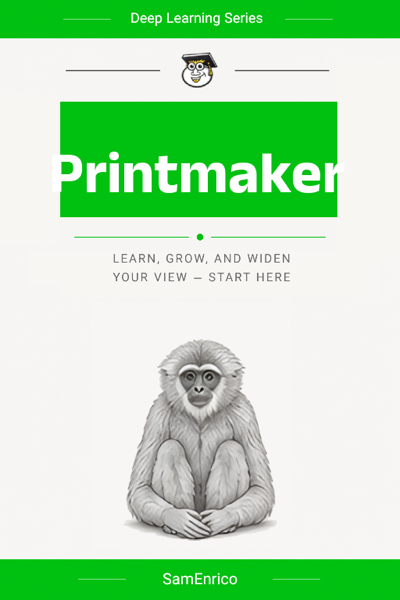
Non-FictionInformativeEducational
Printmaker eBook
A Coursebook on Printmaker
A Coursebook on Printmaker
Formats
Free sample
Chapter 1: The Matrix Lies...--–- Every print begins as a lie. Not a malicious one, but a useful fiction: the idea that a flat, inanimate surface—wood, metal, stone, or mesh—can hold a story. The moment you roll ink across a carved block or wipe it into an engraved line, you are participating in an act of translation. You are asking a rigid material to speak in the language of paper, pressure, and possibility. This chapter dismantles the most persistent myth about printmaking: that it is only about copying.
In truth, printmaking is the art of the multiple, but the multiple is never identical to itself. Each pull from the same matrix carries the subtle fingerprints of time: a ghost of ink left behind, a shift in pressure, a fiber of paper that lifts differently. Welcome to the beautiful, controlled chaos of the printed mark.Before you carve your first line or pull your first proof, you need to understand what a print actually is. The word "print" is burdened with baggage. For most people, it conjures a poster, a greeting card, or a digital file spit out by an office printer.
Those are reproductions. Fine art printmaking is something else entirely. It begins with a matrix: the physical object that holds the image. The matrix might be a slab of linoleum, a sheet of copper, a flat limestone, or a stretched screen of polyester mesh. You alter the matrix—by cutting, scratching, drawing, or blocking—and then you transfer that altered surface to paper or fabric.
The result is a print. But here is the crucial distinction: a fine art print is not a copy of an original painting. It is an original artwork in its own right, conceived specifically for the medium in which it is made. The great printmaker Stanley William Hayter put it this way: "The print is not a translation of a painting. It is a translation of an idea into a language that happens to be print."You will hear the word "edition" constantly in this book.
An edition is a set of identical prints pulled from the same matrix, usually signed and numbered by the artist. A typical edition might read "12/50" in the lower left corner of the print: the twelfth print pulled from an edition of fifty. Once the edition is complete, the matrix is often canceled—scratched or destroyed—to prevent further prints from being made. This scarcity creates value. But you will also encounter "artist's proofs" (marked A/P), which are prints pulled outside the numbered edition for the artist's personal use, and "monotypes," which exist as single unique prints because the matrix is cleaned after every pull.
All of these are fine art prints. None of them are posters.The Four Families of Printmaking Every printmaking process belongs to one of four families, defined by how the matrix holds ink. Understanding these categories will orient you for the rest of this book. Read them carefully, because each family demands a different mindset, different tools, and a different relationship to failure.Relief is the oldest and most intuitive family. In relief printing, you cut away the parts of the matrix that you want to remain white.
The raised surface that remains—the part you did not cut—receives the ink. A rubber stamp is a relief print. A linocut is a relief print. A woodcut is a relief print. You apply ink to the high points, press paper against the inked surface, and transfer the image.
The key insight is that you are printing what you leave behind, not what you remove. This is why relief printing rewards bold, graphic thinking. Fine lines are possible but fragile; broad shapes are your friends. Historically, relief printing gave us the illustrated book, the playing card, and the political broadside. It is the family most accessible to the home studio because you can print a relief block with nothing more than a spoon and a little elbow grease.Intaglio (pronounced in-TAL-yo) is the opposite of relief.
Instead of printing from the raised surface, you print from the incised lines. You cut or etch lines into a metal plate—copper, zinc, or steel—and then you push ink into those grooves. You wipe the surface clean, so that ink remains only in the recessed lines. Then you run the plate and dampened paper through a high-pressure etching press. The pressure forces the paper into the grooves, lifting the ink out of the lines and onto the paper.
An intaglio print has a characteristic feel: the lines are slightly raised on the paper surface, like a gentle braille. You can run your fingertip across a Rembrandt etching and feel every stroke. Intaglio includes drypoint (scratching directly into the plate with a sharp needle), etching (using acid to bite lines into the plate), and engraving (cutting lines with a burin). This family rewards patience, precision, and a willingness to work backwards: you are printing from what you have hidden beneath the surface.Planographic printing comes from a Greek word meaning "flat surface." In planography, the matrix is completely flat. There are no raised areas and no incised lines.
Instead, the image is created through chemical repulsion. The most famous planographic process is lithography, invented in 1798 by Alois Senefelder. You draw on a flat limestone with a greasy crayon or liquid tusche. Then you treat the stone with gum arabic and a weak acid, which etches the bare stone so that it will reject ink. When you roll up the stone with oil-based ink, the ink sticks only to the greasy drawing and is repelled by the damp, etched stone.
You then run the stone through a press, and the image transfers to paper. Lithography allows for astonishing range—from the finest pencil-like strokes to broad, painterly washes—because you are drawing, not carving. Contemporary planographic processes include Mylar lithography and Pronto plates, which replace heavy stones with lightweight polyester sheets.Stencil printing is the fourth family, and you already know it from your childhood: put a cutout shape on a surface, paint over it, remove the stencil, and you have an image. Screen printing (also called serigraphy) is the sophisticated, professional version of this idea. You stretch a fine mesh over a frame, block out the areas you do not want to print, and then push ink through the open mesh with a squeegee.
The ink passes through the mesh and onto the paper or fabric below. Screen printing is the workhorse of commercial printing—t-shirts, posters, billboards, circuit boards—but it is also a powerful fine art medium. Andy Warhol used it. Corita Kent used it. Contemporary printmakers use it to layer opaque, brilliant colors that no other process can match.
The key insight of stencil printing is that you can print anything that fits through the mesh: ink, glue, conductive paste, even ceramic slip.The Monoprint Trap: What You Will Not Do in This Chapter Many introductory printmaking books rush to have you pull a monotype as your first project. They want you to experience the magic of transfer immediately. There is nothing wrong with that approach, but monotypes occupy a strange borderland.…
This is the end of the free sample. Get the eBook to keep going. Buy now
About this book
Details
- Author
- Richmond Catrice
- Publisher
- SamEnrico
- Language
- English
- Genre
- Non-Fiction, Informative, Educational
- Released
- 2026-06-03
- Pages (approx.)
- 149
- Available as
- eBook, Audiobook

Read better in the ZLOADR app
Your eBooks on your phone or tablet. Sign in with your SamEnrico account and start reading.
More by Richmond Catrice
 TikTok Dopamine Reset GuideRichmond Catrice$11.99
 Acupuncture Point LocationRichmond Catrice$11.99
 HIIT for CrossFit GuideRichmond Catrice$11.99
 Sibling Estrangement after DeathRichmond Catrice$11.99
 The Last Waltz: Vienna’s Forgotten Funeral Waltz of 1914Richmond Catrice$11.99
 How to Produce ChairsRichmond Catrice$11.99
 Factoring Collection Disputes ManualRichmond Catrice$12.99
 How to Become a Batter ScalerRichmond Catrice$11.99
You may also like
 Hong Kong Handover 1997Dunn Johnnie$11.99
 Zumba For Postnatal Recovery CourseNeal Christian$11.99
 Zumba for BeginnersLadner Nikia$11.99
 YouTube Comment Mining GuideHumes Pandora$12.99
 Worry Box MeditationCarlin Rudy$11.99
 Workplace Stress MeditationNguyen Lynn$11.99
 Workplace Stress and Sleep RepairHawley Ivory$11.99
 Workplace Perfectionism CureDelaney Jeffry$11.99
 Workplace Injustice Anger GuideWallen Isabelle$11.99
 Work Addiction and Burnout LinkGreenwood Ester$11.99
 Women in Yoga and WellnessBeattie Galina$11.99
 Women in Stand Up ComedyChun Evangeline$11.99