
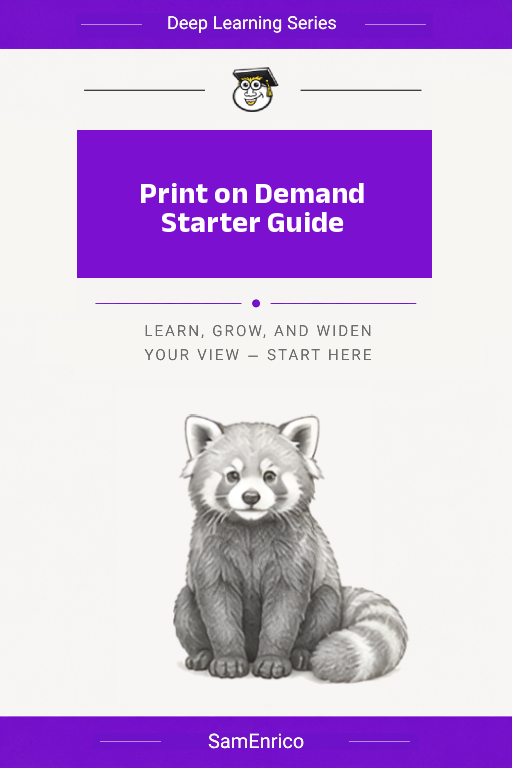
Non-FictionFirst 30 DaysPrint on Demand
Print on Demand Starter Guide eBook
Launch print-on-demand store with Printful or Prin
Launch print-on-demand store with Printful or Printify using zero inventory investment.
Formats
Free sample
Chapter 1: The Zero‑Inventory Lie...--Most beginners get print‑on‑demand completely backward. They see a Tik Tok video of a teenager claiming to make $10,000 a month from “passive POD income,” and they sign up for Printful the same day. They upload a dozen generic designs—a cat with a funny hat, a motivational quote about coffee, a silhouette of a mountain—and then they wait. Days pass. Weeks pass.
Nothing happens. No sales. No traffic. No evidence that anyone on earth wants what they just created.This chapter exists to prevent that from happening to you.The truth is that print‑on‑demand is a real, profitable business model. Thousands of store owners reliably earn full‑time incomes using Printful and Printify without ever touching a box or paying for warehouse storage.
But the path to that outcome has almost nothing to do with “passive income” and everything to do with understanding a simple but counterintuitive trade‑off.You are trading storage fees for marketing work.Traditional retail demands that you buy inventory upfront—often thousands of dollars worth of products that may never sell. You store those boxes in your garage or pay for a warehouse. You pack and ship every order yourself. You eat the cost of anything that doesn’t move. That model is expensive, risky, and physically exhausting.Print‑on‑demand eliminates the inventory problem entirely.
You never buy a product until a customer has already paid you for it. Your POD partner—Printful, Printify, or another provider—handles the printing, packing, and shipping. You never see the product. You never touch a shipping label. From a logistics standpoint, POD is almost magical.But here is the trade‑off that nobody puts on a motivational poster: because POD removes the barriers of inventory and shipping, millions of other people can do it too.
The low barrier to entry means high competition. And high competition means that your success will not come from simply “having a store.” It will come from your ability to do what most POD beginners refuse to do.You must become a marketer. You must become a designer. You must become a customer service representative. And you must do all of this consistently, every single week, without burning out.The good news is that you do not need any special talent to succeed.
You do not need to be a graphic designer. You do not need a following on social media. You do not need a thousand dollars to start. You need a system. And this book is that system.Before we go any further, one critical warning—because most POD books bury this on page 200, and by then it is too late.Do not start with t‑shirts.I am going to repeat that because it is the single most expensive mistake beginners make.
Do not start with t‑shirts. T‑shirts have thin margins. They have sizing issues that generate returns. They have fabric quality that varies wildly between POD partners. And they are the most saturated product in the entire POD universe.
When you search for “funny t‑shirt” on Etsy, you are competing against three million other listings.Instead, this book will guide you toward hard goods—mugs, stickers, phone cases, posters—as your first products. These items have higher margins, fewer returns, and dramatically less competition. You will tackle apparel in month two, after you have validated your niche and generated real cash flow. Every example in this book from Chapter 1 through Chapter 12 will use mugs as the default product unless otherwise specified. That is intentional.
That is how you avoid the beginner trap.Now let me introduce the framework that will guide everything you do from this point forward.The A.R.T. Framework Every successful POD store operates on three core principles. I call this the A.R.T. Framework because it is memorable, and because building a POD business is genuinely a form of art—the art of testing, automating, and collecting your royalties.A is for Automation Automation is what makes zero‑inventory possible. When a customer places an order on your Etsy or Shopify store, your POD partner receives that order automatically.
They print the design. They pack the product. They ship it directly to your customer. They notify you and the customer when the order ships. They provide the tracking number.
And then they charge you only for the production cost—after the customer has already paid you.You never manually send a file to a printer. You never copy‑paste an address into a shipping label form. You never stand in line at the post office. The entire fulfillment process runs on autopilot.But automation has a limit. It handles the logistics.
It does not handle the creativity, the marketing, or the customer service. Those are your responsibilities. Beginners who fail understand this distinction. They assume that “automated” means “no work required.” That is a dangerous misunderstanding.R is for Royalties Every sale you make generates a royalty—not in the formal sense of a licensing deal, but in the practical sense of profit per transaction. If your mug costs 7toproduceandyousellitfor7 to produce and you sell it for 7toproduceandyousellitfor20, your royalty is 13.That13.
That 13.That13 is your compensation for finding the niche, creating the design, writing the listing, and driving the traffic.Most POD books tell you to “just focus on volume.” They say that if you make one dollar per sale, you can scale to a million sales and become a millionaire. That is mathematically true but practically absurd. Beginners do not scale to a million sales. Beginners need to make enough profit per sale to survive long enough to learn what works.That is why this book emphasizes margin over volume. You will learn to price for 40% margin, which on a mug might mean 6–6–6–8 profit and on a premium hoodie might mean 15–15–15–20 profit.
Do not compete on price. Compete on value, on niche specificity, and on the quality of your mockups.T is for Testing Testing is the engine of every successful POD store. You do not know what will sell until you list it. You do not know which design will resonate until you put it in front of real customers. You do not know which product color will outperform others until you run the experiment.Testing requires a specific mindset: you are not attached to any single design.
You are not emotionally invested in your “brilliant idea.” You are a scientist running controlled experiments. List ten mugs. See which three get the most views. Delete the other seven. List ten more.
Repeat forever.The stores that succeed are not the ones with the most talent. They are the ones that test the most frequently and kill their failures the fastest.The Transaction Flow (How Money Moves)Before you spend a single dollar on a domain or a listing fee, you need to understand exactly how money moves through a POD business. This is not complicated, but beginners often misunderstand the timing and end up confused about when they get paid.Here is the complete flow from customer click to your bank account:Step 1: Customer places an order on your store.Whether…
This is the end of the free sample. Get the eBook to keep going. Buy now
About this book
Details
- Author
- Christenson Larue
- Publisher
- SamEnrico
- Language
- English
- Genre
- Non-Fiction, First 30 Days, Print on Demand
- Released
- 2026-05-29
- Pages (approx.)
- 129
- Available as
- eBook, Audiobook

Read better in the ZLOADR app
Your eBooks on your phone or tablet. Sign in with your SamEnrico account and start reading.
More by Christenson Larue
 Effortless Meditation GuideChristenson Larue$11.99
 Async Risk Register Management BriefChristenson Larue$11.99
 Real Estate Comparison TrapChristenson Larue$11.99
 Contingency Management for OUDChristenson Larue$11.99
 Benzo Taper Success Stories WorkbookChristenson Larue$11.99
 The Phantom Fleet: The Unsinkable Legend of the USS EldridgeChristenson Larue$11.99
 The Bridge That Broke the City: The I-35W Collapse and the Race to RebuildChristenson Larue$11.99
 Customer Care Vendor ManagerChristenson Larue$11.99
 Rent Deferral Agreement GuideChristenson Larue$12.99
 Understanding Cousin–walbraum–cegarra SyndromeChristenson Larue$17.99
 How to Start a Prepared Feeds for Farm Animals (wholesale) Business (Beginners Guide)Christenson Larue$11.99
You may also like
 Hong Kong Handover 1997Dunn Johnnie$11.99
 Zumba For Postnatal Recovery CourseNeal Christian$11.99
 Zumba for BeginnersLadner Nikia$11.99
 YouTube Comment Mining GuideHumes Pandora$12.99
 Worry Box MeditationCarlin Rudy$11.99
 Workplace Stress MeditationNguyen Lynn$11.99
 Workplace Stress and Sleep RepairHawley Ivory$11.99
 Workplace Perfectionism CureDelaney Jeffry$11.99
 Workplace Injustice Anger GuideWallen Isabelle$11.99
 Work Addiction and Burnout LinkGreenwood Ester$11.99
 Women in Yoga and WellnessBeattie Galina$11.99
 Women in Stand Up ComedyChun Evangeline$11.99