
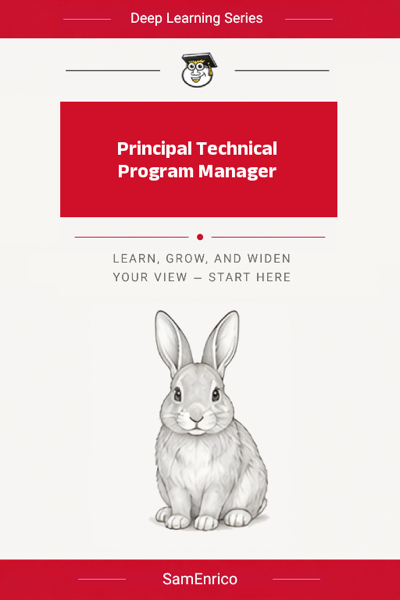
Non-FictionInformativeEducational
Principal Technical Program Manager eBook
A Coursebook on Principal Technical Program Manage
A Coursebook on Principal Technical Program Manager
Formats
Free sample
Chapter 1: The $500 Million Meeting Scheduler--–- The first time someone called me a "meeting scheduler," I was sitting in a glass-walled conference room at a global bank, watching a $500 million trading platform slowly die.The year was 2019. The project was called "Project Phoenix" – ironically, because it was supposed to rise from the ashes of a failed legacy system. I had been brought in as a Principal Technical Program Manager three weeks earlier. My title on the org chart said "Principal TPM." My actual role, according to the fifteen meeting invitations already clogging my calendar, was to "take notes and send reminders."I sat in that meeting, watching the Head of Engineering and the Head of Product argue about a delivery date that neither of them could realistically meet. The project was already six months behind schedule.
The budget had ballooned from 200millionto200 million to 200millionto350 million. Nobody knew the full list of dependencies. Nobody had a complete architecture diagram. And yet, every Tuesday at 10 AM, thirty people filed into that room, talked for ninety minutes, and left with no decisions made.I was supposed to be "managing" this program.But I wasn't. I was scheduling meetings.
I was sending follow-up emails. I was updating a Gantt chart that nobody trusted. I was, for all practical purposes, an expensive administrative assistant with a technical-sounding title.That night, I went home and asked myself a question that would change the entire trajectory of my career: What is the difference between a Principal TPM and everyone else who has ever failed at this job?The answer, I eventually learned, had nothing to do with calendars and everything to do with chaos.The Great Misconception Let me start with a provocation: If your primary tool is a meeting invitation, you are not a Principal TPM. You are a glorified scheduler. And you will fail.This sounds harsh because it is harsh.
The technology industry has spent the last decade confusing "program management" with "project management," and "Principal" with "Senior but with more meetings." The result is a generation of TPMs who are incredibly good at logistics and tragically bad at leadership.But here is the truth that separates Principal-level performers from everyone else:A Project Manager executes a defined plan. A Program Manager coordinates multiple related projects. A Technical Program Manager adds engineering constraints to that coordination. But a Principal TPM does something entirely different: they define the plan when no plan exists, and they create clarity when everyone else is drowning in chaos.Let me walk you through the taxonomy, because understanding these distinctions is the foundation for everything that follows.The Four Levels of Execution Level 1: Project Manager (Output-Focused, Time-Bound)A Project Manager is given a clear scope, a deadline, and a team. Their job is to execute.
They track tasks, manage schedules, and report status. They ask: "Are we on track to deliver Feature X by Friday?"Project Managers are essential. Without them, nothing gets done. But they operate in a world where the problem statement is already defined. Someone else – a Product Manager, a Director, a VP – has already decided what needs to be built.
The Project Manager's job is to make sure it gets built on time.Level 2: Program Manager (Outcome-Focused, Cross-Functional)A Program Manager coordinates multiple related projects across teams. They manage dependencies, resolve conflicts, and ensure that the sum of the parts is greater than the whole. They ask: "Are we achieving the business outcome we committed to?"Program Managers think in horizons of months and quarters. They understand that shipping Feature X is useless if Feature Y isn't ready to consume it. They operate in the space between teams.Level 3: Technical Program Manager (Adds Engineering Constraints)A Technical Program Manager does everything a Program Manager does, plus one critical thing: they understand the technical system well enough to identify risks that non-technical managers would miss.
They ask: "Is this architecture deliverable given our current technical debt and team skill sets?"TPMs can read a system diagram and spot a single point of failure. They know the difference between a blue/green deployment and a canary deployment. They understand why microservices introduce network latency risks. They do not write production code, but they ask the questions that make engineers think twice.Level 4: Principal TPM (Creates Clarity from Chaos)And then there is the Principal TPM.The Principal TPM operates in a different universe entirely. They are not given a defined problem.
They are given a mess. A vague business goal. A directive like "make our payments system more reliable" or "reduce customer churn" or "migrate to the cloud" – with no specification of what success looks like, no clear scope, no existing roadmap, and often no consensus among leadership about what should be done.The Principal TPM's job is not to execute a plan. It is to create the plan. To take a fuzzy, ambiguous, politically charged problem and turn it into a set of concrete, actionable, resourced, and approved initiatives.They ask: "What is the actual problem we are trying to solve?
Who needs to be involved? What are the constraints? What does success look like? And how do we get everyone to agree on the answers to these questions before we write a single line of code?"This is the core distinction that separates Principal TPMs from everyone else. And it is the distinction that most organizations, most job descriptions, and most books get wrong.The Venn Diagram of Success If you take away only one mental model from this chapter, make it this one.The Principal TPM sits at the intersection of three domains.
I call this the Venn Diagram of Success, and it will appear throughout this book as a reference point for every technique and framework we discuss.Domain 1: Engineering (Feasibility)The Engineering domain asks: Can we build this? It concerns itself with technical constraints: architecture, infrastructure, technical debt, team skill sets, development velocity, testing coverage, deployment pipelines, and operational reliability.Most TPMs understand this domain reasonably well. They know how to talk to engineers, they can read a design document, and they understand the SDLC. But Principal TPMs need more than familiarity – they need enough depth to challenge assumptions and spot invisible risks.Domain 2: Product (Viability)The Product domain asks: Should we build this? It concerns itself with customer value, market fit, business model, competitive positioning, and return on investment.This is where many technical TPMs struggle.
They focus so heavily on the how that they forget to question the why. A Principal TPM must be able to sit in a room with Product VPs and argue about customer segmentation, pricing models, and feature prioritization – not as a passive observer, but as an active participant.Domain 3: Operations (Reliability)The Operations domain asks: Can we keep this running? It concerns itself with uptime, incident response, disaster recovery, compliance, security, and long-term maintainability.This domain is the most frequently neglected, especially in organizations that reward feature velocity over system stability. Principal TPMs understand that launching a feature that breaks every weekend is not a success. They fight for reliability as a first-class concern, not an afterthought.The Intersection The magic – and the difficulty – of…
This is the end of the free sample. Get the eBook to keep going. Buy now
About this book
Details
- Author
- Brady Cameron
- Publisher
- SamEnrico
- Language
- English
- Genre
- Non-Fiction, Informative, Educational
- Released
- 2026-06-02
- Pages (approx.)
- 145
- Available as
- eBook, Audiobook

Read better in the ZLOADR app
Your eBooks on your phone or tablet. Sign in with your SamEnrico account and start reading.
More by Brady Cameron
 Vaginal Dryness ReliefBrady Cameron$11.99
 HIIT For Bad ShouldersBrady Cameron$11.99
 Salience Demand ShiftsBrady Cameron$11.99
 Food Addiction and Leptin ResistanceBrady Cameron$11.99
 The Scandal That Shook the Stage: The Divorce of David Garrick and Eva Marie VeigelBrady Cameron$11.99
 How to Produce 3d PrintersBrady Cameron$11.99
 Resignation Letter Email GuideBrady Cameron$12.99
 How to Start a Hobby in Ancient reenactmentBrady Cameron$11.99
You may also like
 Hong Kong Handover 1997Dunn Johnnie$11.99
 Zumba For Postnatal Recovery CourseNeal Christian$11.99
 Zumba for BeginnersLadner Nikia$11.99
 YouTube Comment Mining GuideHumes Pandora$12.99
 Worry Box MeditationCarlin Rudy$11.99
 Workplace Stress MeditationNguyen Lynn$11.99
 Workplace Stress and Sleep RepairHawley Ivory$11.99
 Workplace Perfectionism CureDelaney Jeffry$11.99
 Workplace Injustice Anger GuideWallen Isabelle$11.99
 Work Addiction and Burnout LinkGreenwood Ester$11.99
 Women in Yoga and WellnessBeattie Galina$11.99
 Women in Stand Up ComedyChun Evangeline$11.99