
Non-FictionInformativeEducational
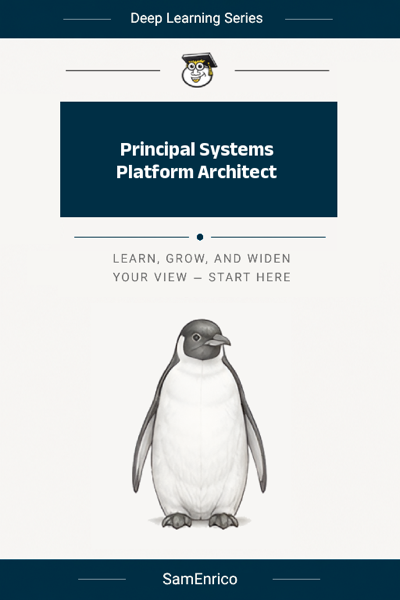
Principal Systems Platform Architect eBook
A Coursebook on Principal Systems Platform Archite
A Coursebook on Principal Systems Platform Architect
Formats
Free sample
Chapter 1: The Multiplier Mandate--–- The engineer sat across from me, shoulders hunched, coffee cold and forgotten. He had just presented his platform to the entire engineering organization. For six months, he had worked alone, nights and weekends, building what he believed was the solution to every problem the company had. His platform could provision databases in seconds. It could spin up Kubernetes clusters with a single command.
It had a beautiful web interface, full observability, and automated security scanning. He had even written comprehensive documentation, something no one else in the company ever did.After the presentation, the CTO asked a single question: "How many teams have adopted this?"The engineer paused. "Well, I'm using it for my team's services.""How many other teams?""None yet. But once they see how good it is, they will."The CTO nodded slowly, then delivered the verdict that would echo in that engineer's mind for years. "You have built a beautiful solution to a problem you assumed existed.
But you never asked anyone what their actual problem was. You have spent six months of company time building something nobody requested, nobody needs, and nobody will use. I admire the craft. But this is not engineering. This is sculpture."That engineer was me.
And that conversation changed everything about how I understand the role of the Principal Systems Platform Architect.This chapter is not about technology. It is about a fundamental shift in identity. Before you write a single line of platform code, before you choose a single tool, before you draw a single architecture diagram, you must internalize a single truth: your job is not to build a platform. Your job is to multiply the effectiveness of every other engineer in the organization. If you build something that only you use, you have failed, regardless of how technically elegant it is.
If you build something that a hundred engineers use every day, you have succeeded, even if the code is embarrassing.This is the Multiplier Mandate. It is the first and most important principle of Principal-level platform architecture. And it is the standard against which every decision you make will be measured.The Mathematics of Multiplication Let us start with a simple equation. An organization has N engineers. Each engineer produces some amount of value per day, which we will call V.
Total organizational output is N times V. As a Principal Platform Architect, you cannot directly increase N, because you do not control hiring. You cannot directly increase V, because you do not control individual productivity. What you can do is build a platform that reduces the time engineers spend on undifferentiated heavy lifting: provisioning, deployment, configuration, debugging common failure modes, integration, and coordination.If your platform saves each engineer one hour per day, and each engineer works eight hours per day, you have effectively increased V by 12.5 percent. For an organization of one hundred engineers, that is the equivalent of adding twelve and a half engineers to the payroll without any additional hiring cost.
If your platform saves each engineer two hours per day, that is twenty-five extra engineers. If your platform saves each engineer four hours per day, that is fifty extra engineers.Now look at your own salary. Add the salaries of your platform team. Divide that number by the cost of a fully burdened engineer at your company. That is how many engineers your platform must effectively "replace" or "create" just to break even.
For most Principal-level platform teams, the break-even point is somewhere between eight and fifteen virtual engineers. That means your platform needs to save at least eight engineers worth of time across the organization. In a hundred-engineer company, that is an eight percent productivity improvement. In a thousand-engineer company, that is less than one percent. The math is not difficult.
And yet, the majority of platform investments never break even.Why? Because they are built without the Multiplier Mandate. They are built to satisfy the architect's curiosity, or to use a cool new technology, or to solve a problem that only the architect's team experiences. They are built as sculpture, not as leverage.The Multiplier Mandate demands a different approach. Before you build anything, you must answer three questions with hard data.
First, what is the current cost of the problem you are trying to solve? Measure it in engineer hours per week. Second, what is the expected reduction in that cost after your platform is built? Be specific. Third, how many engineers will adopt the platform, and what is the adoption cost?
If the numbers do not add up to at least a 3x return on investment, do not build it. Build something else instead.The Principal Identity Shift The hardest part of this role is not technical. It is psychological. Every engineer who reaches the Principal level does so by being an exceptional individual contributor. You have spent a decade or more solving hard problems by yourself, diving deep, writing beautiful code, and emerging victorious.
That is how you got here. And now, everything that made you successful is about to become a liability.The Principal identity shift requires you to go from hero to enabler. The hero writes the critical service that nobody else can write. The enabler writes the tool that lets fifty ordinary engineers write their own services without needing a hero. The hero fixes the production outage at 2 AM.
The enabler builds the observability and automated rollback that prevents the outage from happening in the first place. The hero is celebrated in the moment. The enabler is invisible when things work.This shift is deeply uncomfortable. It feels like you are no longer doing "real work." Your manager may not understand what you do all day. Your peers may wonder why you are not in the codebase as much as you used to be.
Your own impostor syndrome will whisper that you are coasting, that you have lost your edge, that soon everyone will discover you are not as smart as they thought.Ignore that voice. It is wrong. The work of enablement is harder than the work of heroism. Heroism requires technical depth. Enablement requires technical depth, organizational awareness, political savvy, user research, product management, and the patience of a saint.
Heroism has a single success condition: the code works. Enablement has multiple success conditions: the platform works, teams adopt it, teams stay adopted, the platform evolves with their needs, and the platform eventually becomes so boring that nobody talks about it anymore. Boring is the highest compliment a platform can receive.The Adoption Cascade Every platform goes through an adoption cascade. Understanding this cascade is essential to applying the Multiplier Mandate. The cascade has four stages.Stage zero is your own team.
You and your immediate colleagues use the platform because you built it and you have no choice. This stage proves nothing except that the platform can function under ideal conditions. Many platform efforts stop here, with the architects declaring victory while the rest of the organization ignores them. Do not confuse your team's forced adoption with real adoption.Stage one is early adopters. These are engineers who are dissatisfied with the status quo, curious about…
This is the end of the free sample. Get the eBook to keep going. Buy now
About this book
Details
- Author
- Grover Cheree
- Publisher
- SamEnrico
- Language
- English
- Genre
- Non-Fiction, Informative, Educational
- Released
- 2026-05-11
- Pages (approx.)
- 138
- Available as
- eBook, Audiobook

Read better in the ZLOADR app
Your eBooks on your phone or tablet. Sign in with your SamEnrico account and start reading.
More by Grover Cheree
 Intuitive Eating For Athletes GuideGrover Cheree$11.99
 Personal Ing For Success Content StrategyGrover Cheree$11.99
 No School Picture PrideGrover Cheree$11.99
 The Healthcare Worker ExodusGrover Cheree$11.99
 Gabapentinoid Dosing ManualGrover Cheree$11.99
 Whispering Pines and the Ghost of Paul Bunyan’s AxeGrover Cheree$11.99
 From Basement to Billions: The Untold Story of Alibaba's Global DominationGrover Cheree$11.99
 Understanding Beta-thalassemia (Gene Promoter Involvement)Grover Cheree$17.99
 Ecommerce Sales ReconciliationGrover Cheree$12.99
 Delaware LLC for Venture Backed StartupsGrover Cheree$12.99
 How to Start a Poultry Raising and Breeding Business (Beginners Guide)Grover Cheree$11.99
You may also like
 Hong Kong Handover 1997Dunn Johnnie$11.99
 Zumba For Postnatal Recovery CourseNeal Christian$11.99
 Zumba for BeginnersLadner Nikia$11.99
 YouTube Comment Mining GuideHumes Pandora$12.99
 Worry Box MeditationCarlin Rudy$11.99
 Workplace Stress MeditationNguyen Lynn$11.99
 Workplace Stress and Sleep RepairHawley Ivory$11.99
 Workplace Perfectionism CureDelaney Jeffry$11.99
 Workplace Injustice Anger GuideWallen Isabelle$11.99
 Work Addiction and Burnout LinkGreenwood Ester$11.99
 Women in Yoga and WellnessBeattie Galina$11.99
 Women in Stand Up ComedyChun Evangeline$11.99