
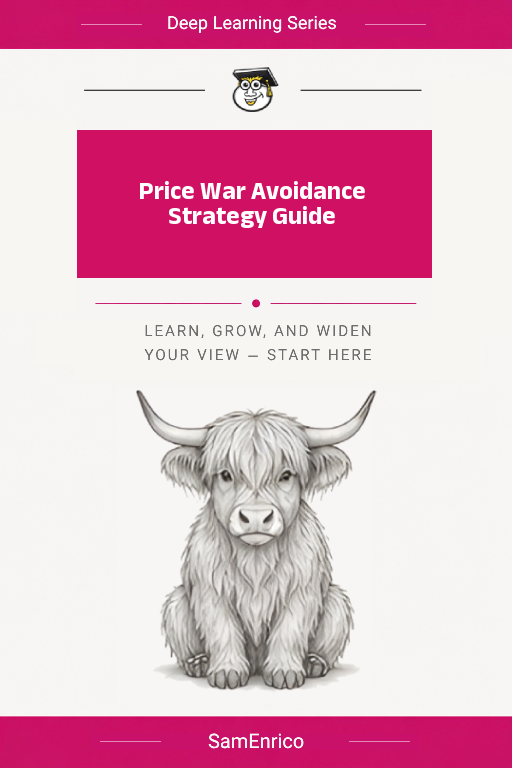
Non-FictionBusiness BriefGame Theory
Price War Avoidance Strategy Guide eBook
Signal pricing intentions to competitors to avoid
Signal pricing intentions to competitors to avoid destructive discounting during inflation.
Formats
Free sample
Chapter 1: The Discount Reflex--It begins quietly. Not with a slammed fist on a boardroom table, not with a dramatic resignation, and certainly not with a memo titled "We Have Declared a Price War." No, the discount reflex starts with something far more innocent: a single exception.A key customer calls. They are loyal, they pay on time, they have been with you for seven years. But inflation is squeezing them, and they ask for a small concession. Just this once.
Just 5%. You hesitate for a moment, but the thought arrives unbidden: We cannot afford to lose them. You authorize the discount. The customer thanks you profusely. The deal closes.
You feel relief.That relief is the first hit of a drug you will soon be unable to quit.Six weeks later, another customer learns about the discount. They do not ask; they demand. "You gave it to them," they say. "We want the same." You hesitate again, but the logic seems inescapable. If you say no, you will look unfair.
If you say yes, you keep the peace. You authorize the second discount. Then a third. Then a tenth.By the end of the quarter, your average selling price has dropped 4%. Your volume is up 6%.
You congratulate yourself on protecting market share. Then the finance team runs the numbers. Your gross profit has fallen 11%. The volume increase, once you factor in the variable costs of producing and shipping those extra units, has actually cost you money. You made more profit last quarter on fewer sales at higher prices than you made this quarter on more sales at lower prices.And the worst part?
Your three largest competitors are doing exactly the same thing. None of you wanted a price war. All of you started one anyway.This is the discount reflex. It is the single most destructive force in modern business, and during inflation, it becomes an epidemic. This chapter will show you why your brain is wired to fall into this trap, how to recognize the early symptoms before they become terminal, and why the first step to winning the peace is admitting that you are already addicted to the deal.The Math That Everyone Knows and Nobody Believes Let us begin with a simple exercise.
You are the CEO of a mid-sized manufacturing company. Last year, you generated 100millioninrevenueata30100 million in revenue at a 30% gross margin, meaning your gross profit was 100millioninrevenueata3030 million. Your volume was one million units at an average price of 100perunit,withvariablecostsof100 per unit, with variable costs of 100perunit,withvariablecostsof70 per unit.This year, inflation has increased your variable costs by 10%, from 70to70 to 70to77 per unit. If you keep your price at 100,yourmargindropsfrom30100, your margin drops from 30% to 23%. Your gross profit on the same volume falls from 100,yourmargindropsfrom3030 million to 23million—alossof23 million—a loss of 23million—alossof7 million.You have two options.
Option one: raise prices by 10% to $110. Option two: keep prices flat, discount aggressively to maintain volume, and pray.Most executives choose option two. They do not say it out loud, but they behave as if discounting is safer than raising prices. The math suggests otherwise.Consider a 2% price increase. On your one million units, a 2% increase adds 2millioninrevenue.Variablecostsdonotchange.Sothat2 million in revenue.
Variable costs do not change. So that 2millioninrevenue.Variablecostsdonotchange.Sothat2 million flows directly to gross profit. A 2% price increase yields a $2 million profit lift.Now consider a 10% volume increase achieved through discounting. To get that volume, you typically need to lower prices. Let us assume a 5% discount to 95perunit.Atthatprice,onemillionunitsgenerate95 per unit.
At that price, one million units generate 95perunit.Atthatprice,onemillionunitsgenerate95 million in revenue. To achieve 10% volume growth, you must sell 1.1 million units. Revenue becomes 1.1 million times 95,or95, or 95,or104.5 million. That is 4.5millionmorerevenuethanlastyear′s4.5 million more revenue than last year's 4.5millionmorerevenuethanlastyear′s100 million. Sounds good, right?But variable costs at 77peruniton1.1millionunitsare77 per unit on 1.1 million units are 77peruniton1.1millionunitsare84.7 million.
Subtract that from 104.5million,andyourgrossprofitis104.5 million, and your gross profit is 104.5million,andyourgrossprofitis19.8 million. Last year, gross profit was $30 million. You have just worked harder, sold more, and generated less than two-thirds of the profit you made before.The 2% price increase, with no volume change, gives you 32millioningrossprofit(1millionunitsat32 million in gross profit (1 million units at 32millioningrossprofit(1millionunitsat110 minus 77millioninvariablecosts).Thediscount−drivenvolumeincreasegivesyou77 million in variable costs). The discount-driven volume increase gives you 77millioninvariablecosts).Thediscount−drivenvolumeincreasegivesyou19.8 million. The price increase is worth an extra $12.2 million in profit compared to the discounting strategy.This is not subtle.
This is not a matter of opinion. This is arithmetic. Yet executives across every industry consistently choose the path that destroys more value. Why?Loss Aversion: The Psychological Engine of Self-Destruction The answer lies in a well-documented cognitive bias called loss aversion. Discovered by psychologists Daniel Kahneman and Amos Tversky, loss aversion is the finding that losses hurt roughly twice as much as equivalent gains feel good.
Losing 100causesabouttwicetheemotionaldistressofgaining100 causes about twice the emotional distress of gaining 100causesabouttwicetheemotionaldistressofgaining100. This asymmetry distorts decision-making, especially under stress.Apply this to pricing. A potential price increase threatens a loss of customers. The executive imagines a key account leaving, a salesperson complaining, a competitor celebrating. This imagined loss feels acute, immediate, and personal.
A potential discount, by contrast, offers the gain of a retained customer and a closed deal. The gain feels specific and controllable. The loss feels vague and terrifying.Even when the math proves that price increases generate higher profits, the emotional weight of the feared loss overpowers the rational calculation. The executive chooses the discount not because it is smarter, but because it feels safer.Inflation magnifies this effect. When costs rise, the pressure to "do something" intensifies.
Doing nothing—holding prices steady while costs climb—feels passive and dangerous. Raising prices feels aggressive and risky. Discounting feels like a compromise. It feels like action without confrontation. It is the path of least psychological resistance.This is the discount reflex.
It is not a failure of intelligence. It is a feature of human biology. Your brain is wired to avoid losses, and in the fog of inflation, discounting looks like loss avoidance. It is actually loss creation, but evolution did not prepare you for quarterly earnings reports.The Fear Signal: What Your Discounting Communicates to Competitors Here is where the discount reflex becomes catastrophic. Your internal psychology does not stay internal.
It leaks. Every discount you authorize, every "special exception" you approve, every secret rebate you offer sends a signal to the market. And competitors are exquisitely tuned to read these signals.When you discount, you broadcast fear. Not intentionally, not obviously, but unmistakably to anyone who knows how to listen.Consider the following behaviors and the signals they send:Behavior: Hiding prices behind "Call for Quote" buttons on your website.Signal: We are afraid to be transparent because we do not know what our prices should be. We are hoping customers will not comparison shop.Behavior: Authorizing one-off discounts for large customers while maintaining list price for small customers.Signal: Our pricing has no integrity.
We will fold under pressure. The only question is how hard you have to push.Behavior: Announcing a price increase, then quietly offering "rebates"…
This is the end of the free sample. Get the eBook to keep going. Buy now
About this book
Details
- Author
- Russo Germaine
- Publisher
- SamEnrico
- Language
- English
- Genre
- Non-Fiction, Business Brief, Game Theory
- Released
- 2026-06-01
- Pages (approx.)
- 143
- Available as
- eBook, Audiobook

Read better in the ZLOADR app
Your eBooks on your phone or tablet. Sign in with your SamEnrico account and start reading.
More by Russo Germaine
 Posture Reset Before TalksRusso Germaine$11.99
 Park Bench WorkoutRusso Germaine$11.99
 Wedding Speech Mastery GuideRusso Germaine$11.99
 Body Language in FinanceRusso Germaine$11.99
 The Silk Road and the Stadium: How Ancient China's Football Fields United EmpiresRusso Germaine$11.99
 Live In Resident ManagerRusso Germaine$11.99
 How to Produce Card Game AccessoriesRusso Germaine$11.99
 How to Start a Oil-rig Transportation By Towing or Pushing Business (Beginners Guide)Russo Germaine$11.99
You may also like
 Hong Kong Handover 1997Dunn Johnnie$11.99
 Zumba For Postnatal Recovery CourseNeal Christian$11.99
 Zumba for BeginnersLadner Nikia$11.99
 YouTube Comment Mining GuideHumes Pandora$12.99
 Worry Box MeditationCarlin Rudy$11.99
 Workplace Stress MeditationNguyen Lynn$11.99
 Workplace Stress and Sleep RepairHawley Ivory$11.99
 Workplace Perfectionism CureDelaney Jeffry$11.99
 Workplace Injustice Anger GuideWallen Isabelle$11.99
 Work Addiction and Burnout LinkGreenwood Ester$11.99
 Women in Yoga and WellnessBeattie Galina$11.99
 Women in Stand Up ComedyChun Evangeline$11.99