
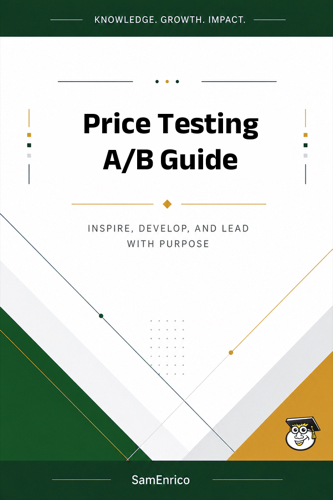
Non-FictionBusiness BriefA/B Testing
Price Testing A/B Guide Audiobook
Experiment with different prices on segments.
by Burton Barry
Experiment with different prices on segments.
Formats
Free sample
Chapter 1: The One-Price Lie--–- In 2016, a small software company called Basecamp made a decision that seemed perfectly reasonable. They raised the price of their entry-level plan from $29 to $99 per month. The backlash was immediate, furious, and nearly fatal. Existing customers felt betrayed. Prospective customers compared screenshots on Twitter.
Blog posts accused them of greed. Within weeks, they had lost nearly a third of their projected revenue.The twist? Basecamp’s product was objectively worth $99. Their costs had gone up. Their feature set had tripled.
By every objective measure, the new price was fair. But fairness, as it turns out, has nothing to do with it.What Basecamp discovered—what every business eventually discovers—is that customers don’t react to the objective value of your product. They react to the difference between what they expected to pay and what you are asking them to pay. And when you charge everyone the same price, you are guaranteed to get that difference wrong for most of your customers.This chapter dismantles the most dangerous assumption in modern business: that a single, “fair” price is the safest path. In the pages that follow, we will uncover why the one-price model leaves money on the table, drives customers away, and creates the very backlash that pricing teams fear most.
More importantly, we will introduce the alternative: segment-based A/B testing as the scientific method for discovering what different groups of customers are actually willing to pay.The Consumer Surplus Funeral Every time a customer buys your product at the price you set, two things happen simultaneously. First, you earn revenue. Second, the customer experiences what economists call consumer surplus—the gap between what they paid and what they would have been willing to pay.Consider a simple example. You sell a project management tool for $20 per month. Customer A is a freelance designer with three clients.
She would happily pay $30 per month but finds your tool at $20. Her consumer surplus is $10. Customer B is a cash-strapped nonprofit coordinator. He can barely afford $15 per month but stretches to $20 because he needs the features. His consumer surplus is negative $5—he feels like he overpaid.
Customer C is a student who would pay $8 but sees $20 and never buys. Her consumer surplus is zero because she doesn’t purchase at all.The one-price model has failed all three customers. Customer A left $10 on the table that…
This is the end of the free sample. Get the Audiobook to keep going. Buy now
About this book
Details
- Author
- Burton Barry
- Publisher
- SamEnrico
- Language
- English
- Genre
- Non-Fiction, Business Brief, A/B Testing
- Released
- 2026-06-10
- Pages (approx.)
- 139
- Available as
- eBook, Audiobook

Listen in the VoxFlicks app
Audiobooks and audio dramas wherever you go. Sign in with your SamEnrico account and press play.
More by Burton Barry
 Name Backup RecordingBurton Barry$11.99
 Nap Alarm StrategiesBurton Barry$11.99
 Contempt In Relationships GuideBurton Barry$11.99
 Spotify Wrapped ObsessionBurton Barry$11.99
 Shopping Relapse PreventionBurton Barry$11.99
 OKRs for EntrepreneursBurton Barry$11.99
 The Vision Screening VolunteerBurton Barry$11.99
 The Star Maps of the Dogon: Decoding the Cosmos in Ancient MaliBurton Barry$11.99
 The Cursed Gaze of Medusa's SistersBurton Barry$11.99
 Service Providers Guide to Leather & Vinyl RepairBurton Barry$11.99
 How to Produce UndergroundBurton Barry$11.99
 AI Working Capital OptimizationBurton Barry$12.99
You may also like
 Hong Kong Handover 1997Dunn Johnnie$11.99
 Zumba For Postnatal Recovery CourseNeal Christian$11.99
 Zumba for BeginnersLadner Nikia$11.99
 YouTube Comment Mining GuideHumes Pandora$12.99
 Worry Box MeditationCarlin Rudy$11.99
 Workplace Stress MeditationNguyen Lynn$11.99
 Workplace Stress and Sleep RepairHawley Ivory$11.99
 Workplace Perfectionism CureDelaney Jeffry$11.99
 Workplace Injustice Anger GuideWallen Isabelle$11.99
 Work Addiction and Burnout LinkGreenwood Ester$11.99
 Women in Yoga and WellnessBeattie Galina$11.99
 Women in Stand Up ComedyChun Evangeline$11.99