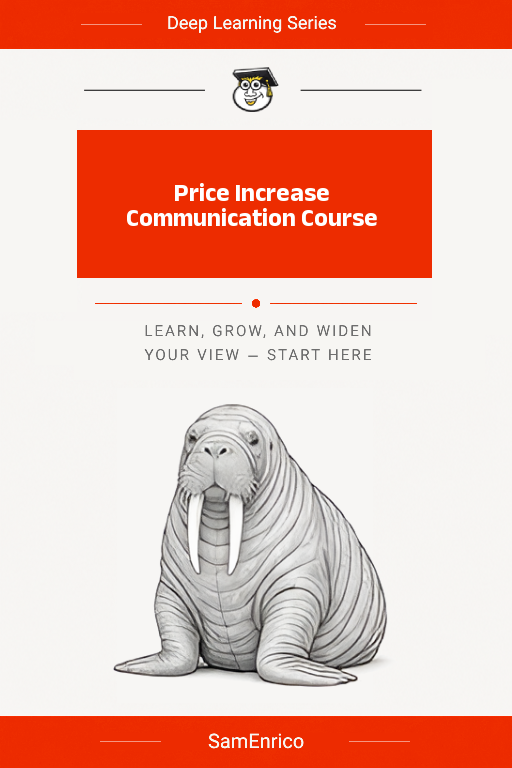
Price Increase Communication Course
Announce inflation driven price hikes to customers
Announce inflation driven price hikes to customers without losing loyalty using framing and timing tactics.
Formats
About this book
Free sample
Chapter 1: The Loyalty Trap--Most business leaders believe they have loyal customers. They point to renewal rates measured in years, contracts signed without negotiation, and the blessed absence of complaints. This belief is not merely optimistic. It is dangerous. What companies call loyalty is almost always inertia, and a price increase is the magnifying glass that reveals the difference.
When you announce a price hike, customers you thought were your foundation often become the first to leave. Not because they are unreasonable. Not because your product is bad. But because you mistook convenience for commitment, comfort for conviction, and the difficulty of leaving for the value of staying.This chapter dismantles that illusion and introduces the unified framework that will underpin every tactic in this book. You will learn why most customer relationships are built on a psychological quirk called Status Quo Bias, why a ten-dollar price increase feels like a twenty-five-dollar loss, and how to segment your customers not by revenue alone but by the one variable that predicts their reaction to bad news: the difference between habit and genuine commitment.
By the end of this chapter, you will understand exactly which customers are truly loyal, which ones are merely comfortable, and how to communicate with each group when inflation forces you to raise prices.The Problem with Loyalty as You Know It Let us start with an uncomfortable truth. Human beings are fundamentally lazy. Not in the pejorative sense, but in the cognitive sense. The brain consumes roughly twenty percent of the body's energy while accounting for only two percent of its mass. Evolution has therefore optimized the brain to conserve energy whenever possible.
One of the primary ways it does this is through cognitive biases that favor the familiar over the novel, the existing over the new, and the effortless over the effortful.This is called Status Quo Bias. It is the human tendency to prefer things as they are because changing requires work. Your customer stays with you not because they love you, not because you are the best option, but because switching would require them to learn…
This is the end of the free sample. Get the eBook to keep going. Buy now
Contents
- Chapter 1
- Chapter 2
- Chapter 3
- Chapter 4
- Chapter 5
- Chapter 6
- Chapter 7
- Chapter 8
- Chapter 9
- Chapter 10
- Chapter 11
- Chapter 12
Details
- Author
- Benedict Spring
- Publisher
- SamEnrico
- Language
- English
- Genre
- Non-Fiction, Business Brief, Customer Communication
- Released
- 2026-05-28
- Pages (approx.)
- 149
- Available as
- eBook, Audiobook

Read better in the ZLOADR app
Your eBooks on your phone or tablet. Sign in with your SamEnrico account and start reading.
More by Benedict Spring
 Empathetic Listening GuideBenedict Spring$11.99
 Detox Hallucinations GuideBenedict Spring$11.99
 The Remote Worker Pomodoro MasteryBenedict Spring$11.99
 Self Esteem Age Gap LoveBenedict Spring$11.99
 Deductible Selection GuideBenedict Spring$11.99
 Personal Brand for FinanceBenedict Spring$11.99
 Neuroception of SafetyBenedict Spring$11.99
 Bifidobacterium GuideBenedict Spring$11.99
 The Serpent’s Throne: Exile of the Last Dragon KingBenedict Spring$11.99
 The Architect of the Future: Black Engineers Who Built the Modern WorldBenedict Spring$11.99
 How to Produce Fireplace and Wood Stove AccessoriesBenedict Spring$11.99
 How to Trade ZincBenedict Spring$11.99