
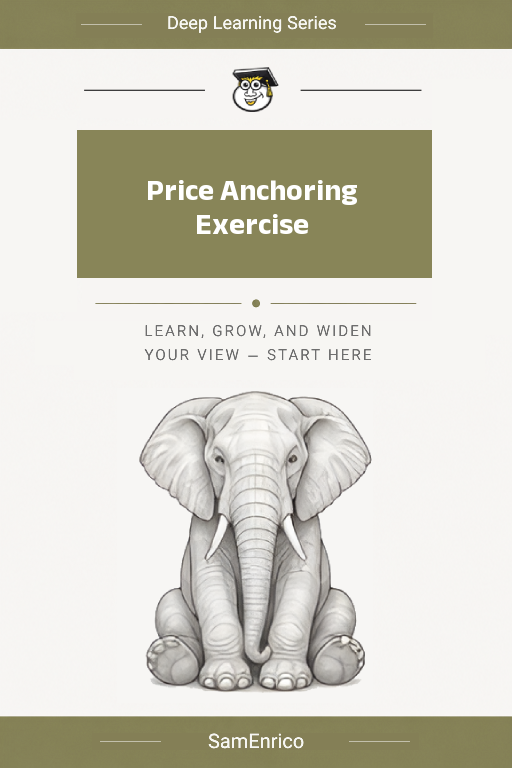
Non-FictionFirst 30 DaysPricing PsychologyBehavioral Economics
Price Anchoring Exercise eBook
Present a premium option first to make your target
Present a premium option first to make your target price feel reasonable using proven anchoring psychology.
Formats
Free sample
Chapter 1: The Ghost in the Tag--–- On a hot summer morning in February 1994, Stella Liebeck ordered a 49-cent cup of coffee at a Mc Donald’s drive-through in Albuquerque, New Mexico. She was 79 years old, a retired department store clerk, and a grandmother. Her grandson Chris pulled the Ford Probe into a parking spot so Stella could add cream and sugar to her coffee. She placed the cup between her knees to remove the lid. The cup tipped over.
The coffee spilled into her lap.Stella suffered third-degree burns over 16 percent of her body. She spent eight days in the hospital, underwent skin grafts, and was permanently disfigured. She asked Mc Donald’s to pay 20,000forhermedicalbills.Mc Donald’soffered20,000 for her medical bills. Mc Donald’s offered 20,000forhermedicalbills.Mc Donald’soffered800. Stella sued.Here is what every business owner, entrepreneur, and sales professional should learn from this tragedy.
The case is not about coffee. It is not about negligence. It is not about a grandmother who made a mistake. It is about the most powerful force in pricing psychology: the first number that enters a human mind.Stella’s attorney, Reed Morgan, had a problem. The jury was being asked to compensate an elderly woman for horrific injuries caused by coffee that Mc Donald’s served at 180 to 190 degrees Fahrenheit—temperatures that cause full-thickness burns in two to seven seconds.
But juries do not hand out millions of dollars for spilled coffee. Morgan needed the jury to see the number “2.9million”beforetheysawanyothernumber.Hedidnotaskfor2.9 million” before they saw any other number. He did not ask for 2.9million”beforetheysawanyothernumber.Hedidnotaskfor2.9 million because he thought that was the correct number. He asked for $2.9 million because it represented two days of Mc Donald’s coffee sales worldwide. It was an arbitrary number.
It was also a perfect anchor.The jury awarded Stella 2.9million.Thejudgelaterreducedtheawardto2.9 million. The judge later reduced the award to 2.9million.Thejudgelaterreducedtheawardto640,000. But notice what happened: 640,000feltreasonablebecauseitwascomparedto640,000 felt reasonable because it was compared to 640,000feltreasonablebecauseitwascomparedto2.9 million. Without that anchor, $640,000 would have felt astronomical for a cup of spilled coffee. The first number changed everything.This is the Ghost in the Tag.
It haunts every transaction, every negotiation, every pricing page, every proposal. Once a customer sees a number, that number becomes the reference point for every subsequent number they encounter. They cannot un-see it. They cannot logic their way around it. The first price presented is not just a price.
It is the lens through which every other price is evaluated.The Science of the Invisible Anchor In 1974, two psychologists named Daniel Kahneman and Amos Tversky published a paper that would eventually win Kahneman a Nobel Prize. They called it “Judgment under Uncertainty: Heuristics and Biases.” In that paper, they described a phenomenon they called “anchoring and adjustment.”The experiment was deceptively simple. Kahneman and Tversky spun a roulette wheel in front of participants. The wheel was rigged to land on either 10 or 65. After the wheel stopped, they asked participants one question: “What percentage of United Nations member countries are African?”The participants who saw the wheel land on 10 guessed an average of 25 percent.
The participants who saw the wheel land on 65 guessed an average of 45 percent. The roulette wheel had nothing to do with the United Nations. It had nothing to do with Africa. It was random. And yet the number on that wheel—an arbitrary, meaningless number—shaped the estimates of intelligent adults.Kahneman and Tversky had discovered that the human mind does not estimate from scratch.
It starts from a reference point and adjusts. The problem is that the adjustment is always insufficient. If the anchor is high, you end up high. If the anchor is low, you end up low. The anchor does not need to be relevant.
It does not need to be logical. It just needs to arrive first.This is not a quirk of laboratory experiments. This is how the human brain processes numerical information. The effect has been replicated hundreds of times across dozens of countries. Real estate agents anchor to list prices and appraise homes higher.
Judges anchor to random dice rolls and issue longer sentences. Doctors anchor to previous diagnoses and miss new symptoms. Negotiators anchor to first offers and capture more value.The anchor works because of two cognitive mechanisms. The first is “selective accessibility.” When you see a high anchor, your brain automatically searches for reasons why that number might be appropriate. You start building a mental case for the anchor, whether you believe it or not.
The second is “anchor-and-adjust.” You start at the anchor and move toward your best guess, but you stop when you reach a plausible number—not the correct number. The anchor pulls you like gravity.The Social Security Number Experiment The most famous anchoring demonstration for business professionals comes from Dan Ariely, the behavioral economist who wrote Predictably Irrational. Ariely wanted to know whether arbitrary anchors would influence real purchasing decisions—not just guesses about United Nations membership.He gathered a group of MIT students. He gave them a list of products: a wireless keyboard, a bottle of wine, a box of Belgian chocolates, and a few other items. Then he asked them to write down the last two digits of their Social Security numbers.
He did not explain why.Next, Ariely asked each student whether they would pay that dollar amount for each product. If your SSN ended in 88, would you pay 88forthekeyboard?Ifyour SSNendedin12,wouldyoupay88 for the keyboard? If your SSN ended in 12, would you pay 88forthekeyboard?Ifyour SSNendedin12,wouldyoupay12 for the keyboard? The students answered yes or no. Finally, Ariely asked them to write down their maximum bid for each product—the highest price they would actually pay.The results were astonishing.
Students with SSNs ending in the top 20 percent (80–99) bid 300 to 500 percent more than students with SSNs ending in the bottom 20 percent (1–20). For the keyboard, the high-anchor group bid an average of 55,whilethelow−anchorgroupbidanaverageof55, while the low-anchor group bid an average of 55,whilethelow−anchorgroupbidanaverageof16. For the wine, 45versus45 versus 45versus12. For the chocolates, 15versus15 versus 15versus5.The last two digits of a Social Security number have nothing to do with the value of a keyboard. The students knew this.
And yet the number influenced their bids as if it were relevant. Ariely asked the students afterward whether they thought the SSN had affected their bids. They said no. They were wrong.This is the critical insight for anyone who sets prices. Your customers do not think they are being anchored.
They will tell you that your high price did not affect them. They will be lying—not deliberately, but because the anchoring effect operates below conscious awareness. The Ghost in the Tag works in the dark.Why Logic Does Not Save You You might be thinking: “My customers are smart. They will see through a high anchor. They will ignore the first price and evaluate my product on its merits.”This is the most expensive mistake in pricing.Kahneman and Tversky tested this directly.
They told participants about the anchoring effect. They explained how it worked. They warned them that they would be shown an anchor. Then they asked…
This is the end of the free sample. Get the eBook to keep going. Buy now
About this book
Details
- Author
- Erickson Randall
- Publisher
- SamEnrico
- Language
- English
- Genre
- Non-Fiction, First 30 Days, Pricing Psychology, Behavioral Economics
- Released
- 2026-05-30
- Pages (approx.)
- 148
- Available as
- eBook, Audiobook

Read better in the ZLOADR app
Your eBooks on your phone or tablet. Sign in with your SamEnrico account and start reading.
More by Erickson Randall
 Coworking Space FocusErickson Randall$11.99
 Tension Headache Stress Reduction WorkbookErickson Randall$11.99
 Team Collaboration Rituals GuideErickson Randall$11.99
 NVC for NeurodivergentsErickson Randall$11.99
 The Voice Stress Effect GuideErickson Randall$11.99
 Binge Eating Recovery WorkbookErickson Randall$11.99
 MyFitnessPal InfluencerErickson Randall$11.99
 Nap for Mood RegulationErickson Randall$11.99
 Blue Zone Caregiving RoleErickson Randall$11.99
 The Frozen Whisperers: Secrets of the Vanishing InuitErickson Randall$11.99
 Ragnarok Rising: The Prophecy That Shaped the Viking AgeErickson Randall$11.99
 The Phantom of Flight 522: The Unsolved Mystery of the Vanishing BoeingErickson Randall$11.99
You may also like
 Hong Kong Handover 1997Dunn Johnnie$11.99
 Zumba For Postnatal Recovery CourseNeal Christian$11.99
 Zumba for BeginnersLadner Nikia$11.99
 YouTube Comment Mining GuideHumes Pandora$12.99
 Worry Box MeditationCarlin Rudy$11.99
 Workplace Stress MeditationNguyen Lynn$11.99
 Workplace Stress and Sleep RepairHawley Ivory$11.99
 Workplace Perfectionism CureDelaney Jeffry$11.99
 Workplace Injustice Anger GuideWallen Isabelle$11.99
 Work Addiction and Burnout LinkGreenwood Ester$11.99
 Women in Yoga and WellnessBeattie Galina$11.99
 Women in Stand Up ComedyChun Evangeline$11.99