
Non-FictionInformativeEducational
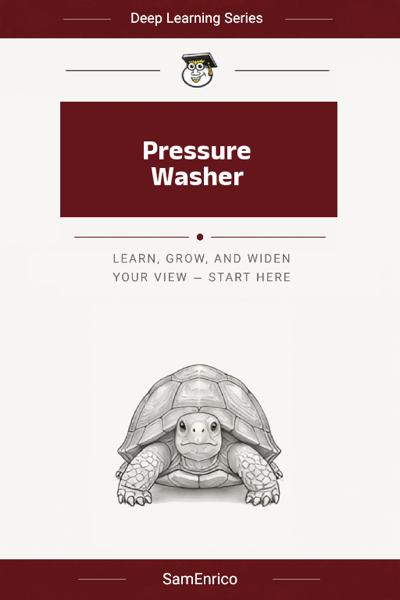
Pressure Washer eBook
A Coursebook on Pressure Washer
A Coursebook on Pressure Washer
Formats
Free sample
Chapter 1: The Water Bullet...--– You are about to point a weapon at someone’s home. You probably did not know that. Most people do not. They see a pressure washer as a cleaning tool—a step up from a garden hose with a spray nozzle. They think, “More pressure means cleaner surfaces.” They think, “If a little is good, a lot is better.” They are wrong.
And in the next ten minutes, you will learn why that misunderstanding has cost homeowners billions of dollars in damaged property and sent thousands of pressure washing operators to the emergency room with injuries that will never fully heal.This book is not a collection of tips and tricks. It is not a weekend warrior’s guide to washing your driveway once a year. It is a coursebook. By the time you finish the twelve chapters, you will understand the physics, chemistry, safety protocols, and business strategies that separate professional pressure washing operators from amateurs who cause damage. You will learn why some contractors charge five hundred dollars for a house wash while others charge ninety-nine dollars and still struggle to find work.
You will learn the difference between cleaning something and destroying it.But before any of that, you need to unlearn something. You need to let go of the most seductive, dangerous, and persistent myth in the entire industry.The Myth That Destroys Driveways The myth sounds like common sense. It sounds like progress. It sounds like this: Higher pressure cleans better.Manufacturers love this myth. They advertise their machines proudly: “4,000 PSI!
5,000 PSI!” The numbers get bigger every year. Consumers see a larger number and assume they are buying a better machine. They pay more money for more PSI, convinced that they are making a smart investment in cleaning power.They are being deceived.Here is the truth that the marketing departments do not want you to know: A pressure washer with 4,000 PSI and low water flow will clean slower and less effectively than a machine with 2,500 PSI and high water flow. Not a little slower—dramatically slower. We are talking about the difference between finishing a driveway in forty-five minutes versus three hours.
We are talking about the difference between rinsing away dirt in one pass versus scrubbing the same spot for thirty seconds while the high-pressure stream etches permanent lines into the concrete.The equation is simple, and it is not up for debate among engineers who design these machines. Cleaning power equals pressure multiplied by flow. In mathematical terms: Cleaning Units = PSI × GPM.GPM stands for gallons per minute. It is the amount of water moving through the machine. And it matters as much as pressure—often more.Let us run the numbers on two real machines.
Machine A is the kind sold at big box stores to homeowners. It advertises 3,000 PSI. Impressive, right? But it delivers only 2.0 GPM. Its cleaning units are 3,000 × 2.0 = 6,000.
Machine B is a professional-grade machine often sold through industrial suppliers. It advertises only 2,500 PSI—five hundred pounds less than Machine A. But it delivers 4.0 GPM—twice the water flow. Its cleaning units are 2,500 × 4.0 = 10,000.Machine B has sixty-seven percent more cleaning power than Machine A, despite having lower pressure. It will clean a driveway faster.
It will rinse away debris more completely. It will leave fewer streaks because the higher water volume carries the dislodged dirt away from the surface instead of just blasting it into the air.This is not an opinion. This is fluid dynamics. This is physics. And if you ignore it, you will waste hours of your life scrubbing surfaces that could have been cleaned in a fraction of the time.The Four Faces of Pressure Washing Not all pressure washing is the same.
In fact, the term “pressure washing” is so broad that it covers four distinct categories of work. Each category requires different equipment, different techniques, and different levels of training. Confusing them is the second most common mistake beginners make.Pressure Washing is what most people imagine when they think of this industry. It uses high pressure (typically 2,500 to 3,500 PSI for residential work) and moderate water flow (3.0 to 5.0 GPM). The cleaning action comes primarily from the physical force of water striking the surface and knocking dirt loose.
Pressure washing is the right choice for concrete driveways, sidewalks, parking lots, brick patios, and other hard, durable surfaces that can withstand impact. It is a terrible choice for anything delicate.Soft Washing sounds like a contradiction. How can you wash something with low pressure? The answer is chemistry. Soft washing uses low pressure (100 to 500 PSI for most surfaces, and only 50 to 100 PSI for roofs) combined with sodium hypochlorite—the same active ingredient in household bleach, but at carefully controlled concentrations.
The chemicals kill mold, algae, lichen, and bacteria at the root. The low pressure then rinses away the dead organic matter. Soft washing is the right choice for roofs, vinyl siding, stucco, wood, and any surface that would be damaged by high pressure. We will spend an entire chapter on soft washing later, because getting it wrong can kill landscaping, corrode gutters, and destroy roofs.Hydro-blasting is industrial pressure washing. It uses pressures from 10,000 to 40,000 PSI, often with specialized rotating nozzles.
Hydro-blasting removes rust from ship hulls, cleans concrete forms in construction, and strips paint from steel bridges. This is not residential work. If you are reading this book, you almost certainly do not need hydro-blasting equipment. But you need to know that it exists, because some of the safety principles carry over to lower-pressure work—especially the risk of injection injuries, which we will cover in Chapter 7.UHP-Jetting stands for ultra-high pressure jetting. These systems operate at pressures exceeding 55,000 PSI.
They do not clean surfaces; they cut them. UHP water jets cut through steel, concrete, and stone. This is a manufacturing and demolition tool, not a cleaning tool. Mentioning it here serves only one purpose: to show you the spectrum of water pressure technology. A residential pressure washer at 3,000 PSI sits at the very low end of that spectrum.
And yet, as you will learn in Chapter 7, even 3,000 PSI is enough to inject water through a leather boot and into your foot, carrying bacteria that will rot your flesh from the inside.The Substrate Strength Chart Every surface has a maximum pressure it can withstand before damage occurs. Exceed that pressure, and you are not cleaning—you are destroying. The destruction may be immediate and obvious, like a hole blown through rotting wood. Or it may be subtle and delayed, like microscopic cracks in concrete that widen over multiple freeze-thaw cycles until the entire driveway crumbles.Here are the safe maximum pressures for common surfaces. Memorize these numbers.
They will save you from lawsuits.Concrete can handle up to 3,000 PSI when it is in good condition. Older concrete, spalled concrete, or concrete with exposed aggregate should never see more than 2,000 PSI. The proper technique for concrete cleaning uses a 25-degree green nozzle held twelve to eighteen inches from the surface, working in steady passes rather than lingering on any spot.Brick and mortar are more delicate than concrete. The bricks themselves can handle about 2,000 PSI, but the mortar…
This is the end of the free sample. Get the eBook to keep going. Buy now
About this book
Details
- Author
- Schuster Silva
- Publisher
- SamEnrico
- Language
- English
- Genre
- Non-Fiction, Informative, Educational
- Released
- 2026-05-06
- Pages (approx.)
- 138
- Available as
- eBook, Audiobook

Read better in the ZLOADR app
Your eBooks on your phone or tablet. Sign in with your SamEnrico account and start reading.
More by Schuster Silva
 The HGH Dehydroepiandrosterone SynergySchuster Silva$11.99
 Parent Self Care JournalSchuster Silva$11.99
 Japanese Immigrant Business PioneersSchuster Silva$11.99
 AI Substitute Lesson PlannerSchuster Silva$11.99
 ABCDE for Job Search PrioritizationSchuster Silva$11.99
 The Jury That Couldn’t Decide: The Unprecedented Deliberation in the Assassination of Rafik HaririSchuster Silva$11.99
 Understanding Meckel Like SyndromeSchuster Silva$17.99
 How to Become a New-car Get-ready MechanicSchuster Silva$11.99
 USA Raise Non Union GuideSchuster Silva$12.99
 Time Blocking for Board Meeting PrepSchuster Silva$12.99
You may also like
 Hong Kong Handover 1997Dunn Johnnie$11.99
 Zumba For Postnatal Recovery CourseNeal Christian$11.99
 Zumba for BeginnersLadner Nikia$11.99
 YouTube Comment Mining GuideHumes Pandora$12.99
 Worry Box MeditationCarlin Rudy$11.99
 Workplace Stress MeditationNguyen Lynn$11.99
 Workplace Stress and Sleep RepairHawley Ivory$11.99
 Workplace Perfectionism CureDelaney Jeffry$11.99
 Workplace Injustice Anger GuideWallen Isabelle$11.99
 Work Addiction and Burnout LinkGreenwood Ester$11.99
 Women in Yoga and WellnessBeattie Galina$11.99
 Women in Stand Up ComedyChun Evangeline$11.99