
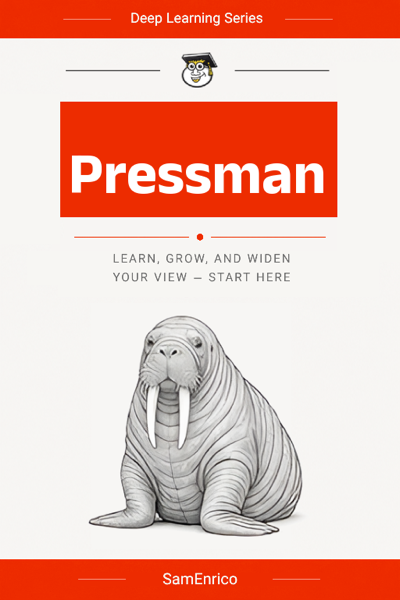
Non-FictionInformativeEducational
Pressman eBook
A Coursebook on Pressman
A Coursebook on Pressman
Formats
Free sample
Chapter 1: The Coded Catastrophe…–- The phone rang at 2:17 AM. On the other end was a vice president who had stopped using exclamation marks three hours ago and now spoke in the flat, exhausted monotone of someone watching their career implode in slow motion. “The platform is down,” she said. “Not slow. Not glitchy.
Down. And we have seventy-two thousand active users who cannot log in, cannot trade, and cannot withdraw their money. How long?”The lead developer, whose name was Marco and who had not slept in thirty-one hours, stared at the cascade of red error messages flooding his terminal. He had no answer. The monitoring dashboard looked like a Jackson Pollock painting made of failure.
Databases had desynchronized. Cache servers had choked on corrupted keys. The authentication service was throwing exceptions that should have been impossible. And somewhere, buried under six months of technical debt and “we’ll fix it later” shortcuts, was the actual root cause.He said the only honest thing he could say. “I don’t know.”The vice president hung up.
Seventy-two thousand users would eventually get their money back, after a week of manual reconciliation. The startup would survive, barely, after laying off a third of its staff. Marco would quit within a month, convinced he was a fraud. And every single person involved would swear, privately and publicly, that they had done everything right.They hadn’t. And that is why this book exists.This is not a book about syntax.
It is not a book about which programming language is faster, which framework is trendier, or which text editor has the best plugins. Those things matter, the way the quality of a carpenter’s hammer matters. But a master craftsman with a mediocre hammer still builds a house that stands. An amateur with the finest tools still builds a shed that collapses in the first storm.This book is about the difference between writing code that runs and engineering software that lasts. It is about the discipline that separates professional software developers from hobbyists who happen to get paid.
It is about seeing software not as a sequence of instructions but as a system—a living, breathing, often chaotic system that must be understood, controlled, and improved before it destroys the people who depend on it.And it starts with a fundamental question that most developers never ask, because they think the answer is obvious. The answer is not obvious. The answer will make you uncomfortable. Let us begin.The Two Faces of Software: Product and Vehicle What is software?Most programmers would answer with something like “instructions that tell a computer what to do.” That is accurate in the same way that saying “a car is metal that moves” is accurate. It misses the point entirely.Software is two things at once, and the failure to hold both truths in your head simultaneously is the single greatest source of disaster in this industry.First, software is a product.
It delivers computing capability. You open Microsoft Word, it lets you write a letter. You launch Spotify, it plays music. You use a calculator app, it adds numbers. In this sense, software is something you buy, install, or subscribe to.
It has features. It has versions. It has a user interface. This is the face of software that everyone understands, including your grandmother and the venture capitalist who just wrote a seven-figure check.Second, and far more dangerous, software is a vehicle. It delivers something else—something that may not even be software.Consider the engine control unit in your car.
It runs software. But you did not buy that software. You bought transportation. The software is the vehicle for the car’s ability to manage fuel injection, ignition timing, and emission controls. When that software fails, you do not get an error message.
You get a car that stalls on the highway.Consider the software in a pacemaker. You did not buy the code. You bought continued cardiac function. The software is the vehicle for keeping someone alive.Consider the trading platform that Marco was trying to save at 2:17 AM. The users did not download that platform because they enjoyed using it.
They used it because it was the vehicle for moving their money. When the software failed, they did not lose access to a nice interface. They lost access to their rent money, their savings, their ability to pay for medical care.This is the distinction that separates software engineering from programming. A programmer asks, “Does my code run?” A software engineer asks, “Does the system that my code enables—the product, the vehicle, the thing that people actually depend on—function correctly, reliably, and safely?”Pressman’s First Law emerges from this distinction: “Code without process is a science experiment. Code with process is a business.”A science experiment can fail.
In fact, most science experiments do fail, and that is fine. That is how science progresses. But a business cannot afford for its core systems to fail like experiments. An airplane cannot afford for its flight control software to fail like an experiment. A hospital’s patient management system cannot fail like an experiment.When you treat software as merely code—as merely instructions that run—you are conducting an experiment with other people’s livelihoods.
When you treat software as a product and a vehicle that must be engineered, you are taking responsibility.The Myth of the Lone Genius Programmer There is a romantic image that permeates our industry. It is the lone genius programmer, working late at night, fueled by pizza and caffeine, single-handedly building something amazing. This image appears in movies, in startup lore, in the origin stories of billion-dollar companies. It is almost completely false, and its persistence has done enormous damage.The truth is that software of any meaningful scale is built by teams. And teams are messy.
Teams have miscommunications. Teams have disagreements about priorities. Teams have people who join, people who leave, people who are brilliant but impossible to work with, and people who are average but make everyone around them better.The lone genius works alone. The lone genius does not need process, because the lone genius has everything in their head. But you are not a lone genius, and neither is anyone on your team.
Even the actual geniuses—the ones who really could build a system alone—do not. They work with others because they understand that software engineering is not a solo sport.This means that you need a way to coordinate the work of multiple people. You need a way to ensure that what you build today does not break what someone else built yesterday. You need a way to make decisions that are not just “what I feel like doing right now.” That way is called process .And process is not a dirty word, no matter what the Agile Industrial Complex has told you. Process is not bureaucracy.
Process is not filling out forms in triplicate. Process is not having a meeting about having a meeting. Process is simply the answer to the question: “How do we consistently produce good results, even when things go…
This is the end of the free sample. Get the eBook to keep going. Buy now
About this book
Details
- Author
- Matson Valery
- Publisher
- SamEnrico
- Language
- English
- Genre
- Non-Fiction, Informative, Educational
- Released
- 2026-05-08
- Pages (approx.)
- 157
- Available as
- eBook, Audiobook

Read better in the ZLOADR app
Your eBooks on your phone or tablet. Sign in with your SamEnrico account and start reading.
More by Matson Valery
 The Post Identification FeedbackMatson Valery$11.99
 Financial Recovery After DivorceMatson Valery$11.99
 Metta for Panic DisorderMatson Valery$11.99
 The Walking Meditation for AddictionMatson Valery$11.99
 Quechua Paqo Andean CosmovisionMatson Valery$11.99
 The Windward Kings: How the Dutch Built an Empire on the WavesMatson Valery$11.99
 Understanding Schmidt SyndromeMatson Valery$17.99
 Mentor Success Metrics TrackingMatson Valery$12.99
 Brazil Currency Conversion GuideMatson Valery$12.99
 How to Start a Petroleum Societies Without Refineries Business (Beginners Guide)Matson Valery$11.99
You may also like
 Hong Kong Handover 1997Dunn Johnnie$11.99
 Zumba For Postnatal Recovery CourseNeal Christian$11.99
 Zumba for BeginnersLadner Nikia$11.99
 YouTube Comment Mining GuideHumes Pandora$12.99
 Worry Box MeditationCarlin Rudy$11.99
 Workplace Stress MeditationNguyen Lynn$11.99
 Workplace Stress and Sleep RepairHawley Ivory$11.99
 Workplace Perfectionism CureDelaney Jeffry$11.99
 Workplace Injustice Anger GuideWallen Isabelle$11.99
 Work Addiction and Burnout LinkGreenwood Ester$11.99
 Women in Yoga and WellnessBeattie Galina$11.99
 Women in Stand Up ComedyChun Evangeline$11.99