
Non-FictionProfessional's Cheat Sheet / Embargo
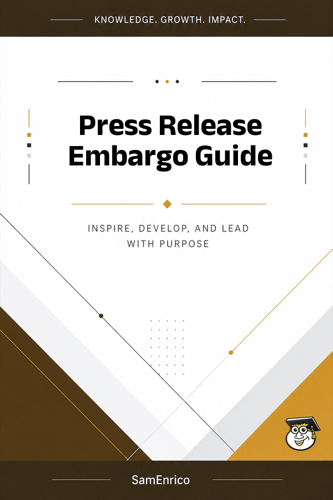
Press Release Embargo Guide eBook
undefined
undefined
Formats
Free sample
Chapter 1: The Gentleman’s Gun...--–- The paradox arrives in the form of a single red line at the top of a PDF. It is not a law. It is not a contract. There are no police officers standing by to enforce it. No judge has signed a warrant.
And yet, for seventy-two hours, that red line will hold back the full weight of the global media. It will silence bloggers who normally publish within seconds. It will make reporters wait, fidget, and reread the same document six times. It will turn a routine product announcement into a coordinated detonation. This is the embargo—the most powerful weapon in public relations, and the only one that works precisely because it has no teeth.The paradox of the embargo is that it is simultaneously one of the most fragile and one of the most formidable tools in the communicator's arsenal.
A single journalist with a shaky internet connection and a deadline can shatter it. A single editor who misreads a time zone can destroy years of planning. And yet, week after week, month after month, embargoes hold. They hold because they are not legal instruments. They hold because they are social contracts.
They hold because the people who break them are not sued—they are shamed, blacklisted, and, worst of all for a journalist, ignored.This chapter is the foundation upon which every tactic, every strategy, and every warning in this book is built. If you do not understand the nature of the embargo—its history, its psychology, its hidden architecture—then the tactical chapters that follow will be useless. You will be a technician wielding a tool you do not understand. And in public relations, a misunderstood tool is not a tool at all. It is a liability.The Birth of Silence: 1920s Science Desks The embargo was not invented in a boardroom.
It was invented in the cramped offices of science magazines in the 1920s, where editors faced an impossible problem. Researchers at universities and laboratories were making breakthroughs—in penicillin, in quantum mechanics, in the structure of the atom—but those breakthroughs were incomprehensible without explanation. A wire service reporter who received a press release at 9 AM and had a deadline at 11 AM could not possibly understand the implications of a new cancer treatment. The result was a cascade of errors: headlines that overstated findings, articles that confused correlation with causation, and, in the worst cases, public panic.The solution emerged from a simple negotiation. A science journalist named David Dietz, who would later win a Pulitzer Prize, proposed a deal to the American Association for the Advancement of Science.
Give him and a handful of other reporters the research papers three days before the public announcement. In exchange, they would not publish a single word until the embargo lifted. The researchers would get accurate coverage. The journalists would get time to think. The public would get stories that did not cause heart attacks.The deal worked so well that it became standard practice within a decade.
By the 1930s, the embargo was the default mechanism for any story that required analysis rather than mere transcription. The New York Times had an embargo desk. The Associated Press had embargo editors. The system ran on nothing more than handshake agreements and the mutual understanding that a broken embargo meant permanent expulsion from the club.This is the first principle of the embargo, and it is the one that most modern practitioners forget: the embargo is not a restriction of time. It is a gift of time.
You are not telling journalists they cannot publish. You are telling them they do not have to rush. The difference between those two framings is the difference between a partnership and a prison.The Harry Potter Rule: Physical Embargoes and the Midnight Laydown The most famous embargo in modern history was not a PDF. It was a truck. In 2007, Scholastic and Bloomsbury Publishing faced a problem that no amount of red text could solve.
The seventh and final Harry Potter book, Harry Potter and the Deathly Hallows, was the most anticipated publication of the decade. Fans had pre-ordered millions of copies. Spoilers would leak the moment the first book was sold. And yet, the publisher needed to distribute twelve million copies to bookstores across North America without a single page being read before midnight on July 21.The solution was the physical embargo, known in the industry as a "laydown." Armed guards accompanied every truck. Warehouses were sealed with tamper-evident locks.
Bookstore employees who opened boxes early faced termination and lawsuits. The laydown was not a request. It was a fortress. And it worked. At midnight on July 21, bookstores across the continent opened their doors simultaneously, and the global media coverage was not a trickle but a flood.
Every major outlet had prepared their reviews in advance, sitting on embargoed copies for weeks. The result was the largest coordinated media event in publishing history.The Harry Potter Rule teaches a lesson that extends far beyond books: physical embargoes are for physical products. If you are launching a car, a phone, or a vaccine, you can—and should—use physical security to enforce your timeline. But most embargoes are not physical. Most embargoes are digital.
And digital embargoes cannot be enforced with armed guards. They can only be enforced with trust.This distinction is critical, and it will reappear throughout this book. The reader who confuses a physical laydown with a digital embargo is the reader who will be disappointed when a blogger in their bedroom breaks their "strictly embargoed" PDF at 11:47 PM. The two mechanisms are cousins, not twins. They share a name but not a nature.The Jurisdictions of Enforcement: Honor, NDA, and Physical Because the embargo exists in three distinct forms, this book will refer to them throughout as the three Jurisdictions of Enforcement.
Understanding which jurisdiction you are operating in is the first question you must answer before sending a single email.The first jurisdiction is the Honor-Based Embargo. This is the original form, born in the 1920s science desks. It has no legal backing. It relies entirely on the journalist's professional ethics and their desire to maintain access to future embargoes. Honor-based embargoes are appropriate for trade publications, bloggers, and routine announcements where the cost of a leak is inconvenience rather than catastrophe.
The enforcement mechanism for a broken honor-based embargo is not a lawsuit. It is blacklisting. You remove the offending journalist from your list. You tell your peers. You move on.The second jurisdiction is the NDA-Based Embargo.
This is the modern form, increasingly common for high-stakes announcements involving publicly traded companies, mergers, or sensitive data. The journalist signs a legally binding non-disclosure agreement before receiving the embargoed materials. If they break the embargo, they can be sued. NDA-based embargoes are appropriate for major outlets, financial reporters, and any story where the cost of a leak is measured in millions of dollars. The enforcement mechanism is legal action, but as any lawyer will tell you, the threat of a lawsuit is often more powerful than the lawsuit itself.The third jurisdiction is the Physical Laydown.
This is the rare form, reserved for physical products that can be secured with infrastructure. Armed guards, tamper-evident seals, and…
This is the end of the free sample. Get the eBook to keep going. Buy now
About this book
Details
- Author
- Saldana Zoraida
- Publisher
- SamEnrico
- Language
- English
- Genre
- Non-Fiction, Professional's Cheat Sheet / Embargo
- Released
- 2026-06-11
- Pages (approx.)
- 131
- Available as
- eBook, Audiobook

Read better in the ZLOADR app
Your eBooks on your phone or tablet. Sign in with your SamEnrico account and start reading.
More by Saldana Zoraida
 Self Hypnosis For Pregame NervesSaldana Zoraida$11.99
 Networking for Introverts WorkbookSaldana Zoraida$11.99
 Anapanasati for BeginnersSaldana Zoraida$11.99
 Drug Dependency and Employment ReentrySaldana Zoraida$11.99
 Financial Stress at WorkSaldana Zoraida$11.99Financial Stress at WorkSaldana Zoraida$11.99
 Manifest vs Latent DreamsSaldana Zoraida$11.99
 Czechoslovak Velvet DivorceSaldana Zoraida$11.99
 Driving Anxiety MeditationSaldana Zoraida$11.99
 The Last Stand: Trump’s Impeachment Trials and the Battle for DemocracySaldana Zoraida$11.99
 Frostborn and the Hollow MountainSaldana Zoraida$11.99
 Beneath the Blue and White: The Unsung Anthems of the 1995 Women's World CupSaldana Zoraida$11.99
You may also like
 Hong Kong Handover 1997Dunn Johnnie$11.99
 Zumba For Postnatal Recovery CourseNeal Christian$11.99
 Zumba for BeginnersLadner Nikia$11.99
 YouTube Comment Mining GuideHumes Pandora$12.99
 Worry Box MeditationCarlin Rudy$11.99
 Workplace Stress MeditationNguyen Lynn$11.99
 Workplace Stress and Sleep RepairHawley Ivory$11.99
 Workplace Perfectionism CureDelaney Jeffry$11.99
 Workplace Injustice Anger GuideWallen Isabelle$11.99
 Work Addiction and Burnout LinkGreenwood Ester$11.99
 Women in Yoga and WellnessBeattie Galina$11.99
 Women in Stand Up ComedyChun Evangeline$11.99