
Non-FictionProfessional's Cheat Sheet / Best Practices
Press Release Best Practices eBook
undefined
undefined
Formats
Free sample
Chapter 1: The Inbox Graveyard--–- The email arrived at 7:42 AM. By 7:43 AM, it was dead. Not because it was caught in a spam filter or sent to the wrong address. It died because the journalist who opened it made a decision in less time than it takes to tie a shoelace. Delete.
Move on. The press release—crafted with care, debated over for hours, approved by three people—never had a chance.This chapter confronts the painful reality that most press releases are deleted within seconds of arrival. It pulls back the curtain on the modern journalist's inbox, which is less a workspace and more a war zone. It introduces the foundational distinction between a press release and a media pitch—a confusion that kills more stories than bad writing ever will. It presents The Oprah Test, a mental framework that separates those who sound like salespeople from those who sound like news sources.
It reveals the mechanics of "lift and stick" journalism, where a release becomes the published article verbatim. And it equips you with The Reader Test, a simple, brutal method for determining whether your release deserves to live or die before you ever hit send.By the end of this chapter, you will understand exactly why your previous releases failed and, more importantly, what to do about it.The Five Seconds That Decide Everything Let us begin with a number: five. According to a comprehensive survey conducted by the journalism trade publication Muck Rack, the average journalist spends between five and ten seconds deciding whether to open, skim, or delete a press release. Five seconds. That is less time than it takes to read this sentence out loud.Consider what happens inside that five-second window.
A reporter named Sarah—we will call her Sarah, though she could be any journalist at any outlet from a local weekly to a national wire service—opens her email client at 8:00 AM. Her inbox already contains 147 unread messages. By 8:30 AM, before her first cup of coffee is finished, she will receive another forty emails. Buried somewhere in that avalanche is your press release.Sarah does not hate you. She does not hate press releases in principle.
She simply has no time. Her editor has assigned her three stories due by noon. She has a phone interview scheduled in twenty minutes. And she is staring at a screen filled with subject lines, each one screaming for attention.Here is what Sarah sees in those first five seconds: the "From" name, the subject line, and the first few words of the preview text. That is it.
Not your carefully crafted third paragraph. Not the impressive statistic you buried on page two. Not the high-resolution image you attached. Just three data points. If any of them trigger her internal "spam" or "advertisement" or "irrelevant" alarm, your release is deleted without ever being opened.This is not cruelty.
This is triage. Sarah is not a gatekeeper trying to keep you out. She is a professional trying to survive her inbox. Your job is not to demand her attention. Your job is to earn it.The Catastrophic Confusion: Press Release vs.
Media Pitch Before we go any further, we must untangle a knot that strangles most beginners. The knot is the confusion between two completely different tools: the press release and the media pitch. People use these terms interchangeably, but they are not interchangeable. They serve different purposes, take different forms, and arrive at different times.The press release is a factual, self-contained document written in journalistic style. It answers the five W's—Who, What, When, Where, Why—and sometimes the H (How).
It is designed to be published verbatim, meaning a journalist can copy it, paste it into their content management system, and run it as a news story with minimal or no editing. A press release does not ask for coverage; it is the coverage, ready to go.The media pitch is a personalized, persuasive email sent to a specific reporter. It does not attempt to be publishable. Instead, it makes a case for why the reporter should cover your story. It is short, conversational, and tailored to that journalist's beat and recent work.
A pitch invites a conversation; a release delivers the finished product.Here is where the confusion becomes catastrophic. Beginners often try to combine these two tools into one. They write a press release and then send it as if it were a pitch, attaching the release to a generic email that says, "See attached." This fails for two reasons. First, the journalist now has to do extra work—opening an attachment, scrolling through a formatted document—just to understand what you are offering. Second, a press release is not persuasive; it is declarative.
It announces. It does not ask. So when you send a release as a pitch, you are not inviting coverage. You are demanding it. And journalists do not respond well to demands.The correct sequence is this: first, you send a personalized pitch to gauge interest.
If the journalist responds, you then send the press release as a supporting document, either attached or linked. The pitch is the question; the release is the answer. Confusing the two—sending a generic release as a pitch—is the fastest way to get ignored.The Oprah Test: Why You Cannot Pitch a Product Now we arrive at the most important mental framework in this chapter: The Oprah Test. Named after Oprah Winfrey's legendary talk show, which ran for twenty-five seasons and featured thousands of guests, this test asks a single question: "Would Oprah have you on to talk about your book or your product?"The answer, almost always, is no.Let us examine why. Oprah Winfrey did not fill her studio audience with people who wanted to hear a sales pitch.
She filled it with people who wanted to be moved, informed, entertained, or inspired. When Oprah had a guest on her show, the guest did not talk about their book. They talked about the issue the book addressed. They did not talk about their product. They talked about the problem the product solved.Consider the difference.
A cookbook author cannot go on television and say, "Buy my cookbook, which has 120 recipes and is available at all major retailers." That is a commercial. It will be ignored. But that same author can go on television and talk about "the hidden epidemic of busy families who have lost the family dinner" or "five ingredients that can transform weeknight cooking" or "the shocking amount of sugar hidden in so-called healthy meals." Those are issues. Those are conversations. Those are newsworthy.The Oprah Test applies to every outlet, not just talk shows.
The New York Times does not cover your business book; it covers the trend of entrepreneurs retiring broke. The Today Show does not cover your parenting memoir; it covers the crisis of parental burnout. The Wall Street Journal does not cover your software launch; it covers the $47 billion mistake that 90% of small businesses make.Here is the test in practice. Take whatever you want to promote—a book, a product, a service, an event—and ask yourself: "What is the larger issue…
This is the end of the free sample. Get the eBook to keep going. Buy now
About this book
Details
- Author
- Shepherd Rosaline
- Publisher
- SamEnrico
- Language
- English
- Genre
- Non-Fiction, Professional's Cheat Sheet / Best Practices
- Released
- 2026-06-10
- Pages (approx.)
- 135
- Available as
- eBook, Audiobook

Read better in the ZLOADR app
Your eBooks on your phone or tablet. Sign in with your SamEnrico account and start reading.
More by Shepherd Rosaline
 Opioid Dependency Chronic Pain LinkShepherd Rosaline$11.99
 Baseball Hitting Hypnosis GuideShepherd Rosaline$11.99
 The Minimum Wage Mental HealthShepherd Rosaline$11.99
 Networking for Women in BusinessShepherd Rosaline$11.99
 Chest Wall Pain MeditationShepherd Rosaline$11.99
 Object Work Improv GuideShepherd Rosaline$11.99
 Social Anxiety Meditation PrepShepherd Rosaline$11.99
 Nigerian Family ReunificationShepherd Rosaline$11.99
 The Rail Baron’s Empire: Cornelius Vanderbilt and the Birth of Modern CapitalismShepherd Rosaline$11.99
 The Medici Sky: How Florence's Patrons Built the RenaissanceShepherd Rosaline$11.99
 Unplugged: The Rise and Fall of VineShepherd Rosaline$11.99
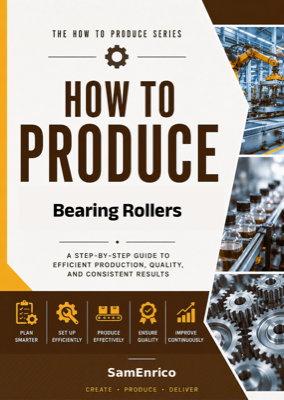 How to Produce Bearing RollersShepherd Rosaline$11.99
You may also like
 Hong Kong Handover 1997Dunn Johnnie$11.99
 Zumba For Postnatal Recovery CourseNeal Christian$11.99
 Zumba for BeginnersLadner Nikia$11.99
 YouTube Comment Mining GuideHumes Pandora$12.99
 Worry Box MeditationCarlin Rudy$11.99
 Workplace Stress MeditationNguyen Lynn$11.99
 Workplace Stress and Sleep RepairHawley Ivory$11.99
 Workplace Perfectionism CureDelaney Jeffry$11.99
 Workplace Injustice Anger GuideWallen Isabelle$11.99
 Work Addiction and Burnout LinkGreenwood Ester$11.99
 Women in Yoga and WellnessBeattie Galina$11.99
 Women in Stand Up ComedyChun Evangeline$11.99