
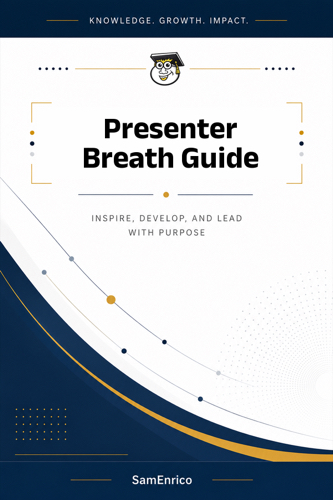
Non-FictionSelf-HelpPublic Speaking
Presenter Breath Guide eBook
Calm nerves before speaking publicly.
Calm nerves before speaking publicly.
Formats
Free sample
Chapter 1: The 75% Reality...--–- The first time your voice cracks in front of forty people, time does not slow down. It stops. You feel the heat rise from your collar, your palms slick against the lectern, and somewhere in the back of your mind, a voice whispers: Everyone can see you falling apart. That voice is lying about the falling apart, but it is telling the truth about one thing: everyone can see something. What they see is not weakness.
What they see is a normal human nervous system doing exactly what evolution designed it to do. The problem is not that you are broken. The problem is that you have been told, your entire life, that the hammering in your chest means you are about to fail.The Statistic That Should Free You Let us begin with a number that will either terrify you or liberate you: seventy-five percent. According to the National Institute of Mental Health and decades of survey data from Chapman University and the Anxiety and Depression Association of America, approximately seventy-five percent of the general population ranks public speaking as their number-one fear. Not death.
Not spiders. Not financial ruin. Speaking. In the famous 1973 "Book of Lists" survey, public speaking topped the list of human fears, with death coming in at number six. Jerry Seinfeld turned this into a joke: the average person at a funeral would rather be in the casket than giving the eulogy.
But beneath the humor lies a serious physiological truth.If you are reading this book because your heart races before a presentation, you are not a rare case. You are not uniquely anxious. You are not somehow less capable than the person who walks on stage without a tremor. You are, in fact, in the overwhelming majority of the human species. The person who appears perfectly calm has almost certainly trained their nervous system—or they are hiding their symptoms exceptionally well.
The distinction between you and a "natural speaker" is not the absence of fear. It is the presence of a different relationship to that fear.This chapter has one job: to convince you, irrevocably, that your pre-speech anxiety is not a personality flaw but a physiological event. And once you understand it as an event rather than an identity, you can begin to intervene. The tool for that intervention is already inside you, moving through your nose and mouth as you read these words. Your breath is the only voluntary entry point into your autonomic nervous system.
Before we teach you how to use it, we have to teach you why you need to.The Evolutionary Mismatch To understand why your hands shake before a presentation, you have to travel back approximately two hundred thousand years. Imagine your ancestor on the savanna. She hears a rustle in the grass. Her brain does not pause to consider whether the sound might be a gentle wind or a curious bird. It activates the sympathetic nervous system—the fight-or-flight response—immediately.
Her heart rate jumps from seventy to one hundred and twenty beats per minute in seconds. Blood shunts away from her digestive system and towards her large muscle groups. Her pupils dilate to take in more visual information. Her prefrontal cortex, the part of the brain responsible for complex planning and nuanced thinking, partially downregulates to allow faster reaction times. She does not think, Should I run or fight?
Her body decides for her, and it decides in a fraction of a second.This system saved her life. It saves our lives today when a car swerves into our lane or a dog charges unexpectedly. The problem is that your nervous system cannot tell the difference between a predator in the grass and a boardroom full of colleagues. It cannot distinguish between a rustling snake and a silent audience waiting for your quarterly report. The same cascade of hormones—adrenaline, noradrenaline, and cortisol—releases whether you are running from a lion or walking toward a microphone.
Your body does not know that you are not going to be eaten. It only knows that you have stopped moving, that multiple faces are oriented toward you, and that somewhere in your memory, a previous embarrassing moment has been tagged as "dangerous."This is the evolutionary mismatch. Your ancient survival hardware is trying to protect you from a threat that does not exist. But try telling that to your racing heart. Try explaining evolutionary biology to your sweaty palms at the moment the presenter says your name.
The mismatch is real, but it is not a sentence. It is simply a starting point.The Feedback Loop You Did Not Know You Were Running Here is where most people get stuck. They feel their heart racing, and they think, I need to calm down. Then they think, Why can’t I calm down? Then they think, Everyone can see that I can’t calm down.
Then their heart races faster. This is not a failure of willpower. It is a feedback loop, and it is driven entirely by your breath.Let me explain with a simple experiment you can try right now. Sit up straight. Then take three very short, shallow breaths—just lifting your shoulders and pulling air into the top of your chest.
Inhale for one second, exhale for one second. Do this three times. Notice what happens. Most people will feel a slight increase in alertness, a subtle quickening of their pulse, and perhaps a sense of mild unease. That is not imagination.
That is your sympathetic nervous system responding to the mechanical signal of shallow breathing. Your brain interprets short, rapid inhales as a sign that something is wrong. It does not know that you are just experimenting. It only knows the pattern.Now reverse it. Take one long, slow breath.
Inhale through your nose for four seconds. Exhale through your mouth for six seconds. Let your belly expand on the inhale. Let it fall on the exhale. Do this three times.
Most people will feel a noticeable drop in tension. Their shoulders may lower. Their jaw may unclench. That is your parasympathetic nervous system—the rest-and-digest branch—responding to the signal of a slow, extended exhale.Here is the cruel irony of public speaking anxiety: when you become nervous, you automatically begin breathing faster and more shallowly. That faster, shallower breathing signals your brain that danger is present.
Your brain releases more stress hormones. Those hormones make your breathing even faster and shallower. This is the feedback loop, and it can run in seconds. You do not decide to start it. Your body decides for you, based on ancient programming and learned experience.
But here is the liberating truth: you can decide to interrupt it. Not by thinking, Calm down. Thinking is too slow, and the thinking brain is partly offline during sympathetic activation. You interrupt it by changing the mechanical pattern of your breath. Your nervous system will follow the breath whether it likes it or not.The Cost of Avoidance Before we go further, we have to name something uncomfortable.
Most people who fear public speaking do not just fear the moment of speaking. They fear the anticipation. They lose…
This is the end of the free sample. Get the eBook to keep going. Buy now
About this book
Details
- Author
- Reaves Vanita
- Publisher
- SamEnrico
- Language
- English
- Genre
- Non-Fiction, Self-Help, Public Speaking
- Released
- 2026-06-06
- Pages (approx.)
- 131
- Available as
- eBook, Audiobook

Read better in the ZLOADR app
Your eBooks on your phone or tablet. Sign in with your SamEnrico account and start reading.
More by Reaves Vanita
 Flow Recovery After BreaksReaves Vanita$11.99
 Metta for Performance AnxietyReaves Vanita$11.99
 Kingston Customer Service BPOReaves Vanita$11.99
 The Iron Discipline: von Moltke and the Birth of Modern WarfareReaves Vanita$11.99
 Religious Accommodation Legal TrapsReaves Vanita$12.99
 Growth Marketing CoordinatorReaves Vanita$11.99
 How to Produce CactusReaves Vanita$11.99
 How to Start a Production of Ice for Food Business (Beginners Guide)Reaves Vanita$11.99
You may also like
 Hong Kong Handover 1997Dunn Johnnie$11.99
 Zumba For Postnatal Recovery CourseNeal Christian$11.99
 Zumba for BeginnersLadner Nikia$11.99
 YouTube Comment Mining GuideHumes Pandora$12.99
 Worry Box MeditationCarlin Rudy$11.99
 Workplace Stress MeditationNguyen Lynn$11.99
 Workplace Stress and Sleep RepairHawley Ivory$11.99
 Workplace Perfectionism CureDelaney Jeffry$11.99
 Workplace Injustice Anger GuideWallen Isabelle$11.99
 Work Addiction and Burnout LinkGreenwood Ester$11.99
 Women in Yoga and WellnessBeattie Galina$11.99
 Women in Stand Up ComedyChun Evangeline$11.99