
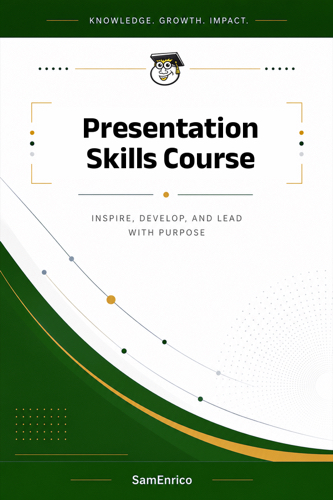
Presentation Skills Course eBook
A complete curriculum for designing and delivering
by Mcgill Sena
A complete curriculum for designing and delivering impactful presentations.
Formats
Free sample
Chapter 1: The Lie We Believe--–- The CEO of a billion-dollar company once told me, “I’d rather have surgery without anesthesia than give the keynote at our annual meeting.” She was not exaggerating. Her assistant had already collected three doctor’s notes from previous years excusing her from speaking. She had hired speech coaches, tried beta-blockers, and even considered hypnotherapy. Nothing worked. Not because the techniques failed, but because she was trying to solve the wrong problem.
She thought her issue was a lack of skill. In reality, her issue was a misunderstanding of fear.This chapter dismantles the most damaging myth in all of presentation training: the belief that some people are “natural presenters” and that you are not. That myth is the lie we believe. It keeps otherwise brilliant professionals silent, stuck, and suffering in meetings where they have something valuable to contribute but cannot force the words out. The truth, backed by neuroscience, sports psychology, and decades of research into high-performance anxiety, is far more liberating.
The difference between a nervous presenter and a confident one is not talent. It is not charisma. It is not a magical gene possessed by TED speakers and late-night hosts. The difference is understanding what fear actually is—and what it is not.We have been taught to treat presentation fear as a weakness. A flaw.
A personality defect that needs to be eradicated. This chapter will argue the opposite: your fear is a sign that you care, that you have something at stake, and that your body is preparing you for something important. The goal is not to eliminate fear. The goal is to rewire your relationship with it. By the end of this chapter, you will understand exactly what happens inside your body when you stand in front of a room, why it happens, and how to use that biological response as fuel rather than fighting against it.
You will also learn two specific, science-backed techniques that you can use before your very next presentation—techniques that take less than two minutes and have been proven to shift your physiology from panic to performance.The lie that some people are natural presenters has a second, more insidious effect. It makes us believe that preparation is unnecessary. If confidence is a gift you either have or you don’t, why bother rehearsing? Why bother learning structure? This is why so many professionals spend hours perfecting their slides and zero minutes practicing their delivery.
They are trying to outsmart their fear with data, hoping that if the slides are dense enough, no one will notice their hands shaking. But the audience always notices. And the problem is not the slides. The problem is that the presenter has never been taught what fear actually is.Let us start with the biology. Then we will move to the mindset shift.
Then we will give you the tools. This chapter is the foundation for everything that follows. If you master what is here—if you truly internalize that your fear is not your enemy—the remaining eleven chapters become infinitely easier. You will learn structure, storytelling, slide design, voice control, body language, and Q&A mastery. But none of those skills will matter if you cannot walk into the room in the first place.
This chapter is about getting you into the room. The rest of the book is about what you do once you get there.The Physiology of Stage Fright: Why Your Body Betrays You–- Imagine you are walking through a savanna ten thousand years ago. You are a hunter-gatherer, and you are alone. Suddenly, you see a group of two hundred faces staring at you. Every single one of them is silent.
Every single one of them is watching your every move. Their eyes track your hands. Their heads tilt as they listen to the sounds coming out of your mouth. In that ancestral environment, two hundred silent, staring faces meant one thing: you were about to be attacked, exiled, or eaten. Your survival depended on an immediate, automatic, full-body response.That response is called the acute stress response.
You know it as fight-or-flight. And here is the critical insight that changes everything: your body cannot tell the difference between two hundred angry predators and two hundred bored colleagues in a conference room. Physiologically, the threat is identical. Your amygdala—a small, almond-shaped cluster of neurons deep in your brain—processes threats in milliseconds, long before your conscious mind can intervene. It scans for danger constantly, and when it detects a potential threat, it sounds the alarm.
That alarm triggers your hypothalamus, which activates your sympathetic nervous system. Within seconds, your body is flooded with hormones designed to help you survive a physical attack.Two of these hormones matter most for presenters: cortisol and adrenaline. They are not the same thing, and understanding the difference is the first step toward mastering your fear.Adrenaline is your accelerator. It increases your heart rate, elevates your blood pressure, and boosts your energy supplies. It dilates your airways so more oxygen reaches your muscles.
It sharpens your vision and redirects blood flow away from non-essential systems (like digestion) and toward your large muscle groups. Adrenaline is why your hands shake before a presentation. It is why your voice trembles. It is why you feel that electric buzz running through your body. Adrenaline is not the enemy.
Adrenaline is rocket fuel. Every elite athlete, every world-class musician, every combat veteran will tell you the same thing: adrenaline sharpens performance if you know how to use it.Cortisol is different. Cortisol is your brake, but not in the way you think. Chronic cortisol elevation—the kind caused by prolonged stress over weeks or months—is destructive. It impairs cognitive function, suppresses the immune system, and damages memory retrieval.
But acute cortisol spikes, the kind that happen right before a presentation, serve a specific purpose. Cortisol helps your body maintain homeostasis under stress. It modulates the fight-or-flight response so you do not spin out of control. The problem is that most presenters experience a cortisol surge that overwhelms their adrenaline, leading to freezing, blanking out, or physically fleeing the situation.The ratio between adrenaline and cortisol determines whether you feel excited or terrified. Elite performers have learned to keep cortisol in check while allowing adrenaline to flow.
Nervous presenters have the opposite ratio: cortisol dominates, and adrenaline becomes just another source of anxiety.Here is the good news. Cortisol is not destiny. You can lower it. You can change that ratio. And you can do it in less than two minutes using techniques that have been validated by peer-reviewed research.
Before we get to those techniques, we need to address the second piece of the puzzle: the difference between how you think about yourself and how you actually perform.The Performance Mindset vs. The Gift Mindset–- Over the past decade, researchers have studied thousands of people who experience high-stakes performance anxiety. They have looked at musicians, athletes, surgeons, and public speakers. The pattern that emerges is remarkably consistent. People who struggle with stage fright are almost always operating from what we call a Performance Mindset.…
This is the end of the free sample. Get the eBook to keep going. Buy now
About this book
Details
- Author
- Mcgill Sena
- Publisher
- SamEnrico
- Language
- English
- Genre
- Non-Fiction, Self-Help / Career
- Released
- 2026-06-06
- Pages (approx.)
- 150
- Available as
- eBook, Audiobook

Read better in the ZLOADR app
Your eBooks on your phone or tablet. Sign in with your SamEnrico account and start reading.
More by Mcgill Sena
 Mnemonic Name Recall GuideMcgill Sena$11.99
 Etsy Vintage Hoarding HelpMcgill Sena$11.99
 Dance Partner Nonverbal LeadMcgill Sena$11.99
 Body Scan for Trauma RecoveryMcgill Sena$11.99
 Podcast Deep DiveMcgill Sena$11.99
 Homicide Prosecution GuideMcgill Sena$11.99
 Sleep As AndroidMcgill Sena$11.99
 The Forgotten Titan: Wavell Wakefield and the Birth of Modern RugbyMcgill Sena$11.99
 The Lost Excalibur: A Knight’s Quest Through TimeMcgill Sena$11.99
 A Collector's Handbook to the Simca 1300Mcgill Sena$11.99
 How to Produce Advertising BoardsMcgill Sena$11.99
 US LLC Formation Cost BreakdownMcgill Sena$12.99
You may also like
 Hong Kong Handover 1997Dunn Johnnie$11.99
 Zumba For Postnatal Recovery CourseNeal Christian$11.99
 Zumba for BeginnersLadner Nikia$11.99
 YouTube Comment Mining GuideHumes Pandora$12.99
 Worry Box MeditationCarlin Rudy$11.99
 Workplace Stress MeditationNguyen Lynn$11.99
 Workplace Stress and Sleep RepairHawley Ivory$11.99
 Workplace Perfectionism CureDelaney Jeffry$11.99
 Workplace Injustice Anger GuideWallen Isabelle$11.99
 Work Addiction and Burnout LinkGreenwood Ester$11.99
 Women in Yoga and WellnessBeattie Galina$11.99
 Women in Stand Up ComedyChun Evangeline$11.99