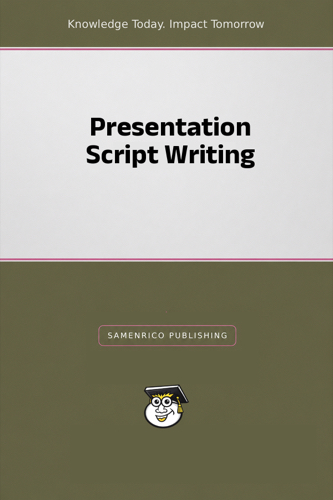
Presentation Script Writing Audiobook
Teaches how to write natural sounding presentation
Teaches how to write natural sounding presentation scripts that don't sound read.
Formats
Free sample
Chapter 1: The Bar Test--–- Let me tell you about the worst presentation I ever gave. I was twenty-four, standing in a windowless conference room in Chicago, reading from a script I had polished for eleven hours. The script was beautiful. Every sentence was grammatically perfect. I had removed every “um,” every contraction, every trace of my actual personality.
I sounded like a corporate FAQ page reading itself aloud. Halfway through, I looked up and saw a senior vice president—a woman whose approval I desperately needed—quietly checking her email under the table. Not sneakily. Just openly, because she had already decided I had nothing worth hearing. That was the day I learned a brutal truth: you can have the best content in the world, but if it sounds like you’re reading, no one will listen.The problem was not my material.
The problem was my relationship to the page. I had written for the eye, not the ear. And in that conference room, I became another casualty of what I now call the Cue Card Crisis—the epidemic of smart people writing scripts that sound like essays, then wondering why audiences tune out.This chapter introduces the single most important mindset shift in this entire book. Before you learn a single technique about structure, storytelling, or formatting, you must understand one thing: a presentation script is not a document. It is a set of instructions for a human voice.
And writing for a human voice requires a completely different set of rules than writing for a printed page.The Distinction That Changes Everything Most people write presentations the same way they wrote college papers. They open a document. They type complete sentences. They organize those sentences into paragraphs. They proofread for grammar.
And then they stand in front of an audience and wonder why every word sounds stiff, formal, and painfully scripted.The problem is not effort. The problem is the medium.Written language is permanent. It sits on a page, and the reader can go back, re-read, pause, and reflect. Written sentences can be long and complex because the reader controls the pace. Spoken language is temporary.
It disappears the moment it leaves your mouth. The listener cannot rewind. They cannot squint at a confusing clause. They get one chance to understand, and then the sentence is gone.This means that a sentence that looks beautiful on…
This is the end of the free sample. Get the Audiobook to keep going. Buy now
About this book
Details
- Author
- Bounds Junita
- Publisher
- SamEnrico
- Language
- English
- Genre
- Non-Fiction, Self-Help, Script Writing
- Released
- 2026-06-11
- Pages (approx.)
- 118
- Available as
- eBook, Audiobook

Listen in the VoxFlicks app
Audiobooks and audio dramas wherever you go. Sign in with your SamEnrico account and press play.
More by Bounds Junita
 Remote Team Offsite CommunicationBounds Junita$11.99
 Dopamine Detox ChallengeBounds Junita$11.99
 Intercreditor AgreementsBounds Junita$11.99
 Whispers in the Dark: The Secret Songs of the Underground RailroadBounds Junita$11.99
 How to Produce CementBounds Junita$11.99
 How to Start a Locker Business (Beginners Guide)Bounds Junita$11.99
 Transportation Climate Route InsuranceBounds Junita$12.99
 Pcb RemediationBounds Junita$11.99