
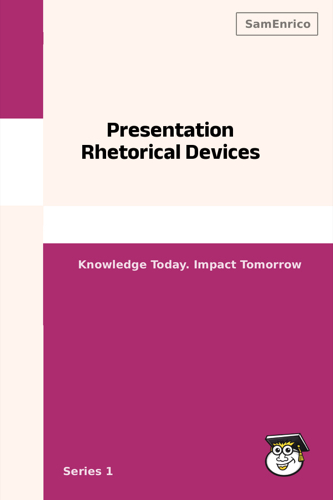
Non-FictionSelf-HelpClassical Rhetoric
Presentation Rhetorical Devices eBook
Teaches classical rhetoric techniques like anaphor
by Kopp Kasi
Teaches classical rhetoric techniques like anaphora, tricolon, and chiasmus.
Formats
Free sample
Chapter 1: The Unspoken Agreement--–- Every presentation is a promise. You stand at the front of the room, or you appear on a screen, or you pull up a chair across from a single decision-maker, and without saying a word, you enter into an agreement with every person who is listening. The agreement is simple but fragile: I will give you my attention. In return, you will give me something worth my time. That is the unspoken agreement.
And most presenters break it within the first ninety seconds.They break it by opening with an agenda slide. “First, I will review last quarter’s performance. Second, I will present our new strategy. Third, I will outline next steps.” This is logical. It is clear.
It is also a breach of contract. The audience did not show up to hear your outline. They showed up to have their time respected, their questions answered, their fears addressed, or their hopes validated. An agenda slide serves you, not them. It says, “Here is what I am going to do to you,” not “Here is what we are going to build together.”They break it by opening with a joke.
A safe joke, a corporate joke, a joke about traffic or weather or the universal misery of meetings. The audience smiles weakly, not because they are amused but because they are being polite. That smile costs them energy. You have started your presentation by asking them to perform emotional labor for you. That is not a gift.
That is a tax.They break it by opening with an apology. “I am sorry I am getting over a cold.” “I apologize that this deck is longer than I hoped.” “Forgive me, I am not a designer.” Every apology is an arrow shot into your own credibility. The audience did not know you had a cold until you told them. Now they are imagining you sneezing on them. The audience did not notice the deck was long until you pointed it out.
Now they are calculating how much of their afternoon you plan to steal.The unspoken agreement is broken before the first real sentence is spoken. And once it is broken, it is almost impossible to repair. The audience’s attention becomes a loan they are reluctant to extend. Their goodwill becomes a resource they hoard. Their memory becomes a sieve.This book exists because the unspoken agreement can be kept.
It can be honored. It can be transformed from a fragile truce into a powerful alliance. But keeping the agreement requires more than good intentions. It requires a systematic understanding of how human beings actually listen, actually remember, and actually decide. It requires the art and science of rhetorical devices.For more than two thousand years, the most effective speakers in history have understood something that most modern presenters have forgotten: the human mind is not a computer.
It does not process information in neat rows of bullet points. It processes information through patterns, through rhythms, through contrasts, through repetitions, through surprises, through resolutions. The ancient Greeks called these patterns figures of speech. The Romans systematized them into a teachable craft. The greatest orators—Cicero, Demosthenes, Churchill, King, Jobs—deployed them not as decoration but as architecture.This book will teach you that architecture.
But before we build anything, we must understand the foundation. And the foundation is not a device. It is not a technique. It is a relationship.The Three Broken Promises The unspoken agreement contains three specific promises that every audience expects you to keep. When you break any of these promises, your presentation begins to die.The Promise of Logic – The audience promises to follow your reasoning, but only if you give them a reason to believe that your reasoning leads somewhere worth going.
They are not asking for a Ph D dissertation. They are asking for a path. A beginning, a middle, and an end that connects. When you jump from evidence to conclusion without showing the connective tissue, you break this promise. When you present data without interpretation, you break this promise.
When you list facts without a thesis, you break this promise.The Promise of Emotion – The audience promises to care about your message, but only if you show them why they should. Caring is not automatic. Caring is earned. When you present dry numbers without stakes, you break this promise. When you describe a problem without making the audience feel its weight, you break this promise.
When you propose a solution without painting the relief it will bring, you break this promise.The Promise of Trust – The audience promises to believe you, but only if you demonstrate that you are worth believing. Trust is not transferred automatically with a title or a job description. Trust is built in real time, sentence by sentence. When you exaggerate, you break this promise. When you hide bad news, you break this promise.
When you use jargon to obscure rather than clarify, you break this promise. When you fail to acknowledge the audience’s expertise, you break this promise.Most presenters break all three promises within the first five minutes. They deliver logic without emotion, emotion without logic, or both without trust. The audience sits in polite silence, waiting for the torture to end. The presenter finishes to lukewarm applause and wonders what went wrong.
“I had great slides,” they think. “I knew my material. Why didn’t they care?”They did not care because you did not keep the agreement.The Three Locks of Persuasion The ancient Greeks, who invented the Western tradition of rhetoric, had a name for the three promises. They called them pisteis—proofs, or means of persuasion. You probably know them by their Greek names: Logos, Pathos, and Ethos.
This book calls them The Three Locks. Every presentation you will ever give must unlock all three. Miss one lock, and your message may be heard but not felt. Miss two, and it will be forgotten by the time the audience reaches the elevator. Miss all three, and you might as well have sent an email.The First Lock: Logos – The Lock of Logic Logos is the architecture of your argument.
It is the structure that makes your reasoning not just understandable but inevitable. When you unlock Logos, your audience does not say, “That’s an interesting perspective.” They say, “Of course. That’s the only conclusion.”Logos is not about having more data than the other person. It is about having the right data arranged in the right order. A pile of facts is not logic.
A list of statistics is not logic. Logic is a chain. Each link must connect to the next. If a link is missing, the chain breaks, and the audience falls into the gap.There are three classical forms of logical argument, and each is useful in different presentation contexts.Deductive Logos begins with a general principle that the audience already accepts and applies it to a specific case. “All publicly traded companies in our sector who missed two consecutive earnings targets saw their stock price decline by at least fifteen percent.
We have missed two consecutive earnings targets. Therefore, we should expect a decline of at least fifteen percent.” This form…
This is the end of the free sample. Get the eBook to keep going. Buy now
About this book
Details
- Author
- Kopp Kasi
- Publisher
- SamEnrico
- Language
- English
- Genre
- Non-Fiction, Self-Help, Classical Rhetoric
- Released
- 2026-06-09
- Pages (approx.)
- 160
- Available as
- eBook, Audiobook

Read better in the ZLOADR app
Your eBooks on your phone or tablet. Sign in with your SamEnrico account and start reading.
More by Kopp Kasi
 Client Presentation Self EsteemKopp Kasi$11.99
 HIIT Heart Health GuideKopp Kasi$11.99
 Warrant Majority ConsentKopp Kasi$11.99
 The Divine Harmony: How Western Masters Shaped the Soul of MusicKopp Kasi$11.99
 Piping DesignerKopp Kasi$11.99
 How to Produce ChainsKopp Kasi$11.99
 Factoring Due Diligence ChecklistKopp Kasi$12.99
 How to Start a Oil Seeds Growing Business (Beginners Guide)Kopp Kasi$11.99
You may also like
 Hong Kong Handover 1997Dunn Johnnie$11.99
 Zumba For Postnatal Recovery CourseNeal Christian$11.99
 Zumba for BeginnersLadner Nikia$11.99
 YouTube Comment Mining GuideHumes Pandora$12.99
 Worry Box MeditationCarlin Rudy$11.99
 Workplace Stress MeditationNguyen Lynn$11.99
 Workplace Stress and Sleep RepairHawley Ivory$11.99
 Workplace Perfectionism CureDelaney Jeffry$11.99
 Workplace Injustice Anger GuideWallen Isabelle$11.99
 Work Addiction and Burnout LinkGreenwood Ester$11.99
 Women in Yoga and WellnessBeattie Galina$11.99
 Women in Stand Up ComedyChun Evangeline$11.99