
Non-FictionSelf-HelpCrisis Management
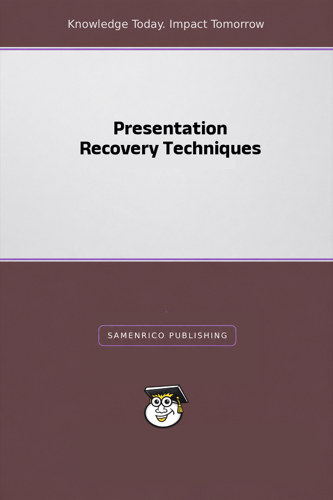
Presentation Recovery Techniques eBook
Bounce back gracefully from technical glitches and
Bounce back gracefully from technical glitches and memory lapses.
Formats
Free sample
Chapter 1: The Pre-Mortem Advantage--–- Most speakers spend hours polishing their opening joke, perfecting their slide transitions, and rehearsing their closing call to action. Almost none spend twenty minutes imagining exactly how their presentation could go wrong. That asymmetry explains why the same people who deliver flawless rehearsals in empty conference rooms fall apart when a microphone dies or a remote goes missing. They have prepared for success but never for failure. And in the gap between those two kinds of preparation, careers stumble.The hard truth about public speaking is not that mistakes happen.
Everyone knows they happen. The hard truth is that most speakers are genuinely surprised when a glitch occurs. That surprise—the wide-eyed, deer-in-headlights moment of “this wasn’t supposed to happen”—does more damage than the glitch itself. Audiences forgive frozen slides. They do not forgive a speaker who looks like their world just collapsed.This chapter introduces a counterintuitive practice borrowed from high-stakes industries like aerospace, emergency medicine, and military strategy: the pre-mortem.
Unlike a post-mortem, which analyzes what went wrong after a failure, a pre-mortem imagines failure before it happens. You look at an upcoming presentation and ask one deceptively simple question: “Assuming this presentation goes badly because of a technical or memory failure, what caused it?” Then you work backward to build systems, habits, and mental scripts that transform you from a speaker who is surprised by glitches into one who expects them, plans for them, and recovers from them so smoothly that the audience barely notices.Why Surprise Is Your Real Enemy Let us distinguish between two kinds of presenters. The first believes that preparation means rehearsing content until it is memorized. This presenter walks into the room carrying only confidence—confidence that the slides will advance, the microphone will work, and their memory will hold. The second presenter also rehearses content but adds an extra layer: they rehearse failure.
They have practiced what to say when the clicker stops working. They have a physical recovery kit waiting in their bag. They have run the “two-minute drill” so many times that recovering from a glitch feels as automatic as advancing to the next slide.When a glitch strikes, the first presenter experiences something close to betrayal. Their brain thinks, “I prepared. This wasn’t supposed to happen.” That sense of betrayal triggers a cascade of cortisol and adrenaline that impairs working memory, narrows attention, and produces the classic panic spiral: heart racing, palms sweating, voice rising.
The second presenter experiences something entirely different. Their brain thinks, “Ah, scenario three. I know what to do.” The absence of surprise preserves cognitive resources for actual recovery.This is not merely a psychological trick. Neuroscience research shows that the brain processes unexpected events differently from expected ones. When something surprises us, the amygdala—the brain’s threat-detection system—lights up and diverts resources away from the prefrontal cortex, which handles complex problem-solving and verbal fluency.
In other words, surprise makes you stupid. Not permanently, not irreparably, but for those critical three to five seconds when you need to be at your sharpest. By contrast, when you have anticipated a potential failure, your brain treats it not as a threat but as a routine event. You stay smarter under pressure.The pre-mortem method, developed by psychologist Gary Klein and later popularized in project management and behavioral economics, capitalizes on this neurological reality. Klein found that teams who conducted pre-mortems before projects identified thirty percent more potential risks than teams who simply brainstormed “what could go wrong.” The difference lies in specificity and psychological safety.
Brainstorming invites vague worries. The pre-mortem invites concrete narratives of failure. “The projector might fail” is a worry. “The HDMI cable I left in my hotel room means I cannot connect my laptop, so I have to present from memory while someone runs upstairs to find a replacement” is a narrative. Narratives generate actionable solutions.The Top Ten Glitches That Actually Happen (Not the Ones You Fear)Before building a recovery system, you need an honest inventory of what actually goes wrong.
Many speakers fear catastrophic failures—the building catching fire, a medical emergency, a hostile audience member shouting them down. Those events are so rare that preparing for them specifically wastes energy better spent elsewhere. The glitches that end presentations are almost always small, mundane, and utterly predictable.Based on surveys of over five hundred professional speakers, corporate trainers, and executives, the following ten technical failures account for more than eighty percent of presentation disruptions. Read each one and notice whether you have a specific, rehearsed response.Dead Microphone. Either the battery dies, the speaker inadvertently mutes themselves, or the PA system develops a fault.
The speaker’s natural instinct is to tap the mic, ask “Can you hear me now?” repeatedly, or freeze entirely.Frozen Slide Deck. The presentation software stops responding, usually because the file is corrupted, the computer is overheating, or too many applications are running. The speaker stands there clicking uselessly while the audience watches in silence.Lost Remote Control. The clicker disappears into a bag, falls under a podium, or was left in the green room. Without it, the speaker cannot advance slides and must either ask someone to help or walk to the computer repeatedly.No Internet Connection.
The venue’s Wi-Fi requires a login the speaker does not have, the network is down, or the connection is too slow to load cloud-based content. Any presentation relying on live demos, embedded videos, or web-based slides grinds to a halt.Projector or Monitor Failure. The screen goes black because of a loose cable, an overheated projector, or a power issue. The speaker suddenly has visuals but no way to show them.Wrong File Version. The speaker saved their final presentation on their laptop, but the venue computer has an older version.
Or they emailed themselves the wrong file. Or they updated slides after making the USB backup.Unresponsive Clicker. The remote’s batteries are dead, the USB receiver is not plugged in, or the clicker is not paired with the computer. The speaker clicks repeatedly, nothing happens, and they eventually say something like “I guess I’ll just use the keyboard.”Sudden Loud Noise. A fire alarm, construction outside, a dropped tray in the back of the room, or an audience member’s phone blares at maximum volume.
The speaker stops mid-sentence and does not know whether to wait, repeat themselves, or power through.Forgotten Adapter. The speaker brings their laptop but not the dongle that connects it to the venue’s HDMI or VGA cable. This is epidemic among Mac users but affects everyone who assumes “they’ll have what I need.”Laptop Battery Death. The speaker assumes the venue will have outlets, arrives to find none near the podium, and watches their battery drop from one hundred percent to zero over forty-five minutes.Read that list again. How many of these have happened to you?
How many have you seen happen to someone else? Now ask yourself a harder question: for how many of these do you have a specific, practiced, automatic response?Building Your Recovery Kit: Physical Tools for Mental Resilience A recovery…
This is the end of the free sample. Get the eBook to keep going. Buy now
About this book
Details
- Author
- Patton Sheryl
- Publisher
- SamEnrico
- Language
- English
- Genre
- Non-Fiction, Self-Help, Crisis Management
- Released
- 2026-06-08
- Pages (approx.)
- 127
- Available as
- eBook, Audiobook

Read better in the ZLOADR app
Your eBooks on your phone or tablet. Sign in with your SamEnrico account and start reading.
More by Patton Sheryl
 Self Talk For RejectionPatton Sheryl$11.99
 Relationship Check InPatton Sheryl$11.99
 Radical Forgiveness WorkbookPatton Sheryl$11.99
 Joy Harjo Poet WarriorPatton Sheryl$11.99
 Walking Commute OptionPatton Sheryl$11.99
 Habit Formation for LearningPatton Sheryl$11.99
 The Thames Torso Murders: A Killer’s Gruesome TrailPatton Sheryl$11.99
 The Sumerian Star Maps: Enheduanna's Celestial LegacyPatton Sheryl$11.99
 Service Providers Guide to Animal GroomingPatton Sheryl$11.99
 How to Produce Water-based Interior PaintPatton Sheryl$11.99
 How to Produce a TreatmentPatton Sheryl$11.99
 Visa Interview for PhD ApplicantsPatton Sheryl$12.99
You may also like
 Hong Kong Handover 1997Dunn Johnnie$11.99
 Zumba For Postnatal Recovery CourseNeal Christian$11.99
 Zumba for BeginnersLadner Nikia$11.99
 YouTube Comment Mining GuideHumes Pandora$12.99
 Worry Box MeditationCarlin Rudy$11.99
 Workplace Stress MeditationNguyen Lynn$11.99
 Workplace Stress and Sleep RepairHawley Ivory$11.99
 Workplace Perfectionism CureDelaney Jeffry$11.99
 Workplace Injustice Anger GuideWallen Isabelle$11.99
 Work Addiction and Burnout LinkGreenwood Ester$11.99
 Women in Yoga and WellnessBeattie Galina$11.99
 Women in Stand Up ComedyChun Evangeline$11.99