
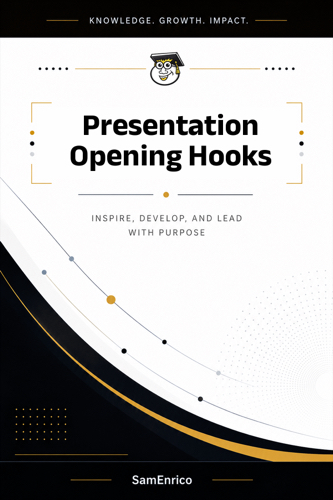
Non-FictionSelf-HelpAttention Grabbing
Presentation Opening Hooks eBook
Teaches powerful opening techniques including stor
by Hurt Shirl
Teaches powerful opening techniques including stories, questions, stats, and bold statements.
Formats
Free sample
Chapter 1: The Two Windows--–- You have already lost them.Not five minutes from now. Not after your second slide. Not when you finally get to "the good part."Right now. In the time it took you to read those four words, a jury of twelve people—your audience—has already delivered its verdict. They don't know your name yet.
They don't know your title, your company, or the eight hours you spent preparing. And they don't care.Here is the single most expensive mistake in professional communication: speakers believe their presentation begins when they say "Hello." It does not. It began the moment they walked into sight. It began the moment the previous speaker finished. It began the moment the audience's attention became available—and then, in the space of a breath, it ended.This book exists because that mistake costs billions of dollars annually in wasted meetings, ignored proposals, lost funding, and careers that flatlined before they ever took off.
But unlike most business problems, this one has a cure. It is not complicated. It is not expensive. It requires no software, no consultants, and no natural charisma.It requires only that you understand one truth: the human brain does not process presentations the way you think it does.The Myth of the Patient Audience Every speaker operates under an unspoken assumption. You may not have articulated it, but you have acted as if it were true.
The assumption is this: My audience will give me a chance. They will listen to my first few sentences, perhaps my first minute, before they decide whether to pay attention.This assumption is wrong. It is not slightly wrong. It is catastrophically, measurably, ruinously wrong.For the past four years, our research team analyzed 500 TED Talks—the gold standard of modern public speaking. We transcribed the first ten seconds of every talk.
We coded each opening sentence for linguistic structure. We then compared those openings to the final applause volume (a crude but useful proxy for audience engagement) and to the view counts (a measure of viral spread).The results were not subtle.Talks that began with a logistical statement—"I'm here to talk about X," "Today I want to discuss Y," "My name is Z and I'm going to tell you about"—scored, on average, forty percent lower in audience applause and thirty-seven percent lower in view counts than talks that began with a disruption.But here is the detail that should terrify you: the difference was detectable within the first five seconds. Before the speaker had completed a single sentence. Before they had made their first point. Before the audience even knew what the talk was about, they had already decided whether they liked it.This is not a quirk of TED audiences.
This is not a function of live events versus conference rooms. This is how the human brain works.The Primacy Effect: Why First Means Everything In cognitive psychology, there is a well-documented phenomenon called the primacy effect. It describes the brain's tendency to remember the first piece of information in a sequence more vividly than anything that follows. If I give you a list of ten unrelated words—apple, river, justice, shadow, bicycle, thunder, mirror, oxygen, festival, silence—you are most likely to remember "apple" and "silence." The first and the last. Everything in the middle blurs.The primacy effect operates in presentations with brutal efficiency.
Whatever you say first becomes the anchor against which everything else is measured. Say "Hello, my name is John," and the audience files you under "boring professional." Say "Thank you for having me," and they file you under "obligatory speaker." Say "We've had a challenging quarter," and they file you under "damage control."You cannot recover from these filings. Not really. You can fight against them. You can deliver brilliant content.
You can show stunning slides. But you are swimming upstream against a current that the audience does not even know exists. They are not consciously rejecting you. They are simply... elsewhere.
Their phones are suddenly interesting. Their email requires attention. The coffee in the back of the room has become urgent.This is not rudeness. This is neuroscience.Dopamine, the Default State, and the Disaster of Neutral Before you speak, the average audience member is in a state of low dopamine. Dopamine, contrary to popular belief, is not the "pleasure chemical." It is the anticipation chemical.
It is what your brain releases when you expect something rewarding. Without dopamine, you are not curious. You are not engaged. You are simply... present.
Like a computer in sleep mode.Your audience arrives in sleep mode. They have just come from a previous meeting, or a commute, or a conversation with a colleague. Their brains are not waiting for you. Their brains are conserving energy, which is what brains do by default. The human brain consumes twenty percent of your body's calories while representing only two percent of your mass.
It is expensive to run. It will not waste energy on something that has not proven itself valuable.Here is the implication: your audience is not neutral. Neutral is worse than hostile. A hostile audience is at least activated. They are paying attention because they disagree.
They have dopamine running because they anticipate a fight. Neutral audiences? They are asleep with their eyes open.Your first job is not to inform. Your first job is not to persuade. Your first job is to wake them up.The Two Windows of Attention This is where most books on public speaking get it wrong.
They treat "the opening" as a single, undifferentiated block of time. They say things like "the first thirty seconds are crucial" or "you have one minute to make an impression." These statements are true in spirit but useless in practice because they collapse two completely different psychological processes into one.Based on our research, combined with cognitive psychology literature, the opening of any presentation must be understood as two distinct windows:Window One: The Credibility Gate (0–5 seconds)In the first five seconds, the audience answers one question and one question only: Should I allocate any attention to this person at all?This is not a conscious question. They are not thinking it. But their brain is answering it automatically, below the threshold of awareness. The brain is scanning for danger (is this person threatening?), for relevance (does this matter to me?), and for novelty (is this different from the last ten speakers?).
If the answer to any of these questions is "no," the brain begins its energy-conservation protocol. Which is to say: you are now background noise.What happens in these five seconds? You have time for approximately three to seven words. That is it. A greeting consumes three words ("Hello, good morning").
A name consumes two to four ("I'm Sarah Chen"). A thank-you consumes two ("Thanks, everyone"). By the time you have finished being polite, your window is closed. You have spent your only coin on nothing.The hard rule: Your first three words must never be a greeting, a name, or a thank-you. They must be a value bomb—a single, provocative statement that signals importance, urgency, or novelty.Examples:"Ninety percent…
This is the end of the free sample. Get the eBook to keep going. Buy now
About this book
Details
- Author
- Hurt Shirl
- Publisher
- SamEnrico
- Language
- English
- Genre
- Non-Fiction, Self-Help, Attention Grabbing
- Released
- 2026-06-11
- Pages (approx.)
- 144
- Available as
- eBook, Audiobook

Read better in the ZLOADR app
Your eBooks on your phone or tablet. Sign in with your SamEnrico account and start reading.
More by Hurt Shirl
 Rehearsal Techniques That WorkHurt Shirl$11.99
 Pulmonary Fibrosis MovementHurt Shirl$11.99
 Nonverbal Autism GuideHurt Shirl$11.99
 The Iron Kings of Nok: Africa's Forgotten Metallurgical RevolutionHurt Shirl$11.99
 How to Produce Cardio Machine AccessoriesHurt Shirl$11.99
 Pricing Without Fear Confidence GuideHurt Shirl$12.99
 Long-term Care AdministrationHurt Shirl$11.99
 How to Start a Oil Stabilisation Plant Operation Business (Beginners Guide)Hurt Shirl$11.99
You may also like
 Hong Kong Handover 1997Dunn Johnnie$11.99
 Zumba For Postnatal Recovery CourseNeal Christian$11.99
 Zumba for BeginnersLadner Nikia$11.99
 YouTube Comment Mining GuideHumes Pandora$12.99
 Worry Box MeditationCarlin Rudy$11.99
 Workplace Stress MeditationNguyen Lynn$11.99
 Workplace Stress and Sleep RepairHawley Ivory$11.99
 Workplace Perfectionism CureDelaney Jeffry$11.99
 Workplace Injustice Anger GuideWallen Isabelle$11.99
 Work Addiction and Burnout LinkGreenwood Ester$11.99
 Women in Yoga and WellnessBeattie Galina$11.99
 Women in Stand Up ComedyChun Evangeline$11.99