
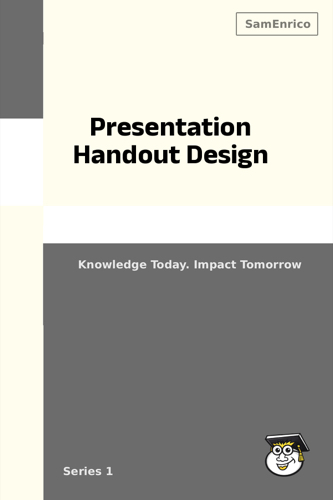
Non-FictionSelf-HelpMaterial Design
Presentation Handout Design eBook
Teaches how to create effective takeaway handouts
by Khan Marnie
Teaches how to create effective takeaway handouts that reinforce without distracting.
Formats
Free sample
Chapter 1: The Slideument Funeral--The first time I saw a presenter hand out a 47-page booklet before saying a single word, I watched the audience die. Not literally, of course. But something essential expired in that room. Eyes dropped to paper. Shoulders curled forward.
The speaker became a podcast playing in an empty kitchen. By page three, three people were doodling. By page twelve, someone was checking email under the table. And the presenter? He kept talking, blissfully unaware that his handout had already committed the one sin a handout cannot survive: it had become the main event.This is the curse of the slideument.
And if you have ever printed your slide deck and called it a handout, you have committed this exact crime.Let me be clear about what I mean. A slideument is a bastard hybrid—a file designed to be projected on a screen, printed on paper, and archived in a folder, all while pretending to serve three masters equally. It is the Swiss Army knife of presentation collateral, except the blade is dull, the corkscrew is rusted, and the scissors cut nothing but your credibility. The word itself is a portmanteau of "slide" and "document," coined by presentation theorist Nancy Duarte, and it describes the single most common mistake in the history of business communication.You have seen slideuments. You have probably created slideuments.
They are the decks where every slide is crammed with eight bullet points in ten-point font because "someone might want to read the details later." They are the handouts that repeat exactly what you said, word for word, so the audience member thinks, "Why am I listening when I can read this twice as fast?" They are the reason conference rooms are filled with the soft rustle of page-turning rather than the sharp crack of insight.This chapter is a funeral for the slideument. We will bury it properly. We will say a few words over its grave. And then we will walk away, never to return, because there is a better way to design handouts that reinforce without distracting. But first, we must understand why the slideument fails so catastrophically—and why almost every presenter falls into its trap.The 3-for-1 Fallacy: Why More Is Never More The slideument is born from a seemingly reasonable assumption: efficiency.
Why create three separate files when one file can do everything? The thinking goes like this: "I need slides for my presentation. I need a handout for the audience. I need an archive for my team. Why not just print my slides?
That's three birds with one stone."This is the 3-for-1 Fallacy, and it is wrong for three ironclad reasons.First, the medium of projection is fundamentally different from the medium of paper. A projected slide is ephemeral. It exists for ten to thirty seconds before it disappears, replaced by the next slide. The audience's eyes are drawn to movement, contrast, and the speaker's face. The slide is a supporting actor.
On paper, that same content is frozen. It does not disappear. It sits on the table, staring back at the reader with the permanence of a tombstone. The audience can examine it for ten minutes if they choose. What worked as a quick visual cue now looks shallow.
What worked as a provocative headline now reads as incomplete. What worked as a six-word bullet point now seems like a missed opportunity.Second, the cognitive load is incompatible. When you project a slide, the audience listens to you while glancing at a few key words or an image. When you hand them a dense printed page, they stop listening. Not because they are rude.
Because the human brain literally cannot process spoken language and complex written text at the same time. The neuroscientist John Sweller demonstrated this through his Cognitive Load Theory: our working memory has two separate channels—one for auditory information, one for visual information. But here is the catch: the visual channel cannot process two competing visual inputs simultaneously. When someone reads text on a page, their visual channel is occupied. They cannot also process your slides.
And they certainly cannot process your face, your gestures, and your tone while decoding a dense paragraph of ten-point type.Third, the timing is misaligned. A presentation moves forward in time. The speaker controls the pacing. A handout is static. The reader controls the pacing.
When you merge them, you create a fight for control. The speaker wants to reveal information in a sequence. The reader wants to skip ahead, go back, or stop altogether. In that fight, the reader always wins, because the printed page is patient and the speaker is not.I once watched a CEO deliver a quarterly earnings presentation. He handed out a forty-page slideument at the door.
By the time he reached slide three, half the room was on slide fifteen. By slide ten, the analyst in the front row was reading the appendix. The CEO kept talking, but no one was listening. They were reading. And because they were reading, they were not asking questions, not challenging assumptions, not engaging.
The meeting ended in silence. The CEO thought it went well. It did not. The slideument had murdered curiosity.The Neuroscience of Split Attention Let me take you inside the brain for a moment. Imagine you are attending a presentation.
The presenter says, "Our revenue grew twenty percent last quarter." At the exact same moment, your eyes land on a sentence in the handout that says, "Revenue grew twenty percent last quarter." You have just experienced redundancy. Your brain processes the auditory signal in the temporal lobe. It processes the written signal in the visual cortex. Both signals say the same thing. Your brain automatically filters one out—usually the spoken one, because reading is faster than listening.But here is where it gets worse.
What if the handout says something slightly different? "Revenue grew twenty percent, excluding one-time adjustments." Now your brain has a conflict. It must compare the two sources, resolve the discrepancy, and decide which to believe. That takes cognitive energy. While you are resolving that conflict, you miss the next sentence the speaker says.
By the time you look up, the presenter is on slide six, and you are still on slide three.This is called the split-attention effect, and it is the silent killer of presentation handouts. Every time you ask an audience to read and listen simultaneously, you force them to choose. Most will choose reading, because text is permanent and speech is fleeting. But some will choose listening, only to realize later that they missed half the details. Either way, you lose.
The handout becomes a competitor, not a collaborator.There is a famous study from the University of New South Wales that illustrates this perfectly. Researchers gave two groups of students the same educational content. One group received a text-only document. The other group received the same text alongside an audio narration. The second group performed worse on comprehension tests, not better.
Why? Because they spent cognitive energy reconciling the two inputs instead of processing meaning. More input did not equal more learning. It equaled more interference.Your audience is…
This is the end of the free sample. Get the eBook to keep going. Buy now
About this book
Details
- Author
- Khan Marnie
- Publisher
- SamEnrico
- Language
- English
- Genre
- Non-Fiction, Self-Help, Material Design
- Released
- 2026-06-09
- Pages (approx.)
- 133
- Available as
- eBook, Audiobook

Read better in the ZLOADR app
Your eBooks on your phone or tablet. Sign in with your SamEnrico account and start reading.
More by Khan Marnie
 The Remote Talent Show GuideKhan Marnie$11.99
 HIIT for Fat Loss CourseKhan Marnie$11.99
 Warrant Pari Passu GuideKhan Marnie$11.99
 The Chariot Races of Antioch: The Ancient Rivalry That United a KingdomKhan Marnie$11.99
 Perennial Ryegrass HarvestingKhan Marnie$11.99
 How to Produce a Central Vacuum CleanerKhan Marnie$11.99
 Receivable Factoring Fundamentals CourseKhan Marnie$12.99
 How to Start a Log Decorticators Business (Beginners Guide)Khan Marnie$11.99
You may also like
 Hong Kong Handover 1997Dunn Johnnie$11.99
 Zumba For Postnatal Recovery CourseNeal Christian$11.99
 Zumba for BeginnersLadner Nikia$11.99
 YouTube Comment Mining GuideHumes Pandora$12.99
 Worry Box MeditationCarlin Rudy$11.99
 Workplace Stress MeditationNguyen Lynn$11.99
 Workplace Stress and Sleep RepairHawley Ivory$11.99
 Workplace Perfectionism CureDelaney Jeffry$11.99
 Workplace Injustice Anger GuideWallen Isabelle$11.99
 Work Addiction and Burnout LinkGreenwood Ester$11.99
 Women in Yoga and WellnessBeattie Galina$11.99
 Women in Stand Up ComedyChun Evangeline$11.99