
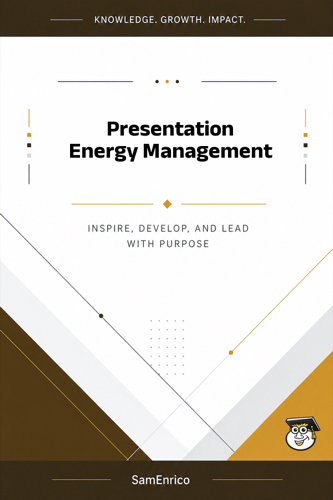
Non-FictionSelf-HelpEnergy Management
Presentation Energy Management eBook
Teaches how to modulate vocal and physical energy
Teaches how to modulate vocal and physical energy for different presentation segments.
Formats
Free sample
Chapter 1: The Energy Bank...–- Every speaker believes their slides are their salvation. They spend forty hours curating fonts, aligning logos, and hunting for the perfect stock photo of a handshake. Then they walk on stage, lean on the podium, and speak in a flat, exhausted monotone for twenty minutes while the audience mentally checks out before the second slide. The slides were fine. The speaker was not.This is the most expensive mistake in professional communication.
Companies spend billions annually on presentation training, yet the vast majority of that training focuses on content structure, data visualization, and storytelling arcs. These matter. But they are not the primary problem. The primary problem is what this book calls resting energy—the default, unmodulated physical and vocal state a speaker brings to the stage when they are not actively thinking about their delivery.Resting energy is the enemy of engagement. It is the reason a brilliant executive with twenty years of experience can put an entire boardroom to sleep.
It is the reason a startup founder with a world-changing product can walk away from a pitch meeting with a "we'll think about it." And it is the reason you have sat through countless presentations where you remember absolutely nothing five minutes after they ended.This chapter introduces the foundational framework of Presentation Energy Management: the Energy Quotient, the 55/38/7 rule with its critical distinction, and the Energy Bank metaphor that will guide every technique in this book. By the end of this chapter, you will understand exactly why your resting energy is ruining your great content—and you will have taken the first step toward fixing it.The Distraction Economy Before we discuss how to manage your energy, we must understand the environment in which you are speaking. The audience you face today is fundamentally different from the audience of ten years ago. They have been trained—relentlessly, expertly, and without their consent—to expect constant micro-shifts in stimulation.Consider what the average professional consumes before walking into your presentation. They scroll Tik Tok for fifteen minutes on the train, where videos change every 15 to 30 seconds, each one designed to trigger a tiny dopamine hit.
They watch Instagram Reels while waiting for their coffee, where the algorithm punishes any moment of stillness. They skim Twitter threads and Linked In posts, each one competing for their fragmented attention with notifications, emails, and calendar alerts.This is the Distraction Economy, and it has fundamentally rewired the attentional circuitry of your audience. A 2019 study from Microsoft found that the average human attention span had dropped from twelve seconds to eight seconds—less than that of a goldfish. Whether you find this statistic alarming or exaggerated, the underlying reality is undeniable: your audience is arriving at your presentation already partially distracted, already primed to disconnect, and already carrying the neural habits of short-form content consumption.Here is what this means for you as a speaker. If your energy remains flat—if you stand still, speak at a single volume, maintain a single pace, and never shift your physical or vocal output—the audience's brain will treat you like a boring Tik Tok video.
It will swipe away mentally. Not because your content is bad, but because their neural training demands variety. You are competing not against other speakers but against the expectation of constant micro-stimulation that every social media platform has drilled into them.The speaker who understands this has a massive advantage. They do not need to become a carnival barker or a You Tube influencer. They simply need to learn to modulate their energy—to create those micro-shifts intentionally, strategically, and authentically.
That is what this book teaches. But first, we must dismantle the single most destructive belief that most speakers hold.The Content Fallacy Most speakers believe a dangerous lie: that content is king. They believe that if they just have the right data, the perfect story, the most compelling argument, the audience will naturally pay attention. This is the Content Fallacy, and it is wrong.Content is not king. Delivery is king.
Content is merely the vehicle that delivery drives.Let us be precise about what this means. A brilliant script delivered poorly will fail. A mediocre script delivered brilliantly can succeed. This is not an argument for empty style over substance. It is an argument that substance is invisible without the energy to illuminate it.
You can have the most advanced architectural blueprint in the world, but if you hand it to someone in a dark room, they cannot build the building. Energy is the light by which your content is seen.This is why two speakers can deliver the exact same material and get radically different results. One stands behind the podium, reads bullet points, and watches the audience drift away. The other walks the stage, shifts volume and pace, uses intentional pauses, and commands the room. The words were identical.
The energy was not.The Content Fallacy is comforting because it allows you to focus on what is safe: your slides, your script, your data. It asks nothing of your body or your voice. But it is a trap. The speakers who rise to the top of their fields—the TED stage headliners, the keynotes who get standing ovations, the executives whose quarterly updates people actually attend—are not necessarily the ones with the best content. They are the ones who have learned to manage their energy.This book will teach you to do the same.
But to do that, we need a shared language for talking about energy. We need a metric.The Energy Quotient (EQ)Just as an intelligence quotient measures cognitive ability, the Energy Quotient (EQ) measures your natural baseline of physical and vocal energy on a scale from 1 to 10. This is not a judgment of your worth as a speaker. It is simply a diagnostic tool to help you understand where you start so you can learn to move intentionally along the spectrum.A speaker at EQ Level 1 is barely moving, barely audible, and barely modulated. Their gestures, if they exist at all, are confined to a small zone around their torso.
Their voice stays within a three-note range. Their pace is steady but lifeless. They are not bad people. They are not stupid people. They are simply low-energy presenters who have never been taught to raise their output.A speaker at EQ Level 10 is explosive.
They move across the entire stage. Their gestures are wide and dramatic. Their voice shifts from whisper to roar. Their pace accelerates and decelerates intentionally. They are exhausting to watch for more than a few minutes because they never come down from the peak.
They have range, but no control.The goal of this book is not to turn you into a 10. The goal is to teach you to access the full spectrum of 1 to 10 so you can dial up when the room needs energy and dial down when the room needs gravity. A speaker who only knows 1 through 4 is boring. A speaker who only knows 7 through 10 is exhausting. A speaker who can move from a 3 to an 8 and back to a 4 is magnetic.Take the following self-assessment honestly.
There are no wrong answers. Your EQ score is simply your starting point.The EQ Self-Assessment For each statement, rate yourself…
This is the end of the free sample. Get the eBook to keep going. Buy now
About this book
Details
- Author
- Guillory Dimple
- Publisher
- SamEnrico
- Language
- English
- Genre
- Non-Fiction, Self-Help, Energy Management
- Released
- 2026-06-08
- Pages (approx.)
- 150
- Available as
- eBook, Audiobook

Read better in the ZLOADR app
Your eBooks on your phone or tablet. Sign in with your SamEnrico account and start reading.
More by Guillory Dimple
 HIIT for Women GuideGuillory Dimple$11.99
 Sibling Mental Illness GuideGuillory Dimple$11.99
 Five Elements Theory GuideGuillory Dimple$11.99
 The Arsenic Trials: Victorian Justice and the Poisoner's ParadoxGuillory Dimple$11.99
 Notification vs Non Notification GuideGuillory Dimple$12.99
 How to Produce Chair and Sofa CushionsGuillory Dimple$11.99
 How to Start a Pipes Made of Steel Business (Beginners Guide)Guillory Dimple$11.99
 Post Market Surveillance AnalystGuillory Dimple$11.99
You may also like
 Hong Kong Handover 1997Dunn Johnnie$11.99
 Zumba For Postnatal Recovery CourseNeal Christian$11.99
 Zumba for BeginnersLadner Nikia$11.99
 YouTube Comment Mining GuideHumes Pandora$12.99
 Worry Box MeditationCarlin Rudy$11.99
 Workplace Stress MeditationNguyen Lynn$11.99
 Workplace Stress and Sleep RepairHawley Ivory$11.99
 Workplace Perfectionism CureDelaney Jeffry$11.99
 Workplace Injustice Anger GuideWallen Isabelle$11.99
 Work Addiction and Burnout LinkGreenwood Ester$11.99
 Women in Yoga and WellnessBeattie Galina$11.99
 Women in Stand Up ComedyChun Evangeline$11.99