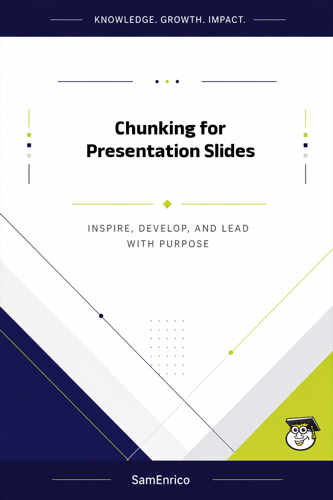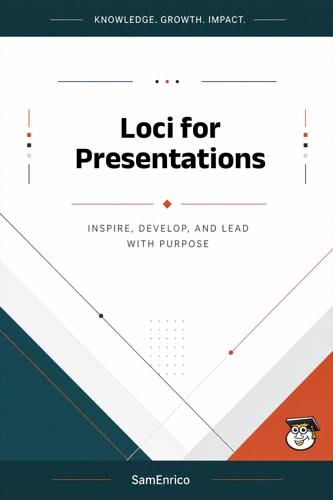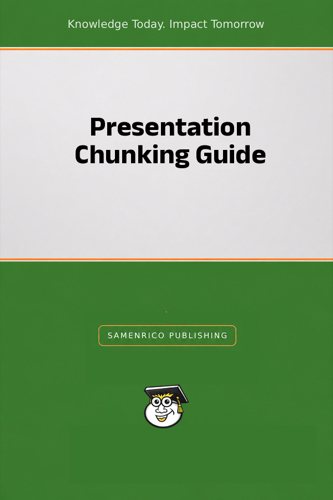
Presentation Chunking Guide eBook
Organize slides and talking points into three part
Organize slides and talking points into three part memory structures.
Formats
Free sample
Chapter 1: The Seven-Item Curse--–- You have just finished what you believe is a brilliant presentation. Forty-five minutes. Eighteen slides. Four case studies. Three data tables.
You answered every question with confidence. You stayed on time. As you walk back to your seat, the CEO leans over to her deputy and whispers something you were not meant to hear: “I have no idea what he just proposed.”This is not a failure of your expertise. It is not a failure of your slides. It is not even a failure of your public speaking skills.
It is a failure of memory—specifically, the memory of every single person in that room. And the problem started long before you opened your mouth. It started the moment you decided to include “seven key points” in your agenda.Let me tell you about a curse that haunts every presentation, every meeting, and every pitch. I call it the Seven-Item Curse, and it has destroyed more good ideas than bad slides ever have.The Anatomy of the Curse The Seven-Item Curse works like this. A presenter knows their material deeply.
They have seven important things to say. They list them clearly, often numbering them: “First, second, third…” By the time they reach point four, the audience has forgotten point one. By point six, they have forgotten point two. When the presenter finishes point seven and asks, “Any questions?” the audience does not know what to ask because they no longer remember what they heard.This is not speculation. This is cognitive science, and it has been understood for decades, yet almost no one applies it to presentations.In 1956, a Harvard psychologist named George Miller published a paper that became one of the most cited works in psychology.
Its title was “The Magical Number Seven, Plus or Minus Two.” Miller’s finding was simple and astonishing: the human working memory can hold approximately seven items at once. Some people can hold nine. Some can hold five. But seven is the average.Here is what most people miss. Miller was describing the absolute upper limit of working memory—the point at which the system begins to fail.
Seven items is not a comfortable capacity. It is the breaking point. It is the number of digits you can repeat back immediately after hearing them, before you forget. And crucially, that limit applies only when you have nothing else competing for your attention.Now add a live presenter. Add slides.
Add the pressure of deciding what matters. Add the natural human tendency to rehearse your own thoughts while the presenter is still talking. In a real presentation environment, the practical limit for reliable recall is not seven. It is not five. It is three.The Stanford Study That Changed Everything In 2014, a team of researchers at Stanford’s Graduate School of Business conducted a study that should have ended the debate about presentation length forever.
They took one hundred experienced managers and divided them into two groups. Both groups watched the same thirty-minute presentation about a fictional company’s strategic options. The content was identical. The slides were identical. The only difference was the structure.The first group watched a presentation organized into seven sections.
The presenter said, “I have seven points to make today.” The second group watched the same content organized into three sections. The presenter said, “I have three major themes to cover.”After the presentation, both groups were asked to write down everything they remembered. Then they were asked to write down the presenter’s main recommendation. Then they were asked to explain, in their own words, why that recommendation made sense.The results were not close. The group that saw the three-part structure remembered twice as much content.
They were three times more likely to correctly state the main recommendation. And they were four times more likely to be able to explain the reasoning behind that recommendation.The researchers had a name for what they found. They called it “cognitive compression”—the brain’s ability to pack more information into memory when that information is organized into small, meaningful groups. The three-part structure did not delete information. It created hooks for the brain to hang information on.Why Your Brain Is Not a Hard Drive To understand why three is the magic number, you have to understand something fundamental about human memory.
Your brain is not a computer. It does not store information like files on a hard drive. It stores information in associations, in patterns, and—most importantly—in chunks.Here is a simple experiment. Look at these letters for five seconds, then look away: F B I C I A N B C.How many did you remember? Most people remember four or five.
Now look at this sequence for five seconds: F B I – C I A – N B C.Suddenly, the task becomes trivial. You see FBI, CIA, NBC. Three chunks instead of nine letters. Your memory capacity did not change. Your brain simply recognized patterns it already knew and compressed the information.This is chunking.
It is the single most powerful memory tool the human brain possesses. And it is the single most underused tool in professional presentations.Every time you present a list of seven unrelated items, you are asking your audience to do something their brains are not designed to do. You are asking them to hold seven separate, unconnected ideas in working memory while simultaneously listening to you, looking at your slides, and deciding whether to agree with you. That is not a request. It is a demand that they fail.The chess grandmaster does not see thirty-two pieces on the board.
They see five or six strategic groupings—attacking formations, defensive structures, tactical threats. The novice sees thirty-two separate pieces and is overwhelmed. The grandmaster does not have a better memory. They have better chunking.But here is the critical distinction that most books get wrong. The grandmaster’s five or six chunks are for analysis, not for live oral recall.
When you are sitting quietly, studying a chess board, you can hold five chunks in mind. When you are listening to a live presentation, with all its distractions and time pressure, your reliable limit drops to three. That is why this book focuses on three—not because five is impossible, but because three is the only number that works under real conditions.The Primacy and Recency Trap There is another reason the Seven-Item Curse is so destructive, and it has to do with two quirks of human memory called primacy and recency.Primacy means that people remember the first thing they hear. Recency means that people remember the last thing they hear. Everything in the middle is a blur.
If you have ever left a meeting remembering only the opening statement and the closing summary, you have experienced primacy and recency in action.Now do the math. If you have seven points, the audience will reliably remember point one (primacy) and point seven (recency). They will vaguely remember point two if they were paying close attention. Points three, four, five, and six might as well not exist.You have just spent 80 percent of your presentation…
This is the end of the free sample. Get the eBook to keep going. Buy now
About this book
Details
- Author
- Rains Beverley
- Publisher
- SamEnrico
- Language
- English
- Genre
- Non-Fiction, Self-Help, Presentation Skills
- Released
- 2026-06-08
- Pages (approx.)
- 126
- Available as
- eBook, Audiobook

Read better in the ZLOADR app
Your eBooks on your phone or tablet. Sign in with your SamEnrico account and start reading.
More by Rains Beverley
 Binge Eating and Marriage HandbookRains Beverley$11.99
 Beginner Stretching RoutineRains Beverley$11.99
 Couples Cognitive RestructuringRains Beverley$11.99
 Sales Professional Interruption GuideRains Beverley$11.99
 The Lost Kingdom of the Blue Nile: The Prehistoric Quest for the Source of LifeRains Beverley$11.99
 Silent Witness: The Forgotten Codebreakers of World War IIRains Beverley$11.99
 Bookkeeping Referral SystemRains Beverley$12.99
 Warehouse & Distribution DBRains Beverley$12.99
 Understanding Encephalocele AnencephalyRains Beverley$17.99
 Fire Extinguisher TechnicianRains Beverley$11.99
 How to Start a Shellfish Farming BusinessRains Beverley$11.99