
Presentation Audience Analysis eBook
Tailor data presentations to executive technical o
Teaches how to research and adapt presentations to specific audience needs.
Formats
Free sample
Chapter 1: The Cognitive Graveyard--–- The conference room on the 14th floor was designed to impress. Floor-to-ceiling windows overlooked the Chicago skyline. A polished mahogany table seated eighteen. The coffee was artisanal. None of it mattered.Mariah, a senior data scientist at a midsize financial services firm, had spent forty-two hours that week preparing for this moment.
She had cleaned three years of transaction data. She had built a random forest model that predicted customer churn with 87% accuracy. She had tested seven iterations of her visualization suite. She had rehearsed her opening remarks in the mirror seventeen times.She clicked to slide one.Three minutes later, the Chief Financial Officer—a man named Garvey who had survived six mergers and forgotten more about risk than Mariah would ever learn—interrupted her."Just tell me," he said, not looking up from his phone, "do we need to change our retention budget or not?"Mariah froze. She had prepared sixty-three slides.
She had a slide on feature importance. She had a slide on the confusion matrix. She had a slide on the precision-recall tradeoff. She did not have a slide that answered Garvey's question in one sentence.She started to explain the confidence intervals.Garvey stood up. "Get back to me when you have an answer," he said, and walked out.The associate from marketing—a well-intentioned junior director named Patel who had been taking diligent notes—leaned over and whispered, "That was brutal.
But honestly, I stopped following you around slide nine. What was a 'random forest' again? I thought we were talking about customers."Mariah packed her laptop in silence. She had the answer. The answer was yes.
The retention budget needed to increase by 12% or the firm would lose its highest-value segment. That sentence—twelve words—was buried on slide forty-one, between a histogram of transaction frequency and a table of Shapley values.No one had seen it. No one had asked for it. And now Garvey thought she was incompetent.This book exists because Mariah's story is not an exception. It is the rule.The One-Size-Fits-None Trap Every day, in thousands of conference rooms, boardrooms, and Zoom calls, brilliant analysts present brilliant data to audiences who cannot hear them.
The analyst speaks in p-values and confidence intervals. The executive hears noise. The analyst shows a regression table. The client feels confused. The analyst explains the methodology.
The engineer interrupts with a question about sample size that derails the entire meeting.The problem is not the data. The problem is not the analyst. The problem is the assumption that one presentation can serve all brains equally.This is the One-Size-Fits-None Trap. It is the single most expensive communication failure in modern business. It costs companies millions in missed opportunities, stalled decisions, and frustrated talent.
It costs presenters their credibility, their confidence, and sometimes their careers.But the trap is not inevitable. It is avoidable. And avoiding it requires understanding something most presenters never consider: the cognitive architecture of their audience.Why Your Audience Checks Their Phone Let us start with a hard truth. When an executive checks their phone during your presentation, they are not being rude. They are being efficient.
Their brain has triaged your information as low priority. When an engineer interrupts your elegant narrative with a question about your sample size, they are not being pedantic. They are doing their job. When a client says "let me think about it" and never calls back, they are not being evasive. They simply did not see themselves in your story.These behaviors are not personality flaws.
They are cognitive constraints.The human brain has a severe limitation that most presenters ignore: working memory. Working memory is the mental scratchpad where we hold information while we manipulate it. It is not storage. It is not long-term memory. It is the small, fragile space where thinking actually happens.And it is tiny.The cognitive psychologist John Sweller demonstrated in the 1980s that working memory can hold approximately four to seven discrete pieces of information at once.
That is it. Seven numbers. Seven concepts. Seven steps. After that, the brain begins to drop information—not because it is lazy, but because it is full.When you present a dense table with fifteen numbers, you have already lost the room.
When you show a flowchart with eleven boxes, you are speaking to yourself. When you walk through a seven-step methodology before stating your recommendation, your audience stopped listening at step three.But here is the nuance that most presentation books miss. Different audiences have different working memory tolerances—not because their brains are structurally different, but because their goals impose different cognitive loads.An executive is not trying to understand your model. They are trying to make a decision. Decision-making under uncertainty is cognitively expensive.
It requires comparing alternatives, assessing risk, imagining outcomes. Every additional piece of information you give an executive competes for the same limited mental space they need to make the decision. This is why executives have the lowest tolerance for detail: one or two numbers at a time. Anything more, and they stop processing. They do not stop because they are bored.
They stop because they are full.A technical audience member—an engineer, a data scientist, an analyst, an academic—has a different goal. They are not trying to make a decision in the moment. They are trying to validate your claim. Validation requires cross-referencing, checking assumptions, identifying flaws. This is also cognitively expensive, but it is a different kind of expense.
A technical audience can hold five to seven variables at once because they are not simultaneously managing decision anxiety. But if you force them to hold your narrative and check your methodology and remember your conclusion, you will exceed their capacity.A client—whether external buyer or internal business partner—falls in between. They are making a decision (like an executive) but they are also evaluating value (like a validator). Their tolerance is three to four value-related metrics. Give them five, and they will ask for the proposal in writing.
Give them six, and they will ghost you.These differences are not judgments of intelligence or attention span. They are engineering specifications for how you must design your presentation.The Three Brains Model Throughout this book, we will refer to three distinct audience personas. Think of them not as stereotypes but as cognitive modes that any audience member may occupy depending on their role, their incentives, and the context of the meeting.The Executive Brain is optimized for pattern recognition, risk assessment, and rapid decision-making under time pressure. This persona is not limited to C-suite executives. It includes any stakeholder whose primary job is to allocate resources, approve budgets, or make go/no-go decisions.
The Executive Brain asks one question: "What do I need to decide, and what is the bottom line?"The Technical Brain is optimized for validation, flaw detection, and methodological rigor. This persona includes data scientists, engineers, analysts, academics, compliance officers, and any stakeholder whose job is to prevent the organization from acting on bad information. The Technical Brain asks one question: "How do you know that, and can I trust it?"The Client…
This is the end of the free sample. Get the eBook to keep going. Buy now
About this book
Details
- Author
- Olivarez Jani
- Publisher
- SamEnrico
- Language
- English
- Genre
- Non-Fiction, Professional's Cheat Sheet, Audience Strategy, Self-Help, Audience Research
- Released
- 2026-05-30
- Pages (approx.)
- 158
- Available as
- eBook, Audiobook

Read better in the ZLOADR app
Your eBooks on your phone or tablet. Sign in with your SamEnrico account and start reading.
More by Olivarez Jani
 Burnout Prevention For StartupsOlivarez Jani$11.99
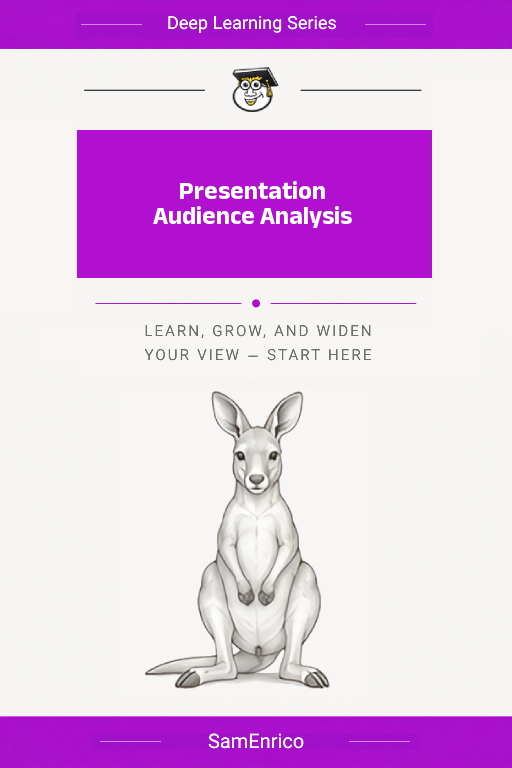 Presentation Audience AnalysisOlivarez Jani$12.99
 Assertiveness Journal WorkbookOlivarez Jani$11.99
 Pre Talk Anticipation JournalOlivarez Jani$11.99
 Anger After Partner's GamblingOlivarez Jani$11.99
 The Sibling Rivalry Self Worth RecoveryOlivarez Jani$11.99
 The Last Scribe of AlexandriaOlivarez Jani$11.99
 Understanding Macrocephaly Mesodermal Hamartoma SpectrumOlivarez Jani$17.99
 Consumer Goods Distribution GuideOlivarez Jani$12.99
 Lead Automation Robotics TechnicianOlivarez Jani$11.99
 How to Start a Channel Islands and Isle of Man Banking Institutes Business (Beginners Guide)Olivarez Jani$11.99