
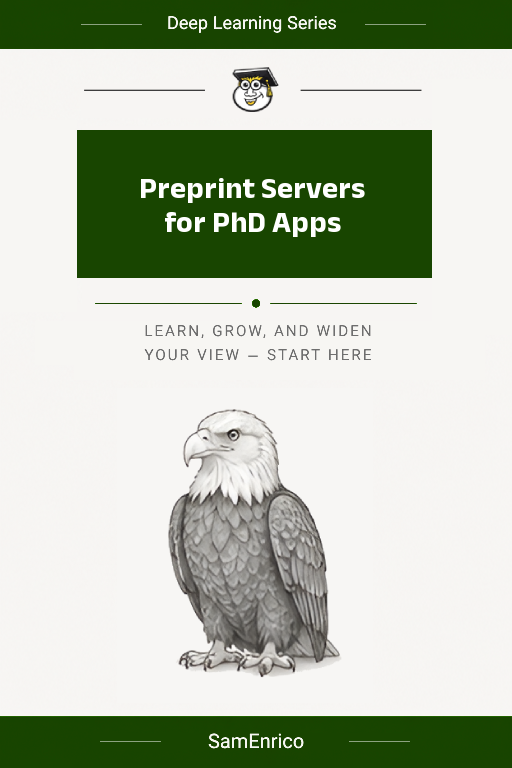
Non-FictionStudent's ShortcutPreprints
Preprint Servers for PhD Apps eBook
Upload working papers to arXiv, bioRxiv, or SSRN a
Upload working papers to arXiv, bioRxiv, or SSRN as citable research outputs before peer review.
Formats
Free sample
Chapter 1: The Invisible Deadline--The December 1st Ph D application deadline is a lie.Not literally, of course. The forms are real. The fee payments process. The letters of recommendation arrive in digital envelopes. But the deadline that matters—the one that determines whether your application lands in the "serious consideration" pile or the "promising but not yet ready" stack—passed months ago.
You just didn't know it existed.Here is the truth that no admissions website will tell you, that no graduate coordinator will put in a FAQ, that no professor will confess in a public lecture: by the time you click "submit" on your application, the most competitive programs have already formed their first impressions of you. Not from your personal statement. Not from your GRE scores. From the citable, verifiable, clickable evidence of your research ability that exists online—or does not exist—long before the official deadline arrives.This chapter is about that invisible deadline. It is about the structural mismatch between how Ph D admissions actually work and how most applicants think they work.
And it is about the single most underutilized tool that can close that gap: the preprint.The 18-Month Trap Let us start with a simple math problem.You graduate from college in May. You have been working in a research lab since your junior year. You have a paper—your own project, not just a co-authorship on a senior grad student's work—that you believe is good enough for a respectable journal. Your advisor agrees. In June, you submit the paper to Journal of Important Research.Now let us track that paper against your Ph D application timeline.June: Submission.
The journal sends a confirmation email. You update your CV to say "under review."July–August: The journal struggles to find reviewers. Three decline. Two ghost.September: Finally, two reviewers agree. The clock starts.October: The reviews come back.
"Major revisions." Not a rejection, but not a quick path forward.November: You resubmit the revised paper. The clock resets.December 1: The Ph D application deadline arrives. Your paper is still "under review."March: Admission decisions are released. Your paper is still "under review."May: The paper is finally accepted. You have a publication.
But you have already been rejected from every program to which you applied.This is not a horror story. This is the median experience.According to data from over 2,000 journals tracked by the publishing analytics platform Publons (now part of Clarivate), the average time from submission to first decision across all academic fields is roughly 13 weeks—about three months. The average time from submission to final acceptance? Between 9 and 18 months, depending on the field. In the life sciences, the median is over 200 days just for the first decision.
In economics, it is not uncommon for papers to sit under review for a year or more.Now let us do the math again, but this time with the preprint option.June: You complete your manuscript. You post it to ar Xiv, bio Rxiv, or SSRN. It receives a DOI and a timestamp. You update your CV to say "Available at ar Xiv:XXXX.XXXXX."August: A potential advisor searches for new papers in their field. Your preprint appears.
They click. They read. They are interested.October: You email that professor. You include a link to your preprint. They remember reading it two months ago.December 1: You submit your application.
Your preprint link is live, citable, and verifiable. The admissions committee clicks it before they read your personal statement.March: You receive an acceptance. The journal still has not made a decision. It does not matter.The preprint did not replace the peer-reviewed publication. It bypassed the timeline problem entirely.Why "Under Review" Has Become Almost Worthless Let me be blunt about something that admissions committees will only hint at in private: a CV line that says "under review at Journal X" has, for most competitive programs, become functionally worthless.This is not because admissions committees are cynical or cruel.
It is because they have been burned too many times.Consider what "under review" actually means in practice. It could mean that the paper was submitted to a legitimate, peer-reviewed journal three days ago and is currently awaiting assignment to an editor. It could mean that the paper has been under review for eleven months and the author has no idea when a decision will arrive. It could mean that the paper was submitted, desk-rejected within 48 hours, but the author simply never updated the CV line. It could mean that the paper was submitted to a predatory journal that "accepts" 95% of submissions within 48 hours and will publish anything for a fee.
There is no way to know.Admissions committees know this. They have seen applicants with "under review" on five different papers who, upon follow-up, admit that three of them were desk-rejected eighteen months ago. They have seen applicants list a journal so prestigious that the acceptance rate is under 5%, only to discover through institutional knowledge that no paper from that applicant's undergraduate institution has appeared there in a decade. They have learned, through painful experience, that "under review" requires trust without verification—and in a hypercompetitive applicant pool, trust is not a currency they are willing to spend.Here is what admissions committees actually want: verifiable outputs. Something they can click.
Something they can read. Something they can assess for themselves without relying on the applicant's characterization of its quality.A preprint provides exactly that. When an admissions committee member sees a preprint link, they can open the PDF immediately. They can scan the abstract. They can flip to the methods section and decide for themselves whether the work is rigorous.
They can check the timestamp and see exactly when the work was completed. They do not need to trust you. They can verify.A professor at a top-10 computer science program—who asked not to be named because he did not want to seem like he was giving "secret" advice—put it this way in a private interview:"When I see 'under review,' I see nothing. I don't know if the paper is any good. I don't know if it will ever be accepted.
I don't even know if it was actually submitted. When I see a preprint link, I see a paper. I can read it in ten minutes and know if this student can think. That's the whole difference."That difference is not subtle. It is the difference between being a vague promise and being a concrete achievement.The Data That Admissions Committees Won't Publish You will not find this data on any graduate school website.
You will not see it in admissions brochures. But it exists, and it tells a clear story.In 2021, a group of researchers at the University of California, Berkeley conducted an internal study of Ph D applications to their molecular biology program. The study was never published—it was for internal use only—but its findings leaked into the broader academic community through word-of-mouth and subsequent smaller-scale replications at other institutions.The finding: among applicants with comparable GPAs, research experience, and letters of recommendation, those who included a preprint link in their application materials…
This is the end of the free sample. Get the eBook to keep going. Buy now
About this book
Details
- Author
- Ellington Mariano
- Publisher
- SamEnrico
- Language
- English
- Genre
- Non-Fiction, Student's Shortcut, Preprints
- Released
- 2026-05-29
- Pages (approx.)
- 146
- Available as
- eBook, Audiobook

Read better in the ZLOADR app
Your eBooks on your phone or tablet. Sign in with your SamEnrico account and start reading.
More by Ellington Mariano
 Amends Making GuideEllington Mariano$11.99
 The Resilience Against ImposterEllington Mariano$11.99
 Procrastination AngerEllington Mariano$11.99
 Hangover Recovery NapEllington Mariano$11.99
 Fibromyalgia and Weather SensitivityEllington Mariano$11.99
 A Zen Monk's Daily LifeEllington Mariano$11.99
 The Community Meeting SpeakerEllington Mariano$11.99
 George Kennan ContainmentEllington Mariano$11.99
 Psychological Safety TeamsEllington Mariano$11.99
 Gilded Exile: The Untold Story of the Romanovs in ParisEllington Mariano$11.99
 The Ghost of the Golden Mile: The Unseen Hand Behind Indira Gandhi's AssassinationEllington Mariano$11.99
 Scalping Techniques and Execution SpeedEllington Mariano$11.99
You may also like
 Hong Kong Handover 1997Dunn Johnnie$11.99
 Zumba For Postnatal Recovery CourseNeal Christian$11.99
 Zumba for BeginnersLadner Nikia$11.99
 YouTube Comment Mining GuideHumes Pandora$12.99
 Worry Box MeditationCarlin Rudy$11.99
 Workplace Stress MeditationNguyen Lynn$11.99
 Workplace Stress and Sleep RepairHawley Ivory$11.99
 Workplace Perfectionism CureDelaney Jeffry$11.99
 Workplace Injustice Anger GuideWallen Isabelle$11.99
 Work Addiction and Burnout LinkGreenwood Ester$11.99
 Women in Yoga and WellnessBeattie Galina$11.99
 Women in Stand Up ComedyChun Evangeline$11.99