
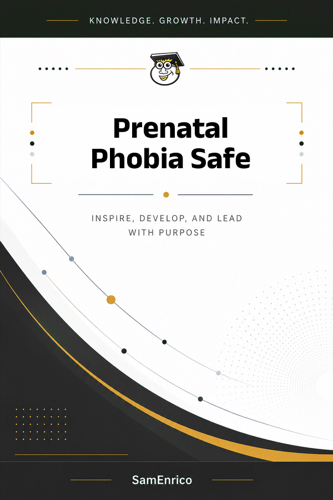
Prenatal Phobia Safe eBook
Treat fears during pregnancy with non-medication e
Treat fears during pregnancy with non-medication exposure while protecting fetal health.
Formats
Free sample
Chapter 1: The Avoidance Trap--–- You are standing in your kitchen, phone in hand, staring at the confirmation text from your obstetrician’s office. The appointment is tomorrow at 9:15 AM. Routine blood work. Just a small needle. Five seconds of discomfort.
Your hand is already trembling. Your heart has begun that familiar, ugly gallop—the one that tells you fight or flight has been triggered. But there is no tiger in your kitchen. There is only a text message.You tell yourself you are protecting your baby. If you skip this blood draw, you reason, your stress hormones won’t spike.
Your heart won’t race. Your baby won’t feel the cascade of cortisol that you know—because you have read the forums, because you have lain awake at 2 AM Googling—crosses the placenta. You imagine your little one floating peacefully, unaware of your terror. So you do what feels like the only loving thing. You cancel.
You reschedule. You avoid.And for about twenty minutes, you feel better.Then the shame arrives. It is not a gentle visitor. It arrives like a fist. You know you need that glucose tolerance test.
You know that skipping the Rhogam shot could sensitize your immune system against a future pregnancy. You know that avoiding routine blood work means your provider cannot check for anemia or infection or gestational diabetes. But knowing does not stop the fear. Knowing only adds a second layer—fear of the fear, and guilt for having it in the first place.This chapter is going to show you something counterintuitive, something that every best-selling book on anxiety confirms but that your instincts will fight: avoidance is not protecting your baby. Avoidance is making your phobia stronger, and your untreated phobia is a greater risk to your fetus than a brief, controlled exposure ever will be.By the end of this chapter, you will understand why hiding from triggers sensitizes your amygdala, why prenatal phobia is fundamentally different from other anxieties, and how to use the 24-Hour Rule to determine whether you need the protocol in this book.
You will also complete an exercise that will likely surprise you—one that will show you, in your own words and numbers, that avoidance is not working.The Safety Trap: Why Your Brain Lies to You Let us start with a basic fact about how all brains work. When you encounter something frightening, your amygdala—a small, almond-shaped cluster of neurons deep in your temporal lobe—sounds an alarm. That alarm triggers your hypothalamus, which activates your sympathetic nervous system. Your heart rate increases. Your breathing quickens.
Your pupils dilate. This is the fear response, and it evolved over millions of years to keep you alive.Here is the crucial piece: your amygdala learns from experience. If you encounter a threat and escape unharmed, your amygdala files that information away. The next time you encounter the same trigger, the alarm sounds a little faster and a little louder. This is called sensitization.Now consider what happens when you avoid.
Let us say you have a phobia of needles. You see an appointment for a blood draw on your calendar. Your amygdala sounds the alarm. You cancel the appointment. The alarm stops.
You feel relief. Your brain logs: Avoidance worked. Needles are dangerous. We survived by running away.The next time you see a needle—even a picture, even the word—your amygdala will sound the alarm even faster. Because last time, you treated the needle like a life-threatening predator.
You fled. And you survived. Your brain does not know the difference between fleeing a tiger and canceling a blood draw. It only knows that you perceived a threat, you escaped, and you are still alive. Therefore, the threat must have been real.
Therefore, you must avoid it again.This is the safety trap. Avoidance provides immediate relief—which is powerfully reinforcing—but it prevents habituation. Habituation is the process by which your nervous system learns, through repeated, non-catastrophic exposure, that a trigger is not actually dangerous. Without habituation, your phobia will not fade. It will grow.Dr.
Edna Foa, one of the world’s leading researchers on anxiety treatment, has demonstrated across dozens of studies that avoidance is the single strongest predictor of whether a phobia will become chronic. In her landmark 2010 meta-analysis of 33 clinical trials involving over 2,000 patients, she found that the degree of avoidance behavior at intake was a better predictor of long-term outcomes than the severity of the fear itself. The more you avoid, the sicker you get.For a pregnant woman, this has direct fetal consequences. Each time you avoid, your amygdala becomes more sensitized. Your baseline anxiety creeps upward.
Your resting cortisol levels—which we will explore in depth in Chapter 2—remain elevated between panic attacks. And that chronic, low-grade cortisol elevation does cross the placenta. Not the spike during a brief exposure. The chronic elevation from living in a state of constant vigilance.The irony is brutal: the behavior you are doing to protect your baby—avoidance—is the very behavior that is most likely to keep your stress hormones chronically elevated. A brief, controlled exposure session might spike your cortisol for ten minutes.
But living in avoidance keeps your cortisol mildly elevated for days or weeks. And it is the chronic elevation, not the acute spike, that concerns fetal medicine specialists.Consider the research of Dr. Catherine Monk at Columbia University Medical Center. Her team has shown that pregnant women with untreated anxiety disorders have higher baseline cortisol levels, which are associated with lower birth weights, earlier gestational age at delivery, and alterations in infant stress reactivity that persist into the first year of life. In her 2019 study of 196 mother-infant pairs, women who met criteria for a specific phobia but received no treatment had infants with significantly elevated cortisol responses to a routine heel stick blood draw at 24 hours of life.
Their babies were already showing signs of a sensitized stress response.The takeaway is uncomfortable but necessary: by avoiding your phobia, you are not keeping your baby calm. You are building a nervous system in yourself—and potentially in your baby—that is primed for anxiety.Why Prenatal Phobia Is Different If you had a fear of flying, you could simply decide not to fly. You could drive, take a train, or stay home. Your phobia might inconvenience you, but it would not carry moral weight.Prenatal phobia is fundamentally different. The stakes are not your comfort.
The stakes are your baby’s health. When you are afraid of a blood draw and you avoid it, you are not just inconveniencing yourself. You are potentially missing a diagnosis of gestational diabetes, which can lead to macrosomia (a very large baby), shoulder dystocia during delivery, neonatal hypoglycemia, and stillbirth in severe cases. When you are afraid of Rhogam and you avoid it, you are putting future pregnancies at risk of hemolytic disease of the newborn. When you are afraid of prenatal vitamins because they trigger your emetophobia, you are risking neural tube defects from folate deficiency.This is not abstract.
These are real, measurable risks.And here is the cruelest part of prenatal phobia: you likely feel guilty about being afraid.…
This is the end of the free sample. Get the eBook to keep going. Buy now
About this book
Details
- Author
- Mallory Alexa
- Publisher
- SamEnrico
- Language
- English
- Genre
- Non-Fiction, Health & Wellness
- Released
- 2026-06-11
- Pages (approx.)
- 152
- Available as
- eBook, Audiobook

Read better in the ZLOADR app
Your eBooks on your phone or tablet. Sign in with your SamEnrico account and start reading.
More by Mallory Alexa
 Danny Gonzalez GregMallory Alexa$11.99
 Research Proposal for NIH F31 FellowshipMallory Alexa$11.99
 Graduate School Stress ManagementMallory Alexa$11.99
 Peak Load PricingMallory Alexa$11.99
 The Senior Pride Self Esteem GuideMallory Alexa$11.99
 Return Migration TrendsMallory Alexa$11.99
 Bodybuilding Posing HypnosisMallory Alexa$11.99
 The Silk and the Scepter: A Royal Alliance of Power and PassionMallory Alexa$11.99
 The Iron Masters of Meroë: Forging the Weapons of the Kushite KingsMallory Alexa$11.99
 The Righteous Brothers: Unchained Melody, Unmatched HarmonyMallory Alexa$11.99
 The Mineral Guide to CancriniteMallory Alexa$11.99
 Electric Vehicle Technology FoundationsMallory Alexa$11.99
You may also like
 Hong Kong Handover 1997Dunn Johnnie$11.99
 Zumba For Postnatal Recovery CourseNeal Christian$11.99
 Zumba for BeginnersLadner Nikia$11.99
 YouTube Comment Mining GuideHumes Pandora$12.99
 Worry Box MeditationCarlin Rudy$11.99
 Workplace Stress MeditationNguyen Lynn$11.99
 Workplace Stress and Sleep RepairHawley Ivory$11.99
 Workplace Perfectionism CureDelaney Jeffry$11.99
 Workplace Injustice Anger GuideWallen Isabelle$11.99
 Work Addiction and Burnout LinkGreenwood Ester$11.99
 Women in Yoga and WellnessBeattie Galina$11.99
 Women in Stand Up ComedyChun Evangeline$11.99