
Non-FictionHealth & WellnessObstetrics
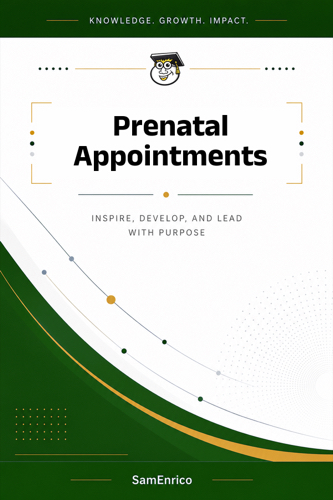
Prenatal Appointments eBook
Teaches schedule and what to expect at each visit.
Teaches schedule and what to expect at each visit.
Formats
Free sample
Chapter 1: The Waiting Room...--You are sitting on the edge of your bed, staring at a plastic stick. Two pink lines. A digital screen that reads “Pregnant.” A plus sign. However the news arrived, it has officially arrived, and now your brain is doing something remarkable. It is cycling through every emotion at once: joy, fear, disbelief, excitement, terror, hope, and a strange, hollow uncertainty about what comes next.You want to do everything right.
You want to call a doctor immediately, schedule every appointment, read every book, and build a fortress of medical certainty around this tiny new life. You pick up your phone. You dial the number for an obstetrician’s office. A receptionist answers. You say, “I just found out I am pregnant.” She asks for the first day of your last period.
You do not know. She asks for your insurance card. You fumble. She tells you your first appointment will be in four to six weeks, and then she hangs up.Four to six weeks. You hang up the phone and think: What am I supposed to do until then?
Is something supposed to happen? What if something goes wrong and I do not know?This chapter is for that moment. It is for the confusing, anxiety-ridden space between the positive test and the first prenatal appointment. It is not a chapter about what happens at four to six weeks. It is a chapter about how to survive the wait, what is actually happening inside your body right now, and how to walk into that first appointment as a calm, prepared, empowered patient rather than a terrified stranger in a paper gown.Let us begin with what no one tells you: the first prenatal appointment is not about your baby.
It is about you.The Unspoken Truth About Your First Visit At four to six weeks of pregnancy, your baby is not a baby yet. It is an embryo. It is smaller than a grain of rice. It does not have a heartbeat that can be heard on a Doppler. It cannot be seen on an abdominal ultrasound.
It is a collection of cells dividing at an astonishing rate, but it is not photogenic, not measurable in meaningful ways, and not something your doctor can “check on” to give you reassurance.So what is the point of the first appointment?The point is your baseline. This appointment exists to answer one question above all others: Who are you, medically speaking, before pregnancy changes everything? Your blood pressure at this visit becomes the number against which every future reading will be compared. Your weight becomes the starting line for recommended gain. Your blood type, your immunity to certain infections, your thyroid function, your hemoglobin levels—all of these become the foundation upon which your entire prenatal care is built.Think of it this way.
If you are building a house, you do not start with the roof. You start with the foundation, buried underground, invisible to everyone who will eventually live there. That is what this appointment is. It is invisible, unglamorous, and absolutely essential.Most first-time parents walk into this appointment expecting magic. They expect to see a tiny flickering heartbeat on a screen.
They expect to hear galloping hooves on a Doppler. They expect to leave with a photo and a wave of reassurance that everything will be fine. When none of that happens, they feel disappointed, anxious, or even abandoned.Let me save you from that disappointment. This appointment is not magic. It is paperwork.
It is blood draws. It is a medical history so detailed it will feel like a biography. And that is exactly what it should be.Choosing Your Medical Home Before you can have an appointment, you need a provider. This decision is more personal than medical, but it is also one of the most consequential choices you will make in your pregnancy. You have three main options, and each comes with its own philosophy, scope of practice, and setting.Obstetrician-Gynecologist (OB/GYN)An OB/GYN is a medical doctor who completed four years of medical school, four years of residency training in obstetrics and gynecology, and often additional fellowship training in high-risk pregnancy (maternal-fetal medicine).
They can manage complicated pregnancies, perform cesarean sections, handle emergencies like hemorrhage or uterine rupture, and care for pre-existing medical conditions like diabetes or hypertension during pregnancy.Choose an OB/GYN if: you have a high-risk condition (diabetes, autoimmune disease, history of preterm birth, multiple gestation), you want the full range of medical interventions available, or you simply prefer the security of a physician-led model.The trade-off: OB/GYN practices are often busy. You may see a different provider at each appointment. The person who delivers your baby may be someone you have never met. Appointments can feel rushed.Family Medicine Physician A family medicine doctor also completed medical school and residency, but their training covers the whole family—adults, children, and pregnant people. Many family physicians provide obstetrical care for low-risk pregnancies, including vaginal deliveries.
Some also perform cesarean sections, though this is less common.Choose a family physician if: you already have a family doctor you love and trust, you want a single provider who might also care for your baby after birth, and you have a low-risk pregnancy.The trade-off: not all family physicians offer obstetrical care. Among those who do, many stop providing it after a certain number of years or after a certain number of deliveries. You need to ask upfront.Certified Nurse-Midwife (CNM) or Certified Professional Midwife (CPM)Midwives are not medical doctors (with the exception of CNMs, who are advanced practice nurses with master’s degrees). They specialize in low-risk, uncomplicated pregnancies and emphasize minimal intervention, natural pain management, patient autonomy, and continuous labor support. CNMs practice in hospitals and birth centers.
CPMs may attend home births.Choose a midwife if: you are low-risk, you want a low-intervention birth, you value longer appointment times and a more relational model of care, and you are comfortable with the plan that you will be transferred to an OB/GYN if a complication arises.The trade-off: midwives cannot perform cesarean sections or manage high-risk conditions. If you develop gestational diabetes, preeclampsia, or need an induction, you will be transferred to physician care.How to Choose: Three Questions for Every Provider Before you schedule your first appointment, call the office and ask these three questions. Listen not just to the answers but to how the person answering sounds. Do they seem rushed? Annoyed?
Helpful? Warm? You are not being demanding. You are gathering data.“Do you deliver at the hospital or birth center I prefer?” If the answer is no, that is a dealbreaker.“Who covers for you when you are off call?” The answer should be a specific person or group. If they say “whoever is on call that day,” ask to meet that person during your pregnancy.“What is your philosophy on induction, epidurals, and cesarean sections?” There is no right answer to this question.
There is only alignment with your values. If you want an unmedicated birth and your provider says “most of my patients get epidurals…
This is the end of the free sample. Get the eBook to keep going. Buy now
About this book
Details
- Author
- Skaggs Camilla
- Publisher
- SamEnrico
- Language
- English
- Genre
- Non-Fiction, Health & Wellness, Obstetrics
- Released
- 2026-06-07
- Pages (approx.)
- 142
- Available as
- eBook, Audiobook

Read better in the ZLOADR app
Your eBooks on your phone or tablet. Sign in with your SamEnrico account and start reading.
More by Skaggs Camilla
 The Nightmare Rescripting CoachSkaggs Camilla$11.99
 From Immigrant To CEO MemoirSkaggs Camilla$11.99
 Unidentified Remains Cold Case Social MediaSkaggs Camilla$11.99
 The Spiral Image InductionSkaggs Camilla$11.99
 Freelancer Burnout Prevention PlanSkaggs Camilla$11.99
 Public Speaking for TeensSkaggs Camilla$11.99
 Mental Toughness HandbookSkaggs Camilla$11.99
 The Jade Emperor's Celestial ArchitectsSkaggs Camilla$11.99
 Whispers of the First Snow: The Lost Colony of Roanoke’s Final WinterSkaggs Camilla$11.99
 How to Produce Nursing and FeedingSkaggs Camilla$11.99
 How to Produce Aquaculture EquipmentSkaggs Camilla$11.99
 Brazil Customer Address Format GuideSkaggs Camilla$12.99
You may also like
 Hong Kong Handover 1997Dunn Johnnie$11.99
 Zumba For Postnatal Recovery CourseNeal Christian$11.99
 Zumba for BeginnersLadner Nikia$11.99
 YouTube Comment Mining GuideHumes Pandora$12.99
 Worry Box MeditationCarlin Rudy$11.99
 Workplace Stress MeditationNguyen Lynn$11.99
 Workplace Stress and Sleep RepairHawley Ivory$11.99
 Workplace Perfectionism CureDelaney Jeffry$11.99
 Workplace Injustice Anger GuideWallen Isabelle$11.99
 Work Addiction and Burnout LinkGreenwood Ester$11.99
 Women in Yoga and WellnessBeattie Galina$11.99
 Women in Stand Up ComedyChun Evangeline$11.99