
Non-FictionMental WealthExpressive Writing
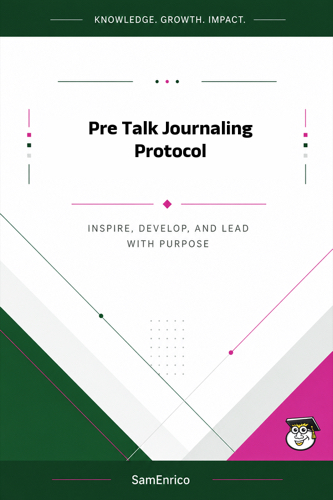
Pre Talk Journaling Protocol eBook
Write uncensored fears for ten minutes then shred
Write uncensored fears for ten minutes then shred the paper symbolically.
Formats
Free sample
Chapter 1: The Seven Visitors...--–- Before a difficult conversation, you are never alone. Seven visitors arrive without invitation. They do not knock. They simply appear in your chest, your throat, your clenched jaw, your racing heart. You did not invite them, but they come anyway, every single time.
Their names are Rejection, Anger, Shame, Foolishness, Loss of Control, Misunderstanding, and Conflict Itself. They have been visiting you since childhood, and they will visit you until your last difficult conversation. The question is not how to make them leave. The question is how to recognize them, name them, and stop them from running the show.This chapter is about those seven visitors. By the time you finish reading, you will be able to identify exactly which fear or combination of fears is activating in your body before any hard talk.
You will understand why your mouth goes dry, why your voice rises an octave, why you suddenly cannot find words you have used a thousand times before. And you will meet a manager named Elena who spent three years frozen before every feedback session—until she learned that the visitors lose their power the moment you write their names on paper.The Anatomy of Pre-Conversation Fear Let us start with a simple question. What actually happens inside you before a difficult conversation? Not the story you tell yourself afterward. Not the rationalization.
The raw, somatic, undeniable experience.For most people, the experience follows a predictable sequence. First, you anticipate the conversation—sometimes hours before, sometimes days. Your brain begins what psychologists call "threat simulation." You run scenarios. You imagine what they will say. You rehearse your responses.
You prepare defenses. This is not a sign of weakness. It is your brain doing exactly what it evolved to do: predict danger before it arrives.But here is the problem. Threat simulation does not resolve fear. It amplifies it.
Each rehearsal adds new branches of possibility. What if they say this? What if they react that way? What if I freeze? What if I cry?
What if they laugh? The branches multiply until your mental map of the conversation contains a thousand possible disasters and zero clear paths.Then the somatic symptoms arrive. Your heart rate increases. Your breathing becomes shallow. Your jaw clenches.
Your palms sweat. Your stomach knots. Your throat tightens. Your voice rises in pitch. You may feel hot or cold.
You may experience the "freeze" response—that peculiar sensation of words disappearing from your mouth as if someone has pulled a plug.These symptoms are not random. They are your autonomic nervous system activating for survival. The problem is that the threat is not a predator. The threat is a conversation. And your nervous system cannot tell the difference.The Seven Core Fears After analyzing hundreds of case studies and decades of communication research, the author has identified seven core fears that recur across virtually every difficult conversation context.
These are not obscure psychological categories. They are the visitors you already know.Fear #1: Rejection This is the fear that the other person will withdraw, dismiss, exclude, or abandon you. It shows up in romantic conflict ("What if they leave me?"), in workplace conversations ("What if they fire me?"), in boundary-setting ("What if they cut me off?"), and in any situation where your sense of belonging feels at stake. Rejection fear is often accompanied by a specific somatic signature: a hollow or empty feeling in the chest, as if something has been scooped out.Fear #2: Anger This is actually two fears in one. First, the fear that the other person will become angry with you.
Second, the fear that you will become angry and lose control. The first fear produces appeasement behaviors: softening your voice, apologizing prematurely, agreeing when you disagree. The second fear produces suppression behaviors: clenching your jaw, holding your breath, speaking in a monotone to avoid leaking emotion. Both are exhausting.Fear #3: Shame Shame is the fear that something is wrong with you. Not something you did—something you are.
Before a difficult conversation, shame whispers: "They will see through you. They will discover that you are incompetent, selfish, fraudulent, or broken." Unlike guilt, which focuses on behavior ("I did something bad"), shame attacks identity ("I am bad"). This is why shame-based fear feels so much heavier than other fears. It is not about what might happen. It is about who you might be revealed to be.Fear #4: Looking Foolish This is the fear of public humiliation, embarrassment, or social diminishment.
It is closely related to shame but distinct. Looking foolish is about performance. You fear that you will say the wrong thing, stumble over words, reveal ignorance, or appear clumsy. This fear is particularly acute in high-stakes professional settings, public speaking, and any conversation where you perceive a power differential. The somatic signature is often facial flushing, sweating, or a sensation of exposure.Fear #5: Losing Control This fear has two dimensions.
First, losing control of the conversation: the other person will take over, dominate, or steer the discussion somewhere you did not intend. Second, losing control of yourself: you will cry, yell, shake, or fall apart. The fear of losing control is often strongest for people who pride themselves on competence, composure, or professionalism. The thought of being seen as "out of control" is more terrifying than the content of the conversation itself.Fear #6: Being Misunderstood This is the fear that no matter what you say, they will not get it. They will twist your words.
They will assume the worst. They will hear something you did not intend. This fear is especially common for people who have experienced invalidation in the past—parents who dismissed their feelings, partners who accused them of bad intentions, bosses who assumed incompetence. The fear of being misunderstood often produces over-explaining: you say the same thing five different ways, hoping one version will land. Over-explaining, paradoxically, makes you harder to understand.Fear #7: Conflict Itself Some people fear not the content of the conversation but the very fact of disagreement.
For these individuals, any conflict—no matter how minor, no matter how well-managed—feels intolerable. This fear often comes from childhood environments where conflict led to punishment, abandonment, or violence. The nervous system learned that disagreement equals danger. As a result, even a simple "I see it differently" can trigger a full threat response. These individuals often avoid difficult conversations entirely, letting problems fester until they become crises.A Self-Diagnostic: Which Fear Owns You?Most people do not experience just one of these fears.
They experience a cluster. But typically, one fear dominates. That dominant fear shapes your entire pre-talk experience. It determines which somatic symptoms appear, which stories your brain generates, and which self-defeating behaviors you reach for.Take a moment to ask yourself the following questions. Do not overthink.
Your first instinct is usually correct.If you had to pick the single most intense fear before a difficult conversation, which of the seven would it be? Rejection? Anger? Shame? Looking foolish?
Losing control? Being misunderstood? Conflict itself?Now ask yourself: what is the first somatic symptom you notice? Racing heart? Shallow breath?
Clenched jaw? Sweating? Freezing? Tight throat? Hot face?Finally, ask yourself: what is your default behavior under this fear?…
This is the end of the free sample. Get the eBook to keep going. Buy now
About this book
Details
- Author
- Keeling Kathlyn
- Publisher
- SamEnrico
- Language
- English
- Genre
- Non-Fiction, Mental Wealth, Expressive Writing
- Released
- 2026-06-09
- Pages (approx.)
- 124
- Available as
- eBook, Audiobook

Read better in the ZLOADR app
Your eBooks on your phone or tablet. Sign in with your SamEnrico account and start reading.
More by Keeling Kathlyn
 Delegation Cost AnalysisKeeling Kathlyn$11.99
 Sitting Meditation MBSR GuideKeeling Kathlyn$11.99
 IBD Fatigue ProtocolKeeling Kathlyn$11.99
 Shadows of the Commission: The Beirut Hostage Rescue That Shook the UnderworldKeeling Kathlyn$11.99
 Freemium Conversion Pricing Without FearKeeling Kathlyn$12.99
 How to Produce Cash Registers and Pos TerminalsKeeling Kathlyn$11.99
 10 Ways to Use Almond Bark (Recipe Book)Keeling Kathlyn$11.99
 Mordenite MiningKeeling Kathlyn$11.99
You may also like
 Hong Kong Handover 1997Dunn Johnnie$11.99
 Zumba For Postnatal Recovery CourseNeal Christian$11.99
 Zumba for BeginnersLadner Nikia$11.99
 YouTube Comment Mining GuideHumes Pandora$12.99
 Worry Box MeditationCarlin Rudy$11.99
 Workplace Stress MeditationNguyen Lynn$11.99
 Workplace Stress and Sleep RepairHawley Ivory$11.99
 Workplace Perfectionism CureDelaney Jeffry$11.99
 Workplace Injustice Anger GuideWallen Isabelle$11.99
 Work Addiction and Burnout LinkGreenwood Ester$11.99
 Women in Yoga and WellnessBeattie Galina$11.99
 Women in Stand Up ComedyChun Evangeline$11.99