
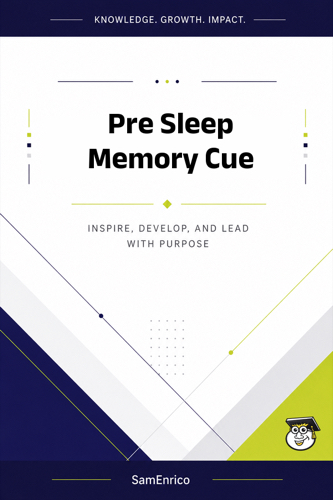
Non-FictionSelf-HelpAutosuggestion
Pre Sleep Memory Cue eBook
Tell yourself you will remember dreams before fall
Tell yourself you will remember dreams before falling asleep.
Formats
Free sample
Chapter 1: The Theft of Dreams--–- I do not remember the first dream I ever lost. None of us do. That is the cruelty of it—the forgetting happens so quietly, so completely, that we do not even know there is a wound. We wake, blink at the ceiling, and carry on. The dream, whatever it was, dissolves like sugar in hot coffee.
By the time we have poured our breakfast, it is gone. And we have been trained to believe this is normal.It is not normal. It is not inevitable. And it is costing you far more than you realize.Let me begin with a confession. For the first thirty-two years of my life, I believed I was a non-dreamer.
I would lie in bed, close my eyes, and wake up seven hours later to an empty black void. No images. No stories. No flying, no falling, no conversations with dead grandparents. Nothing.
When friends told me about their bizarre, vivid dreams over brunch, I would nod politely and feel a small, secret shame. What was wrong with my brain? Was I too logical? Too anxious? Too boring?The answer, I later learned, was none of the above.
I was dreaming every single night, just as every healthy human being does. I was simply failing to record. And the difference between those two things—between dreaming and remembering that you dreamed—is the difference between owning a library and sleeping on top of its books.This book exists to teach you how to open that library.But before we get to the how, we must first understand the what. What are we losing? How much are we losing?
And why has almost no one taught us how to keep it?The 146,000 Dreams You Will Never See Let us do a small calculation together. It will only take a moment, and I promise it will change how you think about tonight.The average human being sleeps for roughly one-third of their life. If you live to eighty years old, that means you will spend approximately twenty-six years asleep. Within those twenty-six years, your brain will cycle through the stages of sleep multiple times each night. The stage that matters most for this book is called REM—Rapid Eye Movement—and it is during REM that the most vivid, narrative-driven dreams occur.Here is the number that stopped me cold when I first encountered it: the average person experiences four to six distinct dream episodes per night.
Each dream lasts anywhere from five to forty minutes. Across a full night, that adds up to approximately two hours of dreaming. Every single night. Two hours of cinema, produced exclusively for you, by you, starring you. Over the course of a lifetime, that is roughly 146,000 individual dream episodes.One hundred and forty-six thousand.Now here is the second number, and it is the one that should make you angry: the average person remembers fewer than two hundred of those dreams.
Two hundred out of 146,000. That is a recall rate of approximately 0.14 percent.Let me put that in perspective. If your waking life had a similar recall rate, you would remember approximately one hour out of every month. You would go to work, come home, see your family, eat dinner, and by the time you woke up the next morning, almost all of it would be gone. You would not know what you did yesterday.
You would not know what you said to your spouse. You would walk through life as a ghost in your own story.That is what we have accepted as normal for our dream lives.I am not telling you this to depress you. I am telling you this because the first step toward solving a problem is recognizing that a problem exists. And the problem is not that you do not dream. The problem is that you have never been taught the simple, repeatable skill of moving those dreams from transient neural activity into long-term memory.The Great Forgetting Machine How did we get here?
Why has almost no one taught us how to remember our dreams?The answer is not conspiracy but neglect. Our educational systems teach us mathematics, literature, history, and science. They teach us how to balance a checkbook, how to write a persuasive essay, how to calculate the trajectory of a thrown baseball. They do not teach us what happens in our own brains during the eight hours we spend horizontal every night. Sleep is treated not as a skill but as a void—a gap in the day where nothing of importance occurs.This cultural blind spot has been reinforced by decades of well-intentioned but incomplete science.
For most of the twentieth century, sleep was studied as a physiological process—heart rate, brainwaves, breathing patterns—rather than a psychological one. Dream content was dismissed as "epiphenomenal," a meaningless byproduct of random neural firing. The famous neuroscientist J. Allan Hobson once compared dreams to a computer's screensaver—pretty to look at, perhaps, but carrying no real information.That view has been thoroughly overturned by modern research. We now know that dreams serve essential functions: memory consolidation, emotional regulation, creative problem-solving, and even threat simulation.
But the cultural residue of that earlier dismissal remains. Most people still believe that dreaming is either irrelevant or, at best, a minor curiosity. They do not realize that forgetting their dreams is not a neutral loss but an active cognitive cost.There is a second reason for our collective amnesia, and it is more insidious. We have built a culture that prizes productivity over presence, doing over being, waking over sleeping. We treat sleep as downtime—a necessary inconvenience before the real business of the day begins.
We brag about how little we sleep. We wear exhaustion like a badge of honor. In such a culture, dreaming becomes an afterthought. Why would you bother remembering something that happens during the "unimportant" hours?I have a different view. I believe that the eight hours you spend asleep are not less important than the sixteen you spend awake.
They are simply different. And the skills you develop during those eight hours—the emotional processing, the creative synthesis, the memory consolidation—do not stay in your bed. They walk with you into your waking life. When you forget your dreams, you are not losing entertainment. You are losing insight, clarity, and a deeper connection to your own mind.The Thirty-Second Window Let me tell you about the single most important discovery I made in my years of researching dream recall.
It is a simple fact, but it explains almost everything about why we forget our dreams so reliably.When you wake up, you have approximately thirty seconds to capture a dream before it begins to degrade. Not ten minutes. Not five. Thirty seconds. In some cases, for particularly vivid dreams, the window may extend to sixty or even ninety seconds.
But the average is thirty.Here is what happens in those thirty seconds. As you transition from sleep to wakefulness, your brain shifts from theta and delta brainwaves (associated with deep relaxation and dreaming) to beta brainwaves (associated with focused, analytical waking thought).…
This is the end of the free sample. Get the eBook to keep going. Buy now
About this book
Details
- Author
- Solis Allegra
- Publisher
- SamEnrico
- Language
- English
- Genre
- Non-Fiction, Self-Help, Autosuggestion
- Released
- 2026-06-08
- Pages (approx.)
- 135
- Available as
- eBook, Audiobook

Read better in the ZLOADR app
Your eBooks on your phone or tablet. Sign in with your SamEnrico account and start reading.
More by Solis Allegra
 Pet Loss Grief GuideSolis Allegra$11.99
 Mindful Walking for PregnancySolis Allegra$11.99
 Study Environment Optimization GuideSolis Allegra$11.99Study Environment Optimization GuideSolis Allegra$11.99
 Compulsive Spending Recovery CoachSolis Allegra$11.99
 The Pomodoro Study MethodSolis Allegra$11.99
 Difficult Customer TalksSolis Allegra$11.99
 SMART Goals for VolunteeringSolis Allegra$11.99
 The Silk Road Kingpin: The Untold Story of Paul Le RouxSolis Allegra$11.99
 The Iron Will of the Arctic: Nansen’s Impossible JourneySolis Allegra$11.99
 Service Providers Guide to Special EventsSolis Allegra$11.99
 How to Produce a KitSolis Allegra$11.99
You may also like
 Hong Kong Handover 1997Dunn Johnnie$11.99
 Zumba For Postnatal Recovery CourseNeal Christian$11.99
 Zumba for BeginnersLadner Nikia$11.99
 YouTube Comment Mining GuideHumes Pandora$12.99
 Worry Box MeditationCarlin Rudy$11.99
 Workplace Stress MeditationNguyen Lynn$11.99
 Workplace Stress and Sleep RepairHawley Ivory$11.99
 Workplace Perfectionism CureDelaney Jeffry$11.99
 Workplace Injustice Anger GuideWallen Isabelle$11.99
 Work Addiction and Burnout LinkGreenwood Ester$11.99
 Women in Yoga and WellnessBeattie Galina$11.99
 Women in Stand Up ComedyChun Evangeline$11.99