
Non-FictionSelf-HelpPrecision Sports
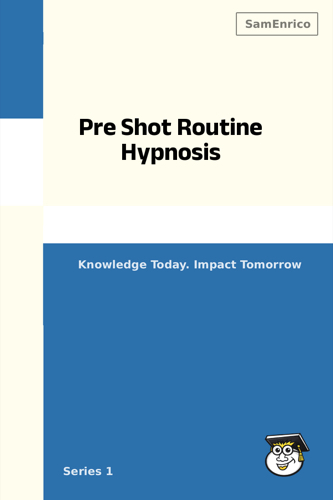
Pre Shot Routine Hypnosis eBook
Develop hypnotic pre performance rituals for golf
by Rico Toya
Develop hypnotic pre performance rituals for golf tennis and shooting sports.
Formats
Free sample
Chapter 1: The Broken Flinch--–- The seventy-two-year-old man had not made a three-foot putt in four years. Not one. Not in practice, not in competition, not even when he was alone on the green at sunset with absolutely nothing at stake. His hands would begin to tremble approximately 1.7 seconds after he took his stance—he knew the timing because a sports psychologist had once filmed him with a high-speed camera. The putter head would twitch.
The ball would veer right. And then he would stand there, frozen, watching a putt that required exactly zero physical effort roll past the hole like a small white insult.His name was Robert, and he had been a scratch golfer for thirty years before the yips stole his game. He had tried everything: longer putters, shorter putters, belly putters, claw grips, left-hand-low, looking at the hole, closing his eyes, breathing techniques, meditation apps, acupuncture, magnesium supplements, and a brief, humiliating experiment with a putting aid that strapped his wrists together like a pair of handcuffs. Nothing worked. The yips, he told me during our first session, were not a physical problem.
He had proven this to himself by sinking forty consecutive three-foot putts one evening while blindfolded, using only feel. The moment he opened his eyes and saw the hole, the tremor returned. His conscious mind, he said, was the enemy.I told him he was exactly right. And then I taught him to blink.The Paradox of Conscious Control This is a book about a specific kind of failure. Not failure of effort, not failure of talent, not failure of practice.
You can practice a golf swing ten thousand times and still slice into the trees on the first tee of a club championship. You can hit a thousand perfect serves off-court and still double-fault at match point. You can shoot a perfect target in practice and then flinch so hard during competition that your bullet misses the paper entirely. This is not a failure of skill. It is a failure of access.
The skill is in you. It is encoded in your motor cortex, burned into your basal ganglia, etched into the neural pathways that control your most precise movements. And yet, when the moment arrives, when the crowd falls silent and the pressure rises and the hole looks impossibly small, you cannot reach it. Something blocks the path between intention and execution. Something inserts itself between the thought and the action.That something is your conscious mind.Let me be clear about what I am not saying.
I am not saying that conscious thought has no role in sports. Of course it does. You need consciousness to decide which club to hit, whether to serve wide or down the middle, whether to aim for the center of the target or the edge. Conscious thought is essential for strategy, for planning, for learning new skills. But here is the truth that separates elite performers from everyone else: once you have made your decision, once you have addressed the ball and set your feet and taken your stance, consciousness becomes a liability.
Every millisecond of conscious analysis after that point degrades the quality of the execution. The reason is simple. Conscious thought is slow. It operates at roughly 40 to 60 bits of information per second. Your subconscious motor system, by contrast, operates at approximately 11 million bits per second.
When you allow consciousness to interfere with a well-learned motor program, you are effectively asking a horse to walk while you micromanage the contraction of each individual muscle fiber. The horse stumbles. The shot fails.This is not philosophy. This is neuroscience. The reticular activating system—a bundle of neurons in your brainstem that functions as a filter for sensory information—determines what you notice and what you ignore.
Under pressure, an untrained reticular activating system fixates on threats: the water hazard, the crowd, the memory of the last double fault, the voice in your head that says "don't miss this." Hypnosis, as you will learn throughout this book, trains your reticular activating system to filter in kinesthetic feedback—the feel of the clubface, the tension in your shoulder turn, the pressure of your finger on the trigger—and filter out irrelevant anxiety signals. You do not need to eliminate nervousness. You simply need to redirect your attention away from it and toward the only thing that matters: the feel of the shot.Robert, the seventy-two-year-old golfer, had become a textbook case of conscious interference. His brain, in the presence of a short putt, was doing exactly what it was designed to do. It was scanning for threats, finding the hole and the stakes and the possibility of missing, and then sending emergency signals to his hands.
The tremor was not a bug. It was a feature. His nervous system was trying to protect him from shame by freezing his motor output. The solution, paradoxically, was not to try harder. The solution was to stop trying.What This Chapter Will Teach You Before we proceed, let me tell you exactly what you will learn in this chapter.
First, you will understand why precision sports—golf, tennis serves, shooting sports—require a fundamentally different mental approach than reactive sports like basketball or soccer. Second, you will learn the neurological basis of the "yips" and its cousins (target panic in shooting, double-fault syndrome in tennis) as a learned subconscious response, not a personality flaw. Third, you will be introduced to the concept of waking hypnosis and why it is the most efficient method for bypassing conscious interference. Fourth, you will learn the single most important distinction in this entire book: the difference between cognitive visualization (which is worse than useless) and hypnotic imagery (which is transformative). And fifth, you will receive your first practical exercise—a breathing protocol that will serve as the foundation for every technique that follows.By the end of this chapter, you will understand why every conscious thought you have after addressing the ball is a betrayal of your own talent.
And you will begin the process of learning to stop.Why Aiming Sports Are Different Let us consider three athletes. The first is a basketball player at the free-throw line. The second is a tennis player preparing to serve. The third is a golfer standing over a three-foot putt. All three are performing stationary, self-paced actions.
But only two of them have time to think. The basketball player has ten seconds to shoot, but the shot itself takes less than one second. The tennis player has twenty seconds between points, but the serve motion takes less than two seconds. The golfer, by contrast, can stand over a putt for thirty seconds or more. That extra time is not a gift.
It is a weapon pointed at his own head.Aiming sports—by which I mean any sport where you have time to aim, time to hesitate, and time to talk yourself out of success—create a unique psychological trap. The trap works like this. You have a target. You have a mechanical action that delivers an implement (club, racket, bow, gun) to a ball or a projectile. And you have time.
Time to notice that your heart is beating faster than usual. Time to remember the last time you missed. Time…
This is the end of the free sample. Get the eBook to keep going. Buy now
About this book
Details
- Author
- Rico Toya
- Publisher
- SamEnrico
- Language
- English
- Genre
- Non-Fiction, Self-Help, Precision Sports
- Released
- 2026-06-10
- Pages (approx.)
- 147
- Available as
- eBook, Audiobook

Read better in the ZLOADR app
Your eBooks on your phone or tablet. Sign in with your SamEnrico account and start reading.
More by Rico Toya
 Neuroplasticity Pain RetrainingRico Toya$11.99
 Buying Retirement Home RemotelyRico Toya$11.99
 The Accountant NetworkRico Toya$11.99
 Self Esteem and Chronic IllnessRico Toya$11.99
 The Silk and the Sickle: Ibn Battuta’s Lost Amazon ExpeditionRico Toya$11.99
 The Enigma of the Rosetta Stone: Decoding Ancient SecretsRico Toya$11.99
 Understanding Eye Defects Arachnodactyly CardiopathyRico Toya$17.99
 Writing Executive Summaries for HR and Talent PlansRico Toya$12.99
 Procurement Transformation GuideRico Toya$12.99
 OSP Construction ManagerRico Toya$11.99
 How to Become a Mold-filling OperatorRico Toya$11.99
You may also like
 Hong Kong Handover 1997Dunn Johnnie$11.99
 Zumba For Postnatal Recovery CourseNeal Christian$11.99
 Zumba for BeginnersLadner Nikia$11.99
 YouTube Comment Mining GuideHumes Pandora$12.99
 Worry Box MeditationCarlin Rudy$11.99
 Workplace Stress MeditationNguyen Lynn$11.99
 Workplace Stress and Sleep RepairHawley Ivory$11.99
 Workplace Perfectionism CureDelaney Jeffry$11.99
 Workplace Injustice Anger GuideWallen Isabelle$11.99
 Work Addiction and Burnout LinkGreenwood Ester$11.99
 Women in Yoga and WellnessBeattie Galina$11.99
 Women in Stand Up ComedyChun Evangeline$11.99