
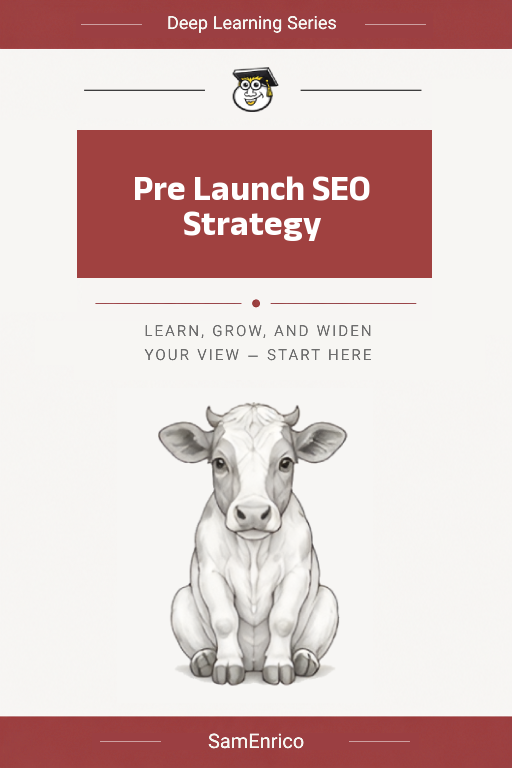
Non-FictionStartup GuideWaitlist Strategy
Pre Launch SEO Strategy eBook
Use SEO to attract pre-launch community members. C
Use SEO to attract pre-launch community members. Content targeting early adopters.
Formats
Free sample
Chapter 1: The Demand Vacuum--The most dangerous day in the life of your business is not the day you run out of money, the day your server crashes, or the day a competitor copies your feature. The most dangerous day is the day you launch. That sounds counterintuitive. Launch day is supposed to be the celebration, the culmination of months of blood, sweat, and sleepless nights. It is the day you finally open the doors and let the world see what you have built.And for ninety percent of founders and authors, that day is a quiet, humiliating failure.Not because the product is bad.
Not because the pricing is wrong. Not because the logo isn't shiny enough. Launch day fails for a reason that has almost nothing to do with the product itself and almost everything to do with a fundamental misunderstanding of how attention actually works in the age of algorithms. The vast majority of entrepreneurs build a product, then try to find an audience, then finally create content to support both. This order of operations is a death sentence.
It is the fastest route to launching a beautiful, functional, completely invisible product into a world that never asked for it because it never knew it existed.This book exists to flip that sequence on its head.What you are about to read is not a traditional SEO guide. It will not teach you how to rank for "best project management software" or "top CRM for small business" because those keywords are graveyards for the pre-launch founder. You cannot win there. Not yet. Instead, this book teaches you how to build a community of early adopters using search engines as your primary acquisition channel before you have a product to sell.
It teaches you how to create a "demand vacuum" — a body of content so useful, so specific, so perfectly aligned with the frustrations of your future customers that when you finally do launch, the market sucks the product out of your hands.This is Chapter One. It is not a warm-up. It is not fluff. It is the demolition of everything you thought you knew about launching, followed by the construction of a new framework that will determine whether your launch day is a funeral or a festival.The Statistic That Should Terrify You Let me start with a number that does not get discussed enough in startup circles or author communities: ninety percent.According to data aggregated from Product Hunt, Amazon KDP, and Crunchbase, approximately ninety percent of new product launches fail to achieve any meaningful traction in their first thirty days. "Meaningful traction" here means more than one hundred paying customers, more than one thousand downloads, or a sustained ranking on the first page of relevant search results.
Ninety percent. That means for every ten founders or authors who pour their hearts into a launch, nine of them watch their announcement tweet get three retweets, their Product Hunt post get seven upvotes, and their email list generate crickets.The reflexive reaction to this statistic is to blame the product. "My solution wasn't good enough." "My pricing was off." "My design wasn't polished." Sometimes that is true. But the more common culprit is far simpler and far more fixable: zero organic authority on the day of launch.Think about what happens when you launch a product using the traditional "spray and pray" method. You issue a press release.
You post on social media. You send an email to your personal network. You might even buy some ads. All of this activity happens on a single day or across a single week. Then you wait.
And nothing happens. Why?Because every single one of those channels — press releases, social media posts, ads, personal emails — is a push channel. You are pushing your message out to people who are not actively looking for you. You are interrupting them. And human beings have become extraordinarily skilled at ignoring interruptions.
We have ad blockers, spam filters, mute buttons, and the infinite scroll. We do not want to be sold to. We want to find answers when we need them.The Velocity Principle: What Amazon and Google Actually Reward The founders who succeed despite the ninety percent failure rate understand something that the other ninety percent do not: algorithms do not care about your launch date. Amazon does not know that you spent six months writing your book. Google does not know that you mortgaged your house to build your Saa S product.
What they know is velocity.Let me explain the Velocity Principle with specificity, because this is the single most important concept in this entire book.Amazon's ranking algorithm for new book releases is built primarily around sales velocity — the rate at which a book sells copies immediately after launch. A book that sells two hundred copies in its first hour will almost always outrank a book that sells two thousand copies spread evenly across its first month. Amazon interprets high initial velocity as a signal of relevance and quality. "If this many people bought it this fast," the algorithm reasons, "it must be worth showing to more people." This is why you see books with zero reviews shooting to the top of their categories for a few hours before settling into a more stable position. That is velocity in action.Google's ranking algorithm operates on a similar principle, but with a different input.
Google rewards answering velocity — how quickly a domain provides the definitive answer to a newly asked question. When a user types a query into Google, the algorithm is trying to solve a specific problem: which page on the internet is most likely to satisfy this user's intent right now? One of the strongest signals is freshness combined with relevance. A page that was published six days ago and has already accumulated twenty backlinks and five hundred visits will often outrank a page that was published six years ago and has slowly accumulated authority over time.Here is the insight that changes everything: you can engineer velocity. You can create it deliberately, pre-launch, without a product to sell.The Fatal Order of Operations Most founders and authors follow a sequence that looks like this:Product → Community → Content They build the product first (or write the book first).
Then they try to find a community to sell it to. Then, as an afterthought or a desperate measure, they create content — blog posts, social media threads, You Tube videos — to try to attract attention. This sequence fails for a structural reason that has nothing to do with execution quality.When you build the product first, you are building in a vacuum. You are making assumptions about what your customers want without any evidence beyond your own intuition. You are designing features, writing chapters, and pricing tiers based on guesses.
Then, when you try to find a community, you discover that the community does not know you exist and has no reason to trust you. You are a stranger knocking on a door. Finally, when you create content, you are creating it under pressure — the launch date is approaching, the clock is ticking, and every blog post feels like…
This is the end of the free sample. Get the eBook to keep going. Buy now
About this book
Details
- Author
- Chapa Herlinda
- Publisher
- SamEnrico
- Language
- English
- Genre
- Non-Fiction, Startup Guide, Waitlist Strategy
- Released
- 2026-06-01
- Pages (approx.)
- 139
- Available as
- eBook, Audiobook

Read better in the ZLOADR app
Your eBooks on your phone or tablet. Sign in with your SamEnrico account and start reading.
More by Chapa Herlinda
 Noise Cancellation AlternativeChapa Herlinda$11.99
 Assertiveness in Romantic RelationshipsChapa Herlinda$11.99
 Mindfulness for New ParentsChapa Herlinda$11.99
 Loneliness After Leaving ReligionChapa Herlinda$11.99
 The Daily Idea Capture HabitChapa Herlinda$11.99
 The Forbidden Screen: How a Medieval Scribe’s Illuminated Manuscripts Sparked a Renaissance Film ScandalChapa Herlinda$11.99
 Learn to Play the BagpipeChapa Herlinda$11.99
 MOOC Certificate Renewal GuideChapa Herlinda$12.99
 How to Start a Phenolic Resins Business (Beginners Guide)Chapa Herlinda$11.99
 Assistant Manager TraineeChapa Herlinda$11.99Assistant Manager TraineeChapa Herlinda$11.99
You may also like
 Hong Kong Handover 1997Dunn Johnnie$11.99
 Zumba For Postnatal Recovery CourseNeal Christian$11.99
 Zumba for BeginnersLadner Nikia$11.99
 YouTube Comment Mining GuideHumes Pandora$12.99
 Worry Box MeditationCarlin Rudy$11.99
 Workplace Stress MeditationNguyen Lynn$11.99
 Workplace Stress and Sleep RepairHawley Ivory$11.99
 Workplace Perfectionism CureDelaney Jeffry$11.99
 Workplace Injustice Anger GuideWallen Isabelle$11.99
 Work Addiction and Burnout LinkGreenwood Ester$11.99
 Women in Yoga and WellnessBeattie Galina$11.99
 Women in Stand Up ComedyChun Evangeline$11.99