
Non-FictionSelf-HelpCompetition Prep
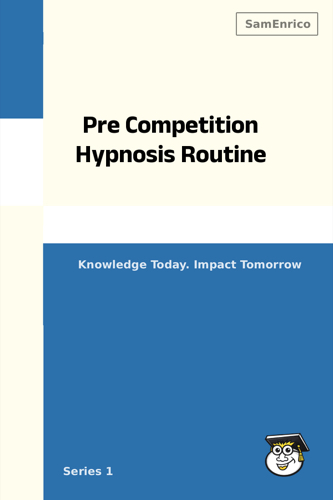
Pre Competition Hypnosis Routine eBook
Optimizes pre game mindset with hypnotic calm and
Optimizes pre game mindset with hypnotic calm and focus.
Formats
Free sample
Chapter 1: The Choke Paradox--–- It is the single most heartbreaking sight in all of sports. The basketball player at the free-throw line, down by one point, with two seconds on the clock. She has made this shot ten thousand times in practice. Her body knows the motion better than she knows her own phone number. The crowd falls silent.
She wipes her palms on her shorts. She takes a deep breath. And then she misses. Not because she lacks skill. Not because she is weak.
Not because she hasn't practiced enough. She misses because she tries too hard.This is the Choke Paradox. The harder you consciously effort to perform, the worse your performance becomes. Trying harder is not the solution to competitive pressure. It is the cause of the problem.
Every athlete has experienced this betrayal: the body that performs flawlessly in training becomes clumsy, hesitant, or frozen when it matters most. The mind that was quiet and clear during practice becomes a screaming committee of doubts, instructions, and fears. The result is the same across every sport, every level, from youth leagues to Olympic finals: a painful, frustrating gap between training and competition.This book is built on a radical but evidence-based claim: the solution to the Choke Paradox is not more mental effort, more positive thinking, or more willpower. The solution is learning to shift your brain into a specific, trainable state of consciousness that sport psychologists call the Zone and clinicians call hypnosis. These are not two different things.
They are the same neurophysiological state described by different languages. And that state can be triggered on command, in under ten seconds, regardless of how loud the crowd is or how much is at stake.The journey of this book is to teach you that skill. But before we build the solution, we must fully understand the problem. Why does trying harder fail? What is happening inside your brain when you choke?
And most importantly, how can the same mechanism that causes choking also be the key to unlocking your best performance?The Neuroscience of the Two Brains To understand why choking happens, you must first understand that you have two functionally distinct brains living inside your skull. This is not a metaphor. This is neuroscience. The distinction between what psychologists call the analytical mind and the unconscious mind is as real as the distinction between your heart and your lungs.The analytical mind lives primarily in your prefrontal cortex, the outer layer of the front part of your brain. This is your conscious, verbal, linear, critical brain.
It is the part that reads these words, that makes to-do lists, that worries about what others think, that tells you "don't miss" before a free throw. The analytical mind is slow. It processes information at about 50 bits per second. It is deliberate, sequential, and exhausting to maintain for long periods. It is also the seat of your inner critic.The unconscious mind, by contrast, lives in a distributed network including the basal ganglia, cerebellum, and somatosensory cortex.
This is your automatic, fast, pattern-based, non-judgmental brain. It processes information at roughly 11 million bits per second. It runs your heartbeat, your breathing, your balance. It also runs your trained motor skills. When a basketball player shoots a free throw, the unconscious mind executes a program that coordinates 47 muscles, dozens of joints, and split-second timing adjustments based on visual feedback.
This program runs automatically, without conscious thought, and it runs perfectly when left alone.Here is the critical fact that most athletes never learn. The analytical mind and the unconscious mind cannot operate at full capacity simultaneously. They compete for neural resources. When you consciously think about a movement you have trained to automaticity, you literally interfere with the unconscious motor program. Your prefrontal cortex sends conflicting signals to your motor cortex.
The smooth, fluid execution becomes jerky, hesitant, and error-prone.This is why trying harder fails. Trying harder means engaging your analytical mind more intensely. But the very act of engagement disrupts the unconscious system that actually knows how to perform. You are stepping on your own hose.The Zone as Hypnosis Every athlete has experienced moments when performance felt effortless, automatic, almost magical. Time slowed down.
The crowd disappeared. The ball seemed bigger than usual, the goal wider, the opponent slower. You were not thinking about your mechanics. You were simply acting, and your actions were perfect.This state has many names. Sport psychologists call it Flow.
Athletes call it the Zone. And clinical hypnotherapists call it trance. These are not separate phenomena. They are the same state of consciousness described by different professions using different vocabularies.The defining features of the Zone are identical to the defining features of hypnosis. First, highly focused attention.
The athlete is not distracted by irrelevant stimuli. Second, reduced critical factor. The inner voice that doubts, judges, and instructs goes silent. Third, time distortion. Minutes feel like seconds, or seconds like minutes.
Fourth, effortless action. Movements happen without conscious volition. Fifth, altered body awareness. Pain diminishes, fatigue recedes, and the body feels like an extension of intention.When you understand that the Zone is hypnosis, you realize something profound. You do not have to wait for the Zone to visit you randomly.
You can learn to induce it deliberately. You can install a trigger that brings you into that state on command, in the locker room before the game, at the free-throw line, or in the final minute of the fourth quarter.But before you can use hypnosis to enter the Zone, you must unlearn what popular culture has taught you about hypnosis. You probably imagine a swinging pocket watch, a stage performer making audience members cluck like chickens, or a sinister therapist extracting hidden memories. These images are not just inaccurate. They are actively harmful to your understanding of what hypnosis actually is and how it can serve you as an athlete.Demystifying Hypnosis: What It Is and Is Not Let us clear the ground immediately.
Hypnosis is not sleep. In sleep, your conscious awareness is absent. In hypnosis, your awareness is heightened, not diminished. You are more alert, more focused, more responsive. You can hear everything around you.
You can open your eyes at any time. You cannot be made to do anything against your values. Stage hypnosis works because the performers are willing volunteers who want to entertain. No one can hypnotize you without your consent.Hypnosis is not mind control. All hypnosis is self-hypnosis.
A hypnotherapist or a recording is merely a guide. You are always in control. You can reject any suggestion that does not align with your goals. The reason hypnosis works for performance enhancement is precisely because you remain in control. You are learning to control your own mind more effectively, not surrendering control to someone else.So what is hypnosis?
Hypnosis is a state of highly focused attention with a reduced critical factor. That is the clinical definition. Let me translate. When you are hypnotized, you are paying attention to something very specific (your breathing, a spot on the wall, a feeling in your body) and your internal critic has temporarily stepped aside. That…
This is the end of the free sample. Get the eBook to keep going. Buy now
About this book
Details
- Author
- Baggett Shenna
- Publisher
- SamEnrico
- Language
- English
- Genre
- Non-Fiction, Self-Help, Competition Prep
- Released
- 2026-06-09
- Pages (approx.)
- 146
- Available as
- eBook, Audiobook

Read better in the ZLOADR app
Your eBooks on your phone or tablet. Sign in with your SamEnrico account and start reading.
More by Baggett Shenna
 Medication Assisted Treatment OptionsBaggett Shenna$11.99
 Skin Pain Meditation GuideBaggett Shenna$11.99
 Press Release For CrisisBaggett Shenna$11.99
 Circadian Rhythm JournalBaggett Shenna$11.99
 Loving Kindness for WorryBaggett Shenna$11.99
 Experiencing Rapture BreathBaggett Shenna$11.99
 Palestinian Family ReunificationBaggett Shenna$11.99
 The Tower of the Hundred Eyes: A Yokai's Architectural ObsessionBaggett Shenna$11.99
 The Golden Voices of the Grand Stage: Black Opera's Triumphant RiseBaggett Shenna$11.99
 How to Become a HumoristBaggett Shenna$11.99
 How to Produce Battery PacksBaggett Shenna$11.99
 AI Masters for Working ProfessionalsBaggett Shenna$12.99
You may also like
 Hong Kong Handover 1997Dunn Johnnie$11.99
 Zumba For Postnatal Recovery CourseNeal Christian$11.99
 Zumba for BeginnersLadner Nikia$11.99
 YouTube Comment Mining GuideHumes Pandora$12.99
 Worry Box MeditationCarlin Rudy$11.99
 Workplace Stress MeditationNguyen Lynn$11.99
 Workplace Stress and Sleep RepairHawley Ivory$11.99
 Workplace Perfectionism CureDelaney Jeffry$11.99
 Workplace Injustice Anger GuideWallen Isabelle$11.99
 Work Addiction and Burnout LinkGreenwood Ester$11.99
 Women in Yoga and WellnessBeattie Galina$11.99
 Women in Stand Up ComedyChun Evangeline$11.99