
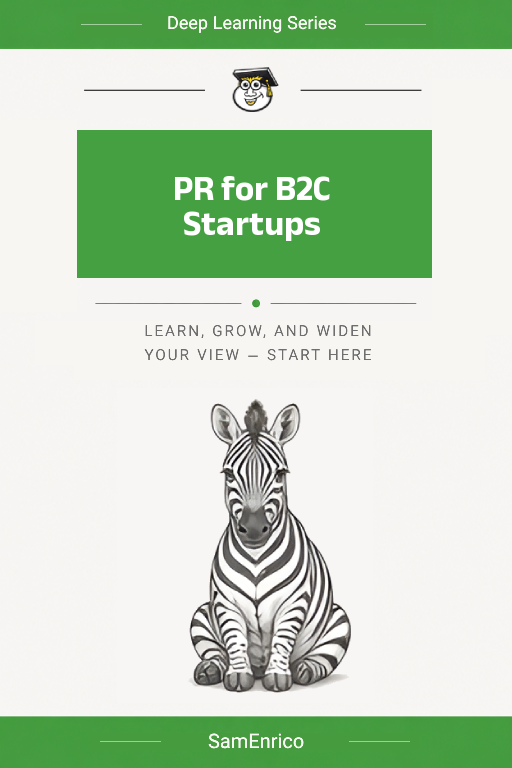
Non-FictionStartup GuideMedia Outreach
PR for B2C Startups eBook
Get consumer media coverage on zero budget. Lifest
by Maes Kandice
Get consumer media coverage on zero budget. Lifestyle, gadget, and consumer tech outlets.
Formats
Free sample
Chapter 1: The Broken Gate...--–- The first thing you need to understand about consumer media is that the gate is not actually locked. It never was. The PR industry spent nearly sixty billion dollars last year convincing founders that the gate exists, that it requires a key, and that the only way to obtain that key is to pay a monthly retainer to someone who already has it. This is a beautiful lie, because it profits from your fear of being ignored.I want you to imagine something. Imagine you are a journalist at a mid-sized consumer tech outlet.
Not a huge one—not The Verge or Wired—but a respected publication with a loyal readership. It is Tuesday morning. You have had one cup of coffee, and you are staring at your inbox. There are two hundred and forty-seven unread emails. Forty-three of them arrived in the last hour alone.
You have a deadline at eleven AM, an editorial meeting at two PM, and your editor just asked you to file an extra story because someone on the lifestyle desk called in sick.Now. Among those two hundred and forty-seven emails, how many of them do you think come from founders asking for coverage? How many contain the phrase "I hope you're well"? How many attach a three-page press release that begins with "Company X, the leader in innovative Y solutions, today announced..."?All of them. Every single one.And here is the truth that no PR agency will tell you: The journalist does not open a single one of those emails.
Not because they are mean. Not because they hate startups. Because they literally do not have the time to read two hundred and forty-seven versions of the same boring announcement.This is the broken gate. The industry has convinced you that getting coverage is a matter of access—of knowing the right person, using the right database, sending the right number of emails. But access was never the problem.
The problem is that you are sending the same email as everyone else. And everyone else is being ignored.So let me ask you a different question. A harder question. A question that will determine whether you get covered or stay invisible.If every founder is sending the same email, and every founder is being ignored, what would happen if you sent a completely different email? What would happen if you sent something that actually helped the journalist do their job?
What would happen if you stopped asking for coverage and started offering value?That is what this chapter is about. And that is what this entire book is about. Not how to buy your way through a gate that does not exist. But how to become the email that gets opened.The Sixty Billion Dollar Lie Let me be specific about the scale of the lie. The global public relations industry generated approximately sixty billion dollars in revenue last year.
A significant portion of that came from retainers paid by startups who believed they needed a "media relations expert" to get their name in print. Those startups paid monthly fees ranging from three thousand dollars to fifty thousand dollars. And what did they get in return? In many cases, they got a junior account executive who had never actually placed a story themselves, sending template emails to a media list purchased from Cision.I am not saying that all PR agencies are useless. There are excellent agencies that deliver real value for specific situations—crisis communication, IPO announcements, large-scale product launches with global coordination.
But for a B2C startup trying to get consumer media coverage on a budget of zero dollars, hiring an agency is not just unnecessary. It is actively counterproductive.Here is why. An agency charges you a retainer. That retainer pays for their time. Their time is expensive.
So they need to "demonstrate value" quickly. That means they will send a press release to five hundred journalists on the first day of the engagement. Those five hundred journalists will receive an email that looks exactly like the other two hundred and forty-seven emails in their inbox. They will delete it. The agency will report back to you that they "secured a high volume of media impressions" (meaning the press release was sent).
And then they will bill you for the next month.The agency is not evil. They are playing a different game. Their game is billable hours. Your game is getting covered. Those games are not aligned.The sixty billion dollar lie is this: You have been told that getting coverage is about access.
It is not. It is about newsworthiness. And newsworthiness has nothing to do with your budget.The Three-Second Decision Before we go any further, I need you to internalize a number. That number is three.Three seconds. That is how long a journalist spends deciding whether to delete your email or read it.
Sometimes less. Sometimes—if you catch them in a good mood, if their deadline just moved, if they have already had their second cup of coffee—maybe five seconds. But never more than that.I want you to really feel what three seconds means. Three seconds is the time it takes to take a single breath and let it out. Three seconds is the time it takes to glance at your phone, see the subject line, and swipe left to archive.
Three seconds is the difference between being read and being forgotten forever.In those three seconds, the journalist is asking themselves exactly one question: Does this email help me do my job?That is it. They are not wondering if you are a nice person. They are not evaluating the quality of your product. They are not impressed by your funding or your team or your "revolutionary approach to X." They are asking a purely selfish, purely practical question: Can I use this?If the answer is no, your email is deleted. It does not matter how many hours you spent writing it.
It does not matter how much you paid your PR consultant. It does not matter how many awards your product has won. The answer was no, and the email is gone.If the answer is yes, your email is opened. And once it is opened, you have another thirty seconds to prove that the yes was justified. But those thirty seconds only exist because you won the first three.So here is the question that will shape everything else in this book: How do you make a journalist answer "yes" in three seconds?The answer is not what you think.
The answer is not "a better subject line." The answer is not "a shorter email." The answer is not "more exclamation points." The answer is structural. It is fundamental. It requires you to stop thinking like a founder and start thinking like a journalist.The Feature Trap Let me diagnose the single most common mistake that founders make when they try to get coverage. I call it the Feature Trap.Here is how the Feature Trap works. You have built a product.
You are proud of it. You have spent months—maybe years—working on it. You know every detail, every feature, every benefit.…
This is the end of the free sample. Get the eBook to keep going. Buy now
About this book
Details
- Author
- Maes Kandice
- Publisher
- SamEnrico
- Language
- English
- Genre
- Non-Fiction, Startup Guide, Media Outreach
- Released
- 2026-05-29
- Pages (approx.)
- 125
- Available as
- eBook, Audiobook

Read better in the ZLOADR app
Your eBooks on your phone or tablet. Sign in with your SamEnrico account and start reading.
More by Maes Kandice
 Empathy For Existential FearMaes Kandice$11.99
 Medication Induced EDMaes Kandice$11.99
 The Military Parent Anger GuideMaes Kandice$11.99
 Twelve Step for BIPOC CommunitiesMaes Kandice$11.99
 The Signature Consistency GuideMaes Kandice$11.99
 The Alchemists of Timbuktu: Science at the Crossroads of the WorldMaes Kandice$11.99
 Minority Firm GSA Schedule GuideMaes Kandice$12.99
 The Breeder's Guide to Navajo-churro SheepMaes Kandice$11.99
 How to Become a Oven DauberMaes Kandice$11.99
 Marketing Account ExecutiveMaes Kandice$11.99
You may also like
 Hong Kong Handover 1997Dunn Johnnie$11.99
 Zumba For Postnatal Recovery CourseNeal Christian$11.99
 Zumba for BeginnersLadner Nikia$11.99
 YouTube Comment Mining GuideHumes Pandora$12.99
 Worry Box MeditationCarlin Rudy$11.99
 Workplace Stress MeditationNguyen Lynn$11.99
 Workplace Stress and Sleep RepairHawley Ivory$11.99
 Workplace Perfectionism CureDelaney Jeffry$11.99
 Workplace Injustice Anger GuideWallen Isabelle$11.99
 Work Addiction and Burnout LinkGreenwood Ester$11.99
 Women in Yoga and WellnessBeattie Galina$11.99
 Women in Stand Up ComedyChun Evangeline$11.99