
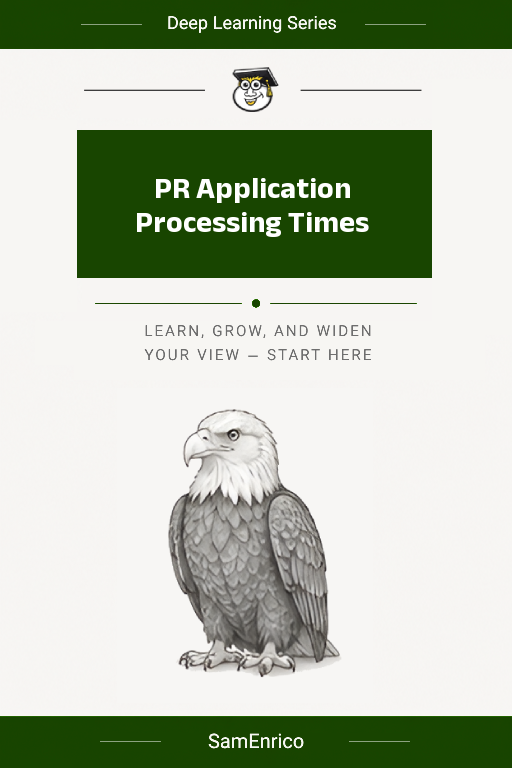
PR Application Processing Times eBook
Wait 6 to 12 months for 189 visa, 3 to 8 months fo
Wait 6 to 12 months for 189 visa, 3 to 8 months for 190, and 2 to 6 months for 491.
Formats
Free sample
Chapter 1: Three Clocks, One Life...-- Every morning for the past fourteen months, Priya opened her immiaccount with the same ritual. She would hold her breath, click the "View Details" button, and stare at the same three words: "Further assessment required." No change. No case officer contact. No end in sight. She had 95 points—near perfect.
She had a job offer from a reputable Australian employer. She had paid a migration agent thousands of dollars. And yet, her application for a Skilled Independent visa (subclass 189) sat in the Department of Home Affairs' black box while friends who applied months after her had already received their grants, booked flights, and started new lives in Melbourne and Brisbane.What Priya didn't understand—what most applicants never understand until it is too late—is that she was running on the wrong clock.The Australian skilled migration program is not one system. It is three parallel systems, each with its own rhythm, its own bottlenecks, and its own hidden timelines. The visa you choose determines not just where you can live or how many points you need, but the very nature of your waiting experience.
A software engineer who applies for a 189 visa and a nurse who applies for a 190 visa are playing entirely different games—with different rules, different odds, and different emotional landscapes. Yet most applicants treat all PR visas as interchangeable, only to discover months into their wait that they made a choice based on incomplete information.This chapter dismantles that mistake. It introduces the core metaphor that will guide this entire book: the three clocks. By the end of these pages, you will know exactly which clock is ticking for you, what a realistic waiting period looks like for your specific circumstances, and—most importantly—whether you are currently running on the right clock at all.The Great Misconception: One Visa, Many Paths The Department of Home Affairs publishes monthly processing time data. It looks clean, scientific, and reassuring.
For the 189 visa, the data might show that 50 percent of applications are processed in six months. For the 190, it might show 3 to 8 months. For the 491, the headline figure might read "2 months" for the fastest applicants.These numbers are not lies. But they are not truths either. They are averages, medians, and percentiles calculated from a population of applications that vary wildly in quality, complexity, and priority.
A nurse with a pristine application and an occupation on the Priority Migration Skilled Occupation List (PMSOL) will move through the system in a fraction of the time required for a marketing specialist with a minor discrepancy in their employment history. The Department's published figures cannot tell you which group you fall into.Worse, the published figures can actively mislead you if you do not understand the fundamental differences between visa subclasses. Consider this: the 189 visa is independent. No state nomination. No employer sponsorship.
No regional commitment. You are judged solely on your points score and your occupation. This sounds simple. In practice, it means you are competing against every other high-points applicant in your occupation category globally. The 190 visa, by contrast, requires state nomination.
You must convince a state government that you will live and work within their borders. This adds a layer of processing time (the state must assess you) but also adds a layer of protection: once a state nominates you, the Department is less likely to refuse your application because the state has already vouched for your genuine intention to contribute. The 491 visa is different again. It is a provisional visa that leads to permanent residency after three years of living and working in a designated regional area. The visa itself may process relatively quickly for a lucky minority, but the pathway to PR is measured in years, not months.These are not minor variations.
They are different species of migration. And yet, most applicants choose their visa based on the simplest heuristic: "Which one is fastest?" This is like choosing a career based solely on which job has the shortest interview process. Speed matters, but it is not the only variable—and in many cases, it is not even the most important one.Clock One: The 189 Meritocracy (6 to 14 Months)The 189 visa is the purest expression of Australia's points-tested system. You earn points for age, English ability, work experience, education, and a handful of other factors. You submit an Expression of Interest (EOI) through Skill Select.
If your points exceed the invitation threshold for your occupation in a given round, the Department invites you to apply for the visa. You then have 60 days to lodge a complete application. Then you wait.The waiting period for the 189 visa has two distinct phases, and understanding the difference between them is critical. The first phase is the EOI waiting period, which can take anywhere from one to six months depending on your occupation and points score. During this phase, your EOI sits in the Skill Select pool, waiting for an invitation round.
High-demand occupations like nursing or social work may receive invitations at lower points thresholds (75 to 80 points) and in every round. Competitive occupations like software engineering or accountancy may require 95 points or more, and you may wait through multiple rounds before receiving an invitation—if you receive one at all.The second phase is the visa processing period, which begins the moment you lodge your application and lasts until the moment the Department makes a decision. According to the Master Timeline Appendix established at the beginning of this book, this phase typically takes 6 to 12 months. However, the distribution is not even. Approximately 50 percent of complete, error-free applications are processed in about 6 months.
The remaining 50 percent stretch to 10 to 14 months. In other words, if you are a typical 189 applicant, you have roughly a coin-flip chance of waiting nearly a year or more.What separates the fast half from the slow half? Document quality. The single biggest predictor of processing speed for a 189 visa is whether your application is "decision ready" on the day you lodge it. A decision ready application contains every required document: police certificates from every country where you have lived for 12 months or more since turning 16, properly formatted employment references that explicitly state hours worked and duties performed, a correctly completed Form 80 (character assessment), and health examinations that have been finalized by the Medical Officer of the Commonwealth.
When a case officer opens a decision ready application, they can assess and approve it in a single sitting. When a case officer opens an application that is missing documents or contains contradictions, they issue a Request for Further Information (RFI), and the application goes back to the end of the queue. Each RFI adds two to six months to the processing time.Consider the two case studies introduced in the original outline. A software engineer with 95 points received an invitation in two weeks—an unusually fast outcome driven by an invitation round that favored their occupation. But their visa took eleven months to process.
Why? Their employment references were vague. The letters stated that they worked as a "senior developer" but did not list specific duties, hours per week, or whether the employment was permanent. The case officer could not verify that…
This is the end of the free sample. Get the eBook to keep going. Buy now
About this book
Details
- Author
- Lunsford Karan
- Publisher
- SamEnrico
- Language
- English
- Genre
- Non-Fiction, Student's Shortcut
- Released
- 2026-06-01
- Pages (approx.)
- 157
- Available as
- eBook, Audiobook

Read better in the ZLOADR app
Your eBooks on your phone or tablet. Sign in with your SamEnrico account and start reading.
More by Lunsford Karan
 Dream Journal For InsomniaLunsford Karan$11.99
 Bihar in the 1857 UprisingLunsford Karan$11.99
 Zimbabwe Hyperinflation EscapeLunsford Karan$11.99
 The Stress Heart Disease LinkLunsford Karan$11.99
 Mindful Walking HandbookLunsford Karan$11.99
 Black Hawk Down MedicLunsford Karan$11.99
 Workaholism And ParentingLunsford Karan$11.99
 Dream Characters MeaningsLunsford Karan$11.99
 The Vanishing Billion: The Untold Story of the Missing Malaysian Airlines Flight 370Lunsford Karan$11.99
 The Sun King: Versailles and the Birth of Modern MonarchyLunsford Karan$11.99
 The Last Broadcast: How a Single Radio Transmission Saved Apollo 13Lunsford Karan$11.99
 Understanding Acute Myeloblastic Leukemia, Minimally DifferentiatedLunsford Karan$17.99
You may also like
 LSE Online Program LengthAgee Letisha$11.99
 Harvard Extension School for Working AdultsRoush Yer$11.99
 LSE Online Reading ListAshford Ludivina$11.99
 LSE Online Language RequirementsWhitten Daphine$11.99
 LSE Online Class SizeHughey Garret$11.99
 LSE Online Alumni MentorshipWild Lyla$11.99
 London School of Economics Alumni NetworkDutton Chantal$11.99
 Harvard Extension School Student SupportCantrell Christene$11.99
 Harvard Extension School Library AccessSantana Adah$11.99
 Harvard Extension School Degree CompletionBray Wyatt$11.99
 Harvard Extension School Course AuditingAbbott Craig$11.99
 Harvard Extension School Extension DiplomaNew Joane$11.99