
Non-FictionSelf-HelpPresentation Skills
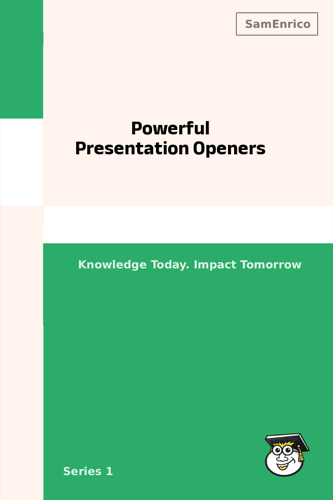
Powerful Presentation Openers eBook
Hook your audience in the first thirty seconds wit
Hook your audience in the first thirty seconds with stories, questions, or facts.
Formats
Free sample
Chapter 1: The Goldfish Lie...--–- In the time it takes you to read this sentence, a goldfish has already forgotten it existed. That is the lie we have been telling ourselves for years.The popular statistic—that the average human attention span has dropped below that of a goldfish—circulates boardrooms, keynote stages, and Linked In posts with the persistence of a bad cold. It is comforting, in a strange way. It gives us permission to blame our audiences. “They just don’t pay attention anymore.” “Everyone is addicted to their phones.” “If only people could focus like they used to.”Here is the truth that no one wants to admit: your audience is not distracted because the world is noisy.
Your audience is distracted because you have not given them a reason to listen.The goldfish statistic is, by the way, entirely false. The study it supposedly came from does not exist. Goldfish have memory spans measured in months, not seconds. But we repeated the lie because it absolved us of responsibility. We wanted to believe that the problem was external.
It never was.This book begins with a hard reset. Before we discuss storytelling techniques, rhetorical questions, or the perfect pause, we must confront the single most uncomfortable reality of public speaking: you do not earn attention. You trade for it. And the currency of that trade is not your expertise, your title, or your slide deck. It is value.
Immediate, specific, undeniable value delivered before the audience has any reason to trust you.Chapter 1, therefore, is not a list of tricks. It is a fundamental reorientation of how you think about the first thirty seconds of any presentation. We will dismantle the neuroscience of distraction, introduce the Reticular Activating System as both enemy and ally, and establish the single diagnostic tool that will save you from ever opening poorly again: the Pass the Phone Test. By the end of this chapter, you will never again begin a presentation with “Thank you for having me” or “I am excited to be here.” Not because those phrases are evil, but because they are expensive. They cost you your most valuable real estate and return nothing.Let us begin where every great presentation actually starts: not with your first word, but with your audience’s first thought.The Thirty-Second Wall Imagine you are standing at the edge of a crowded subway platform during rush hour.
The train arrives. The doors open. You have exactly as long as it takes for the doors to close again to decide whether to step inside. That is approximately thirty seconds.Your audience is standing on that same platform every time you speak. The train is their attention.
The doors are closing. And every single person in the room is silently asking themselves the same question: “Should I stay, or should I mentally leave right now?”This is not cruelty. It is efficiency.The human brain processes approximately eleven million bits of information per second. Your conscious mind can handle only about fifty of those bits. The remaining ten million, nine hundred ninety-nine thousand, nine hundred fifty bits are filtered out automatically by a small, almond-shaped cluster of neurons deep within your brainstem called the Reticular Activating System, or RAS.The RAS is your brain’s bouncer.
It decides what gets into the VIP section of your conscious awareness and what gets tossed onto the street. It is the reason you can sleep through a thunderstorm but wake up instantly when someone says your name from across the house. It is why you can drive a familiar route for twenty minutes and arrive with no memory of the turns. It is also why your audience can stare directly at you for thirty seconds and hear absolutely nothing you said.The RAS has one job: to filter for relevance. It does not care about your biography.
It does not care about your agenda. It does not care about how many hours you spent on your slides. It cares about one thing only—survival and reward. Is this information threatening my safety? Is this information helping me get something I want?
If the answer to both questions is no, the RAS slams the door.Here is what most presenters do in the first thirty seconds. They walk to the front of the room. They say, “Good morning, everyone. Thank you so much for being here today. I am really excited to share some updates with you.
First, let me tell you a little bit about who I am and why we are all here.”By the time they reach the word “updates,” the RAS of every person in the room has already classified the presentation as background noise. The doors have closed. The train has left. The presenter is now speaking to an audience that is physically present but cognitiously absent.This is the Thirty-Second Wall. It is not a wall you can climb.
It is not a wall you can chip away at over time. It is a wall you must break through before the audience even realizes they are standing in front of it.Stephen King understands this better than almost anyone alive. He is one of the most commercially successful authors in history, having sold more than 350 million books. And he will tell you, without hesitation, that he often rewrites his first sentences dozens of times. Not because he is a perfectionist, though he is.
But because he knows that if the first sentence fails, the reader never reaches the second. The book closes. The train departs.King’s novel The Gunslinger opens with: “The man in black fled across the desert, and the gunslinger followed.” Ten words. In ten words, you know there is a chase, a villain, a hero, a setting, and a conflict. You do not know who the man in black is.
You do not know why the gunslinger is following. That is the point. King gives you just enough to stay on the platform, then trusts the mystery to pull you onto the train.Your presentation opener must do the same thing. It must create a gap between what the audience knows and what they want to know. That gap is called a “curiosity gap,” and we will spend an entire chapter on it later.
But for now, understand this: the only thing that gets past the RAS is novelty, threat, or promise. Your opener must be one of those three things. Preferably all three at once.The “Why Should I Care?” Objection There is a voice inside every audience member’s head that speaks louder than you do. It is not malicious. It is not rude.
It is simply efficient. That voice asks one question, over and over, in a loop that runs every two to three seconds: “Why should I care?”Let us call this the WSIC Objection. It is the single greatest obstacle you face as a presenter, and almost no one prepares for it.Most presenters prepare for the opposite. They prepare for the assumption that the audience already cares. They assume that because they were invited to speak, or because the topic is important to…
This is the end of the free sample. Get the eBook to keep going. Buy now
About this book
Details
- Author
- Escamilla Roxy
- Publisher
- SamEnrico
- Language
- English
- Genre
- Non-Fiction, Self-Help, Presentation Skills
- Released
- 2026-06-06
- Pages (approx.)
- 150
- Available as
- eBook, Audiobook

Read better in the ZLOADR app
Your eBooks on your phone or tablet. Sign in with your SamEnrico account and start reading.
More by Escamilla Roxy
 Francis Peace Prayer MisattributionEscamilla Roxy$11.99
 Nonverbal Cues ParentingEscamilla Roxy$11.99
 Social Walking Groups GuideEscamilla Roxy$11.99
 The Federalist Papers: Hamilton’s Secret Theater of RevolutionEscamilla Roxy$11.99
 10 Ways to Use Teriyaki Sauce (Recipe Book)Escamilla Roxy$11.99
 Quantity Surcharge Pricing HandbookEscamilla Roxy$12.99
 LifeguardEscamilla Roxy$11.99
 How to Produce CarabinersEscamilla Roxy$11.99
You may also like
 Hong Kong Handover 1997Dunn Johnnie$11.99
 Zumba For Postnatal Recovery CourseNeal Christian$11.99
 Zumba for BeginnersLadner Nikia$11.99
 YouTube Comment Mining GuideHumes Pandora$12.99
 Worry Box MeditationCarlin Rudy$11.99
 Workplace Stress MeditationNguyen Lynn$11.99
 Workplace Stress and Sleep RepairHawley Ivory$11.99
 Workplace Perfectionism CureDelaney Jeffry$11.99
 Workplace Injustice Anger GuideWallen Isabelle$11.99
 Work Addiction and Burnout LinkGreenwood Ester$11.99
 Women in Yoga and WellnessBeattie Galina$11.99
 Women in Stand Up ComedyChun Evangeline$11.99