
Non-FictionHealth & WellnessSleep Science
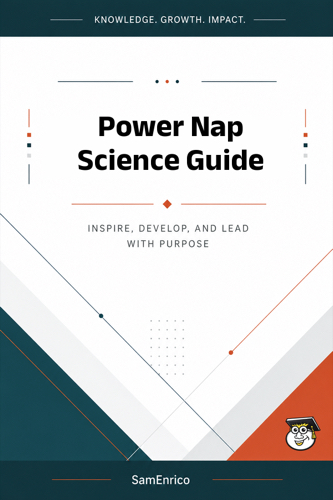
Power Nap Science Guide eBook
Explains optimal nap duration for alertness withou
by Hamrick Mi
Explains optimal nap duration for alertness without grogginess.
Formats
Free sample
Chapter 1: The Forbidden Rest--–- The CEO slumped in her chair at 2:17 PM, eyelids heavy, third cup of coffee growing cold beside her. She had a board meeting in forty-three minutes and a $2 million decision to make. Her brain felt like wet cement. She glanced at the leather couch against the wall—a couch that had sat untouched for three years because no one in her firm dared to be seen lying down during business hours. She wanted to lie down.
She needed to lie down. But a voice in her head, inherited from a century of industrial propaganda, whispered: That would be lazy. That would be weak. That would be failure.This book exists because that voice is wrong.The story of how we came to believe that daytime rest is a moral failing—while simultaneously operating our brains and bodies at a fraction of their potential—is one of the strangest and most costly cultural errors in modern history. It has cost trillions of dollars in lost productivity, caused countless car accidents, shortened careers, and left millions of people suffering through afternoon slumps that a twenty-minute nap would completely eliminate.
The error is not that we get tired. The error is that we were taught to fight that tiredness instead of working with it.This chapter will dismantle the myth of the "lazy napper" brick by brick. You will learn how pre-industrial societies honored natural sleep rhythms, how the Industrial Revolution pathologized rest, how science has spent the last thirty years reversing that damage, and why some of the world's most successful companies now actively encourage napping. By the end of this chapter, you will never feel guilty about closing your eyes at work again. And more importantly, you will understand that strategic napping is not a luxury for the privileged few—it is a performance tool available to everyone.The Pre-Industrial Truth: Biphasic Sleep and the Siesta Before the glow of electric lightbulbs erased the natural boundary between day and night, human sleep looked very different than it does today.
Historian Roger Ekirch spent decades analyzing diaries, court records, and medical texts from the pre-industrial era, and what he found upends everything we think we know about "normal" sleep patterns.Across Europe, Asia, and the Americas, people practiced what is now called biphasic sleep—two distinct sleep periods per night. The first sleep began shortly after dusk, typically around 9:00 PM, and lasted three to four hours. Then came a waking period of one to two hours, often called "the watch." During this time, people prayed, had sex, socialized with neighbors, or simply lay in bed thinking. After this waking interval, they returned for a "second sleep" that lasted until dawn.This pattern was so universal that it appears in literature, medical texts, and even legal depositions. Chaucer's Canterbury Tales refers to the "firste sleep." English prayer books included specific prayers for the waking period between sleeps.
Doctors advised patients on how to manage their two sleeps. No one thought any of this was unusual.Then there was the siesta. In warm climates, particularly around the Mediterranean and in Latin America, the midday rest was not a break from work—it was a biological necessity. Agricultural workers rose before dawn to tend fields in the cool morning hours, rested through the lethal heat of midday (typically 1:00 PM to 4:00 PM), and returned to work in the late afternoon. The Spanish word siesta comes from the Latin sexta hora—the sixth hour after dawn, roughly noon.
This was not laziness. This was survival. Working through the hottest part of the day in pre-air-conditioning conditions meant risking heat stroke, dehydration, and death.In Japan, a different but equally revealing tradition emerged: inemuri, which translates roughly to "sleeping while present." Unlike Western cultures, where sleeping in public is seen as a sign of failure or disrespect, Japan has long viewed inemuri as proof of dedication. A student who falls asleep over their textbook has clearly studied to exhaustion. An office worker who dozes at their desk has worked themselves to the point of collapse.
The sleep itself is the evidence of effort. While this cultural framing has its own problems (it can encourage overwork), it reveals a fundamental truth that the West lost: daytime sleep is not inherently shameful.What did all these pre-industrial cultures understand that we forgot? They understood that human alertness is not linear. It ebbs and flows in predictable rhythms. Fighting those rhythms with caffeine and willpower is possible—for a while.
But it comes at a cost. And that cost is steep.The Industrial Revolution: How the Lightbulb Killed the Nap The villain of this story is not any single person or company. It is a constellation of technological, economic, and social forces that converged in the nineteenth century to create the myth of the 9-to-5, never-sleep, always-productive human.First came artificial light. Gas lamps in the late 1700s and then electric lightbulbs in the late 1800s allowed factories, shops, and eventually offices to operate well after sunset. What had once been a natural boundary—darkness means rest—became optional.
Factory owners realized they could run two or three shifts instead of one. The same workers who had once gone home at dusk now stayed on the factory floor until midnight or later. Biphasic sleep, which depended on darkness, began to disappear from the historical record around the same time that electric lighting became widespread.Second came the factory whistle. Industrial capitalism demanded standardization. Workers needed to arrive at the same time, take breaks at the same time, and leave at the same time.
The natural variability of human energy—the fact that some people peak early and some peak late, that almost everyone experiences a midday dip—was an inconvenience to be engineered away, not a biological reality to be accommodated. Factories built open floors with bright overhead lighting specifically to prevent drowsiness. The message was clear: you will stay awake, you will stay alert, and you will produce.Third came the medical and cultural pathologizing of napping. By the early twentieth century, sleep medicine was in its infancy, and the prevailing wisdom—based on almost no evidence—was that daytime sleep disrupted nighttime sleep. Pediatricians warned parents that allowing children to nap would ruin their ability to sleep through the night.
Adult napping was associated with the elderly, the ill, and the indolent. Sigmund Freud, never one to shy away from dramatic pronouncements, called napping a "regression to an earlier stage of development." Popular magazines ran articles with titles like "Are You Raising a Lazy Child?" that explicitly linked daytime sleep to moral failure.Corporate America embraced this ideology with enthusiasm. Open-plan offices, fluorescent lighting, and coffee breaks (but not nap breaks) became standard. The implicit contract was simple: you sell us your waking hours, all of them, and we will pay you. What you do with your tiredness is your problem.
Take caffeine. Take a walk. Splash water on your face. But do not, under any circumstances, close your eyes.By the middle of the twentieth century, the pre-industrial wisdom of biphasic sleep and midday rest had been almost completely erased from Western culture. A…
This is the end of the free sample. Get the eBook to keep going. Buy now
About this book
Details
- Author
- Hamrick Mi
- Publisher
- SamEnrico
- Language
- English
- Genre
- Non-Fiction, Health & Wellness, Sleep Science
- Released
- 2026-06-10
- Pages (approx.)
- 144
- Available as
- eBook, Audiobook

Read better in the ZLOADR app
Your eBooks on your phone or tablet. Sign in with your SamEnrico account and start reading.
More by Hamrick Mi
 Liquidation WaterfallHamrick Mi$11.99
 Micronutrients For Skin Health GuideHamrick Mi$11.99
 Lease Agreement Clauses GuideHamrick Mi$11.99
 The Maid of Honor SpeechHamrick Mi$11.99
 Memory Improvement HypnosisHamrick Mi$11.99
 Caregiver Self Care HandbookHamrick Mi$11.99
 The International Diplomat StressHamrick Mi$11.99
 The Sitcom PrisonHamrick Mi$11.99
 The Phantom of the Stock Exchange: How a 19th-Century Swindler Built a Paper EmpireHamrick Mi$11.99
 Longwu: The Jade Dragon’s Forgotten OathHamrick Mi$11.99
 From Rags to Tech: The Unlikely Rise of Mike LazaridisHamrick Mi$11.99
 The Strategist's Guide to Business ModelHamrick Mi$11.99
You may also like
 Hong Kong Handover 1997Dunn Johnnie$11.99
 Zumba For Postnatal Recovery CourseNeal Christian$11.99
 Zumba for BeginnersLadner Nikia$11.99
 YouTube Comment Mining GuideHumes Pandora$12.99
 Worry Box MeditationCarlin Rudy$11.99
 Workplace Stress MeditationNguyen Lynn$11.99
 Workplace Stress and Sleep RepairHawley Ivory$11.99
 Workplace Perfectionism CureDelaney Jeffry$11.99
 Workplace Injustice Anger GuideWallen Isabelle$11.99
 Work Addiction and Burnout LinkGreenwood Ester$11.99
 Women in Yoga and WellnessBeattie Galina$11.99
 Women in Stand Up ComedyChun Evangeline$11.99