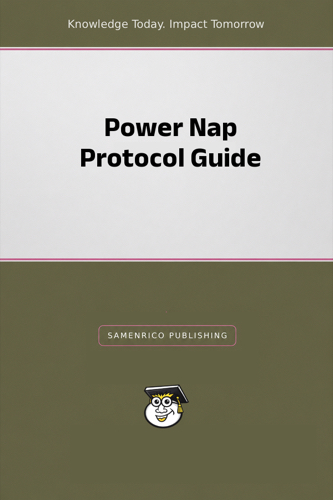
Power Nap Protocol Guide eBook
Limit naps to 20 minutes before 3:00 PM to avoid n
Limit naps to 20 minutes before 3:00 PM to avoid nighttime disruption.
Formats
Free sample
Chapter 1: The Nap Trap--–- The cursor blinks at you from the computer screen. It is 2:47 PM on a Tuesday. You have been staring at the same spreadsheet for eleven minutes without comprehending a single cell. Your eyelids weigh ten pounds each. Your coffee cup, drained three hours ago, sits empty and accusatory.
Your brain feels like it is swimming through cold honey.You make a decision. A reasonable decision. A decision millions of people make every single day."I will just rest my eyes for twenty minutes."You set an alarm on your phone. You find a quiet corner, or perhaps you simply lean back in your office chair. You close your eyes.
The darkness is a relief. The pressure behind your temples begins to ease.Then the alarm goes off. Or rather, you think the alarm goes off. You are not entirely sure. The sound seems to come from very far away, like a radio playing in another room.
You reach for your phone, but your arm does not seem to belong to you. It moves slowly, heavily, as if you are pushing through deep water.You open your eyes. The clock says 3:47 PM. You have been asleep for an hour. Not twenty minutes.
An hour.Panic arrives first. Then confusion. Then the slow, creeping realization that the rest of your workday is a write-off. You sit up too quickly. Your head throbs.
Your mouth is dry. You have no idea what day it is for a full three seconds. When orientation returns, so does the dread.Tonight, you will climb into bed at 10:30 PM, exhausted from the disaster of the afternoon. You will close your eyes. And you will stare at the ceiling until 1:00 AM, scrolling your phone, wondering why you cannot fall asleep.This is the Nap Trap.
And you are not broken. You have simply never been taught the rules.The Problem That Everyone Pretends Doesn't Exist Let us begin with a confession. The author of this book spent fifteen years stuck in the Nap Trap. Fifteen years of "quick rests" that became two-hour comas. Fifteen years of waking up disoriented, headache pounding, absolutely unable to fall asleep until three in the morning.
Fifteen years of believing that I was simply bad at napping, that my body was defective, that some people could nap and some people could not.The truth was simpler and more embarrassing. I did not know how to nap. I had never been taught.Think about that for a moment. We are taught how to tie our shoes, how to drive a car, how to use a spreadsheet, how to cook an egg. But no one teaches us how to sleep during the day.
We are expected to just know. And when we fail, when we wake up groggy and disoriented and useless for the rest of the afternoon, we blame ourselves.We say things like, "I'm just not a napper." Or, "Naps don't work for me." Or, "Every time I nap, I ruin my nighttime sleep."These statements are not true. They are symptoms of missing information.The scientific literature on napping is remarkably consistent, but it has never been translated into a simple, actionable protocol. Researchers have published hundreds of peer-reviewed studies on nap duration, timing, sleep architecture, and cognitive performance. The data is clear.
The recommendations are precise. And almost no one knows about them.This book exists to fix that problem.The Scale of the Problem: How Much Time Are You Losing?Before we dive into solutions, let us quantify what the Nap Trap costs you. These numbers are drawn from aggregated sleep research and productivity studies, and they are staggering.The average American adult experiences a significant alertness dip between 1:00 PM and 4:00 PM. This is not a personal failing. It is a biological fact, hardwired into your brain by millions of years of evolution.
During this dip, cognitive processing speed drops by approximately 20 to 30 percent. Reaction time slows. Working memory capacity shrinks. Error rates increase.Most people attempt to power through this dip with caffeine, willpower, or sheer stubbornness. This strategy works poorly.
Caffeine can mask the symptoms but does not address the underlying biology. Willpower is a finite resource, and by late afternoon, yours is already depleted from a morning of decisions, meetings, and distractions.The result is a daily period of low productivity that lasts two to three hours. Over the course of a year, that adds up to approximately 500 to 750 hours of suboptimal cognitive function. For knowledge workers, this represents tens of thousands of dollars in lost productivity. For students, it represents lower test scores and reduced learning retention.
For parents, it represents shorter tempers and reduced patience.Now add the nighttime disruption. A poorly timed or overly long nap does not just waste your afternoon. It actively damages your nighttime sleep. The average person who naps incorrectly loses an additional one to two hours of nighttime sleep, creating a sleep debt cycle that compounds daily.When you combine afternoon lost productivity with nighttime sleep loss, the total cost of the Nap Trap is enormous. And it is entirely preventable.What This Chapter Will Teach You By the end of this chapter, you will understand three things.First, you will understand why napping is not a luxury but a biological necessity for most people.
The idea that napping is lazy or indulgent is a relatively recent cultural invention, one that contradicts millions of years of human evolution and the sleep patterns of every other mammal on the planet.Second, you will understand the single greatest fear that prevents people from napping: the fear of nighttime disruption. This fear is valid. Napping can absolutely ruin your nighttime sleep. But it only ruins your nighttime sleep when you violate two specific parameters. When you follow the rules, napping actually improves your nighttime sleep quality.Third, you will receive a preview of the protocol that the rest of this book will teach you in precise detail.
You will learn the two numbers that govern all successful napping. These numbers are not suggestions. They are not guidelines. They are hard rules, derived from decades of sleep science, and violating them guarantees failure.Before we get to those numbers, however, we need to clear away the cultural garbage that prevents intelligent people from taking naps in the first place.The Myth of the Monophasic Sleep Schedule Here is something that may surprise you. The idea that humans should sleep once per day, in a single eight-hour block at night, is historically and biologically abnormal.For the vast majority of human history, we slept in two segments.
Historians call this "biphasic sleep." The pattern was simple: a long sleep at night (approximately six to seven hours) and a short sleep in the afternoon (approximately one to two hours). This pattern appears in the historical records of virtually every pre-industrial culture. It appears in ancient Greek and Roman writings. It appears in medieval European manuscripts. It appears in the diaries of everyday people from the eighteenth and nineteenth centuries.What happened to biphasic sleep?
The Industrial Revolution happened.Factory owners needed workers to labor for ten to twelve hours straight. A worker who stopped to…
This is the end of the free sample. Get the eBook to keep going. Buy now
About this book
Details
- Author
- Santos Margarita
- Publisher
- SamEnrico
- Language
- English
- Genre
- Non-Fiction, Health & Wellness, Napping
- Released
- 2026-06-07
- Pages (approx.)
- 141
- Available as
- eBook, Audiobook

Read better in the ZLOADR app
Your eBooks on your phone or tablet. Sign in with your SamEnrico account and start reading.
More by Santos Margarita
 Metta Morning Ritual GuideSantos Margarita$11.99
 Low FODMAP Gut GuideSantos Margarita$11.99
 Loving Kindness For SufferingSantos Margarita$11.99
 Ironclads and Iron Will: The Naval Revolution of the Pacific (1866)Santos Margarita$11.99
 Feng Shui PractitionerSantos Margarita$11.99
 US Sales Tax for Non Resident LLCsSantos Margarita$12.99
 How to Produce Bulletproof VestsSantos Margarita$11.99
 Ultimate Handbook Guide to Harare : (Zimbabwe) Travel GuideSantos Margarita$11.99