
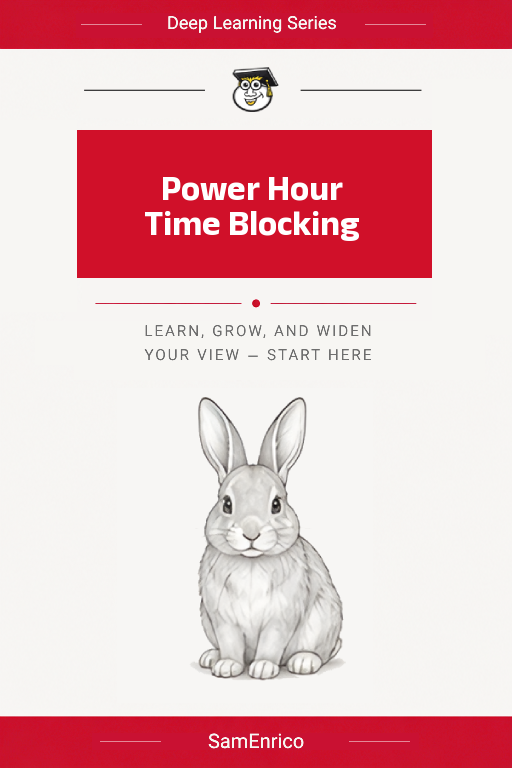
Non-FictionProfessional's Cheat SheetMorningSelf-Help
Power Hour Time Blocking eBook
Schedule one hour of hyper focused work using this
by Decker Peg
Schedule one hour of hyper focused work using this practical technique guide.
Formats
Free sample
Chapter 1: The $10,000 Hour--–- Sarah had been staring at her inbox for forty-seven minutes when the notification popped up."We need to discuss the Q3 deliverables. Can you hop on a call in ten minutes?"She sighed, closed the email draft she had been pretending to work on, and clicked the meeting link. The call lasted twenty-two minutes. Afterward, she spent another fifteen minutes "tidying up" her notes, then checked Slack, where three new threads awaited her. By noon, she had answered forty-three emails, attended two meetings, and moved seventeen tasks from "Today" to "Tomorrow." She had not, however, completed a single thing that actually mattered.At 4:47 PM, her manager sent a message: "Hey, where are we on the Johnson proposal?
That was due yesterday."Sarah's stomach dropped. The proposal. The one thing that would have taken ninety minutes to finish. The one thing she had blocked time for at 9 AM, before the emails started. The one thing she never touched because the inbox had swallowed her whole.She stayed late, finished the proposal at 7:30 PM, and drove home exhausted, guilty, and certain of one thing: she had worked eleven hours and accomplished nothing she was proud of.Sarah is not lazy.
Sarah is not disorganized. Sarah is not bad at her job.Sarah is a victim of the 8-Hour Trap.The Great Lie of Modern Work Here is a truth that productivity gurus rarely admit: you do not have an eight-hour workday. You have a one-hour workday surrounded by seven hours of distraction, reaction, recovery, and pretending.The average knowledge worker spends 60 percent of their day on what researchers call "reactive work"—email, Slack messages, meetings, notifications, and the administrative sludge that accumulates like sediment in a river. That is nearly five hours of every eight-hour day. Another 20 percent goes to "transition time"—the minutes it takes to switch between tasks, find a document, remember where you left off, or simply stare at the screen wondering what you were about to do.That leaves roughly one hour.
One hour of actual, meaningful, needle-moving work.Here is the second truth: most people waste that hour too.They waste it by doing the wrong thing—answering a low-priority email instead of drafting the proposal. They waste it by checking their phone every seven minutes, fracturing their attention into useless shards. They waste it by believing they have all day, so they might as well start with the easy stuff.This book exists because of a simple observation: one hour of hyper-focused work generates more output than the other seven hours combined.Not marginally more. Not slightly more. Dramatically, obviously, life-alteringly more.The science backs this up.
The world's most productive writers, programmers, executives, and artists have discovered the same secret. And now, in these pages, you will learn exactly how to claim your hour.But first, we need to understand how you lost it.Parkinson's Law and the Curse of Abundance In 1955, British historian Cyril Northcote Parkinson published an essay in The Economist that would forever change how we think about work. He observed that bureaucracies expand not because there is more work to do, but because officials want more subordinates and rivals create work for each other. From this observation, he derived a law:"Work expands so as to fill the time available for its completion."This is Parkinson's Law, and it is the single most destructive force in modern productivity.Think about what this means. If you give yourself eight hours to write a report, the report will take eight hours.
You will check email first. Then you will organize your files. Then you will read a few articles. Then you will write a sentence, delete it, rewrite it, check your phone, get coffee, write another sentence, and somehow, miraculously, the report will be finished at 4:59 PM.But if you give yourself ninety minutes to write the same report? You will skip the email.
You will skip the file organizing. You will write the damn report. And at 10:30 AM, you will be done.Parkinson's Law explains why your to-do list never shrinks, why your calendar is always full, and why you feel exhausted without feeling accomplished. You are not working for eight hours. You are stretching one hour of work across eight hours because the time is there, and your brain—efficient, lazy, wonderful brain—will always choose the path of least resistance.The solution is brutal and beautiful: remove the time.When you have only one hour, you cannot afford distraction.
You cannot afford perfectionism. You cannot afford to check your email "just once." The constraint forces intensity. The deadline demands completion. The hour becomes a container for focus, and focus is the engine of everything worth doing.This is the foundation of Power Hour Time Blocking. You are not managing time.
You are constraining it.The Cost of Context Switching (Or: Why Your Brain Is Exhausted)If Parkinson's Law is the why of your unproductivity, context switching is the how.Every time you switch from one task to another—from email to a report, from a report to Slack, from Slack to a meeting—your brain pays a tax. This is not a metaphor. It is a measurable, repeatable, cognitive penalty.Researchers at the University of California, Irvine, studied how long it takes to return to a task after an interruption. Their finding: an average of twenty-three minutes and fifteen seconds. That is not the time to "notice" the interruption.
That is the time to fully re-engage your focus, to remember where you left off, and to rebuild the mental context you had before the interruption.Twenty-three minutes.If you check your email three times during your Power Hour, you have lost sixty-nine minutes of cognitive recovery time. That is more than the hour itself. You have effectively erased your work and gone into debt.But the damage is worse than lost time. Context switching also lowers your functional IQ. A study published in the Journal of Experimental Psychology found that switching between tasks can reduce cognitive performance by the equivalent of losing a full night's sleep.
Fifteen points of IQ. Gone. Just because you glanced at a notification.Think about the math of a typical day:You arrive at 9 AM and check email (switch cost: 23 minutes)You work on a report for 12 minutes (switch cost: 0, you are still working)A Slack message appears; you answer it (switch cost: 23 minutes)You return to the report for 8 minutes A colleague stops by your desk (switch cost: 23 minutes)You return to the report for 4 minutes It is now 10:30 AM. You have spent 69 minutes on recovery and 24 minutes on actual work. The report is not done.
You are exhausted.This is not a personal failing. This is the physics of attention. Your brain was not designed to switch tasks rapidly. It was designed to focus on one thing—a predator, a harvest, a shelter—until completion. When you force it to bounce between inboxes, calendars, and documents, you are asking it to violate its own architecture.Power Hour Time Blocking solves this by creating a context switch firewall.
During your Power Hour, nothing exists except your Most Important Task. Not email. Not Slack. Not notifications. Not the "quick…
This is the end of the free sample. Get the eBook to keep going. Buy now
About this book
Details
- Author
- Decker Peg
- Publisher
- SamEnrico
- Language
- English
- Genre
- Non-Fiction, Professional's Cheat Sheet, Morning, Self-Help, Power Hour
- Released
- 2026-06-09
- Pages (approx.)
- 120
- Available as
- eBook, Audiobook

Read better in the ZLOADR app
Your eBooks on your phone or tablet. Sign in with your SamEnrico account and start reading.
More by Decker Peg
 Spiritual Purpose GuideDecker Peg$11.99
 Design Thinking for LearningDecker Peg$11.99
 Retrospective Meeting GuideDecker Peg$11.99
 SLAA Explained WorkbookDecker Peg$11.99
 NVC for Digital CommunicationDecker Peg$11.99
 Janitorial Shift SleepDecker Peg$11.99
 Meal Prep for ParentsDecker Peg$11.99
 Elizabeth Golden Age CultivationDecker Peg$11.99
 The Lion Builders of Great Zimbabwe: Stone Sculptors of the SavannahDecker Peg$11.99
 The Sonata of the Sun King: Chevalier de Saint-Georges and the Court of VersaillesDecker Peg$11.99
 Service Providers Guide to Imaging & Pediatric RadiologyDecker Peg$11.99
 How to Produce Toy Gift BasketsDecker Peg$11.99
You may also like
 Hong Kong Handover 1997Dunn Johnnie$11.99
 Zumba For Postnatal Recovery CourseNeal Christian$11.99
 Zumba for BeginnersLadner Nikia$11.99
 YouTube Comment Mining GuideHumes Pandora$12.99
 Worry Box MeditationCarlin Rudy$11.99
 Workplace Stress MeditationNguyen Lynn$11.99
 Workplace Stress and Sleep RepairHawley Ivory$11.99
 Workplace Perfectionism CureDelaney Jeffry$11.99
 Workplace Injustice Anger GuideWallen Isabelle$11.99
 Work Addiction and Burnout LinkGreenwood Ester$11.99
 Women in Yoga and WellnessBeattie Galina$11.99
 Women in Stand Up ComedyChun Evangeline$11.99