
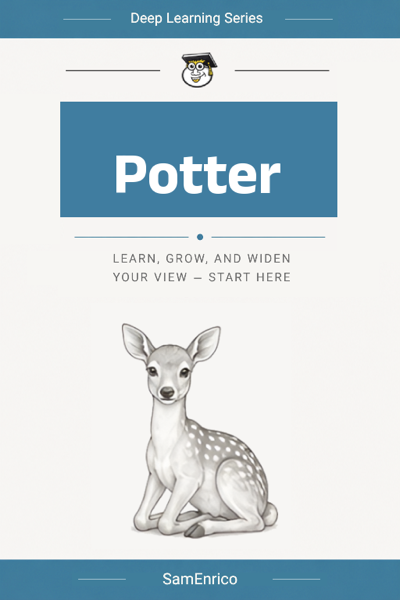
Potter eBook
A Coursebook on Potter
A Coursebook on Potter
Formats
Free sample
Chapter 1: The Boy Who Lived Forever...--–- The idea arrived on a delayed train from Manchester to London in the summer of 1990. A young woman named Joanne Rowling sat staring out the window, her mind drifting somewhere between exhaustion and the desperate hope that a four-hour delay might somehow become productive. She had been working as a researcher and bilingual secretary for Amnesty International, and the train's crawl through the English countryside felt like a metaphor for her life at that moment—slow, uncertain, heading somewhere she could not yet see. Then, without warning or explanation, the image of a boy appeared in her mind's eye. He was thin, dark-haired, wearing glasses, and he did not know he was a wizard.
The idea was so vivid, so complete, that she later said it felt like the boy had been waiting for her on that platform, invisible to everyone else, hoping someone would finally see him. She did not have a pen that worked. This seemingly minor detail—a writer without a working pen—would become the first of a thousand obstacles that defined the making of the single most successful book series in human history. By the time the train reached London, the boy had a name, a school, a rival, and a destiny. He was Harry Potter, and the world would never be the same.This chapter does something unusual for a book about Harry Potter.
It does not begin with magic spells, castle corridors, or the careful literary analysis that will occupy later chapters. Instead, it begins with a question that every bestselling book must answer but few dare to ask directly: Why do some stories capture the world while others, equally well-written, vanish without a trace? The answer, as we will discover across the following pages, has almost nothing to do with luck and everything to do with a perfect storm of timing, psychology, marketing genius, and narrative architecture that Rowling herself did not fully understand until it was already happening. This chapter deconstructs that storm while carefully avoiding any framing of Rowling's life as a Hero's Journey—that framework belongs exclusively to Chapter 2's analysis of Harry's arc. Here, we treat Rowling as a working writer who made good decisions and survived bad ones, not as a mythological figure ascending toward destiny.The Alchemy of Bestsellerdom: From One Thousand to One Hundred Million Let us begin with a number that still shocks publishing professionals: one thousand.
That was the size of the first print run of Harry Potter and the Philosopher's Stone in 1997. One thousand copies for a book that would eventually sell more than 120 million copies by conservative estimates—some sources place the number closer to 150 million when including digital and special editions. To understand how a book goes from one thousand to one hundred million, we must understand the alchemy of the unexpected, because every single element of Potter's success violated established publishing wisdom at the time.In the mid-1990s, children's literature was dominated by series like R.L. Stine's Goosebumps—short, episodic, horror-lite—and the lingering shadow of Roald Dahl's backlist, which was beloved but not actively growing. The conventional wisdom, repeated at every publishing conference and editorial meeting throughout London and New York, was that children would not read long books.
They would not read books without illustrations every few pages. They would not read fantasy that was not explicitly part of a licensed property like Star Wars or The Chronicles of Narnia. Most damning of all, publishers believed that boys would not read books written by women. This last assumption was rarely stated aloud but was encoded in every rejection letter that praised Rowling's writing while expressing concern about "marketability."Rowling's first agent, Christopher Little, sent the manuscript to twelve publishers. Twelve said no.
The reasons varied, but a pattern emerged: the book was too British, too long, too strange, too quiet. One publisher reportedly held the manuscript for an entire year before declining with a form letter. Another suggested that Rowling get a day job and stop wasting her time. The thirteenth publisher, Bloomsbury, said yes only because the chairman's eight-year-old daughter, Alice Newton, read the first chapter and demanded to know what happened next. Bloomsbury's executives later admitted, in interviews following the series' success, that they had no real confidence in the book.
They printed one thousand copies primarily to keep the chairman's daughter happy. Five hundred of those copies went to libraries. Rowling's advance was £2,500, approximately $4,000 at the time. By the standards of the industry, this was a polite dismissal dressed up as a publishing deal.The lesson here is not that publishers are idiots. The publishing professionals who rejected Harry Potter were intelligent, experienced, and genuinely trying to predict what would sell.
The lesson is that bestsellers almost never look like bestsellers until they become one. Harry Potter and the Philosopher's Stone did not have a market. It created one. It did not fit into existing categories because it was the first of a new category—the generational fantasy epic that children and adults would read together, aloud, in the dark, turning pages well past midnight.The Narrative Tinderbox: Why the First Book Ignited Global Attention What did readers actually find in that first thin volume that made them desperate for more? The answer requires a brief digression into narrative psychology, a field that Rowling likely did not study but intuitively mastered.
Humans are pattern-matching machines. We crave stories that feel both familiar and new—what cognitive scientists call "optimal novelty." Too familiar, and the story is boring because the brain has no work to do. Too new, and the story is incomprehensible because the brain cannot find the pattern. Harry Potter sits precisely in the sweet spot between these two failures.The surface level is deeply familiar to any reader of English children's literature. The story follows a boy with a terrible home life who discovers he is special and is whisked away to a magical school where he makes friends, finds enemies, and defeats a villain before the final exam.
That is the plot of dozens of British school stories stretching back to Thomas Hughes's Tom Brown's School Days (1857) and Frank Richards's Billy Bunter series (1908). The tropes were so well-worn by 1997 that an English reader could predict many beats before they happened. The new student is sorted into a house. The older student is suspicious of the newcomer. The headmaster is eccentric but possesses hidden wisdom.
The bully gets his comeuppance in a satisfyingly public manner. The friendship is tested by jealousy and proven by loyalty. The end-of-year feast awards points for bravery and cleverness, and the hero's house wins the cup.But beneath that familiar surface—underneath the feasts and the flying brooms and the chocolate frogs—Rowling buried something genuinely subversive. The hero is not brave because he wants to be. Harry Potter is brave because no one else will protect him.
He has no parents, no safety net, no backup. When he faces the troll in the bathroom, he does so because he cannot bear to let Hermione die. When he faces Quirrell in the dungeons, he does so because…
This is the end of the free sample. Get the eBook to keep going. Buy now
About this book
Details
- Author
- Trimble Virgilio
- Publisher
- SamEnrico
- Language
- English
- Genre
- Non-Fiction, Informative, Educational
- Released
- 2026-05-08
- Pages (approx.)
- 152
- Available as
- eBook, Audiobook

Read better in the ZLOADR app
Your eBooks on your phone or tablet. Sign in with your SamEnrico account and start reading.
More by Trimble Virgilio
 Meditation For Busy People ManualTrimble Virgilio$11.99
 Implementation Intentions PlanTrimble Virgilio$11.99
 Hospital Visitor Conversation GuideTrimble Virgilio$11.99
 Habit Rehearsal VisualizationTrimble Virgilio$11.99
 Walking Meditation for SeniorsTrimble Virgilio$11.99
 The Last Oath of Sir Balin: The Knight Who Cursed CamelotTrimble Virgilio$11.99
 The Alchemist's Fire: Heron of Alexandria and the Birth of AutomationTrimble Virgilio$11.99
 How to Become a Cleaner-touch-up WorkerTrimble Virgilio$11.99
 Freemium Retention GuideTrimble Virgilio$12.99
 One Page Amazon Seller ManualTrimble Virgilio$12.99
 Understanding Gonadal Dysgenesis MixedTrimble Virgilio$17.99