
Non-FictionHealth & WellnessStrength Training
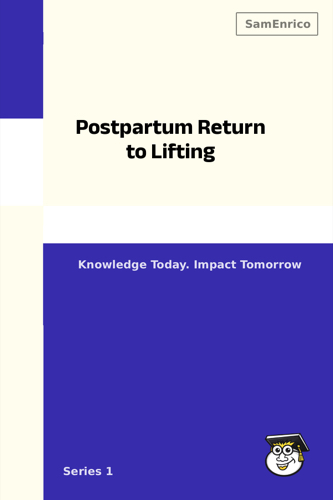
Postpartum Return to Lifting eBook
Guidelines for heavy lifting, CrossFit, and streng
by Shultz Gema
Guidelines for heavy lifting, CrossFit, and strength training.
Formats
Free sample
Chapter 1: The Six-Week Illusion--––- It begins with a piece of paper. A standard, unremarkable piece of paper from a standard, unremarkable postpartum checkup. On it, scrawled in handwriting that could belong to any obstetrician, are three words that have launched a thousand injuries: "Cleared for activity."–- You tuck that paper into your bag, drive home, and start planning your return to the gym. You think about the barbell. You think about the deadlift platform.
You think about the satisfying clang of a heavy squat rerack. You have waited six long weeks—42 days—through sleepless nights, through the fog of newborn care, through the strange and humbling recovery from childbirth. And now, finally, you have permission.–- But here is the truth that no one tells you in that examination room: that piece of paper is not a green light. It is, at best, a yellow one. And for the lifter—the woman who loads a barbell with intent, who chases a one-rep max, who understands the difference between moving weight and moving weight well—that blanket clearance is not just insufficient.
It is dangerously vague.–- This chapter exists because the standard "return to activity" model was not designed for you. It was designed for the average postpartum woman whose idea of exercise is a thirty-minute walk or a gentle yoga class. That is not an insult to those activities; they are valuable in their own right. But they are not heavy lifting. They do not require you to generate intra-abdominal pressures of 150 to 200 millimeters of mercury.
They do not ask your pelvic floor to resist downward forces equivalent to multiple times your bodyweight. They do not demand that your connective tissues withstand the compressive load of a 200-pound squat or the explosive recoil of a snatch catch.–- You are different. And your return to lifting requires a different framework.The Great Misunderstanding: Why "Cleared" Does Not Mean "Ready"–- To understand why the six-week clearance is insufficient, you must first understand what happens to your body during pregnancy and birth that standard medical training often overlooks. Obstetricians are experts in delivering healthy babies and preventing maternal mortality. They are not, generally speaking, experts in barbell biomechanics or the specific demands of high-threshold strength training.
This is not a failure on their part; it is a specialization gap. And that gap is where lifters fall through.–- The six-week clearance emerged from research on wound healing. By six weeks postpartum, the placental attachment site in the uterus has typically healed. Cesarean incisions and vaginal tears have usually closed. Bleeding has stopped.
These are important milestones. They mean you are no longer in the acute, high-risk phase of recovery. But they say almost nothing about the functional capacity of your connective tissues, your neuromuscular control, or your pelvic floor's ability to manage pressure under load.–- Consider the ligamentous system. During pregnancy, your body produced the hormone relaxin, which loosened the ligaments throughout your pelvis and spine to allow for childbirth. This is not a subtle effect.
Relaxin doesn't just target the pubic symphysis; it affects every ligamentous structure in your body, including those that stabilize your sacroiliac joints, your lumbar spine, and even your feet. The half-life of circulating relaxin is short—it drops significantly after delivery—but the lingering effects on ligamentous tensile strength persist for months. Research suggests that ligaments require six to twelve months to regain their pre-pregnancy stiffness and load-bearing capacity.–- Let me repeat that, because it is the single most important sentence in this chapter: Ligaments and fascia take six to twelve months to regain basic tensile strength.–- This is not a conservative estimate designed to scare you. It is a physiological reality. Ligaments are poorly vascularized structures; they heal slowly because blood delivers the nutrients required for tissue repair.
Muscles, by contrast, are richly vascularized. Your quadriceps may feel strong again at eight weeks postpartum. Your rectus abdominis may fire on command. But your uterosacral ligaments, your round ligaments, the fascia of your pelvic floor—these structures are on a different timeline.–- And this timeline has a direct, measurable impact on your ability to lift heavy. When you perform a Valsalva maneuver—holding your breath to create intra-abdominal pressure—you are essentially pressurizing your core canister from the inside.
That pressure pushes downward on the pelvic floor and outward against the abdominal wall. If your ligaments are still lax, they provide less passive support. The pelvic floor must work harder. The linea alba (the connective tissue between your six-pack muscles) must stretch further. This is not a theoretical concern; it is the mechanical reality of every squat, deadlift, and overhead press you will perform in the first year postpartum.Why Lifting Is Different: Axial Loading and the Valsalva Maneuver–- To appreciate why heavy lifting demands a different return-to-sport framework, you need to understand two concepts that are rarely discussed in standard postpartum care: axial loading and the Valsalva maneuver.–- Axial loading refers to force transmitted along the length of the spine.
When you place a barbell across your shoulders and squat, the weight compresses your vertebral column from the top down. This compression is transmitted through your spine, into your pelvis, and down through your pelvic floor. A 135-pound squat does not simply challenge your leg muscles; it imposes a compressive load on every structure between your cervical spine and your perineum.–- By comparison, running involves impact forces of approximately two to three times bodyweight, but those forces are transient and distributed through the legs. The pelvic floor experiences a rapid stretch-shortening cycle with each footstrike, but the sustained, static compression of a heavy squat is mechanically different. It requires the pelvic floor to maintain tension against a constant downward pressure, not just react to brief impacts.–- This is why runners can often return to sport earlier than lifters.
Not because running is easier—running is incredibly demanding in its own way—but because the loading pattern is fundamentally different. A runner's pelvic floor must absorb shock. A lifter's pelvic floor must resist sustained pressure. These are different skills, and they recover on different timelines.–- The second concept, the Valsalva maneuver, is the breath-holding technique that allows lifters to brace their spines under heavy loads. You take a deep breath, close your glottis, and contract your abdominal and thoracic muscles, creating a rigid pressurized cylinder from your diaphragm to your pelvic floor.
This is not optional for heavy lifting; it is essential. Without the Valsalva, your spine cannot achieve the stiffness required to safely transfer load from the barbell to your legs.–- But the Valsalva also increases intra-abdominal pressure dramatically—often to 150–200 mm Hg or higher. For context, a cough generates about 40 mm Hg. A sneeze generates 50–60 mm Hg. A heavy squat generates three to five times that pressure.
And that pressure pushes downward, directly onto a pelvic floor that may still be healing, still under the influence of lingering relaxin, still adapting to its new baseline.–- This is not a reason to fear the Valsalva. It is a reason to train it. And the standard six-week clearance gives you no guidance…
This is the end of the free sample. Get the eBook to keep going. Buy now
About this book
Details
- Author
- Shultz Gema
- Publisher
- SamEnrico
- Language
- English
- Genre
- Non-Fiction, Health & Wellness, Strength Training
- Released
- 2026-06-08
- Pages (approx.)
- 154
- Available as
- eBook, Audiobook

Read better in the ZLOADR app
Your eBooks on your phone or tablet. Sign in with your SamEnrico account and start reading.
More by Shultz Gema
 Stress and Reproductive Health GuideShultz Gema$11.99
 The Growth Mindset for TeachersShultz Gema$11.99
 Sleep Affirmations GuideShultz Gema$11.99
 Lifestyle ED Reversal GuideShultz Gema$11.99
 Job Search After Long CareerShultz Gema$11.99
 Influence Techniques for JournalistsShultz Gema$11.99
 Group Creativity for ResearchersShultz Gema$11.99
 Whispers in the Bamboo: The Cursed Ink of the TsukumogamiShultz Gema$11.99
 The Vanishing of Flight 1956: The Cold War’s Darkest SecretShultz Gema$11.99
 How to Produce Paintball Gun Parts and AccessoriesShultz Gema$11.99
 How to Become a Rug-inspector HelperShultz Gema$11.99
 Elephants: The Complete Elephant GuideShultz Gema$11.99
You may also like
 Hong Kong Handover 1997Dunn Johnnie$11.99
 Zumba For Postnatal Recovery CourseNeal Christian$11.99
 Zumba for BeginnersLadner Nikia$11.99
 YouTube Comment Mining GuideHumes Pandora$12.99
 Worry Box MeditationCarlin Rudy$11.99
 Workplace Stress MeditationNguyen Lynn$11.99
 Workplace Stress and Sleep RepairHawley Ivory$11.99
 Workplace Perfectionism CureDelaney Jeffry$11.99
 Workplace Injustice Anger GuideWallen Isabelle$11.99
 Work Addiction and Burnout LinkGreenwood Ester$11.99
 Women in Yoga and WellnessBeattie Galina$11.99
 Women in Stand Up ComedyChun Evangeline$11.99