
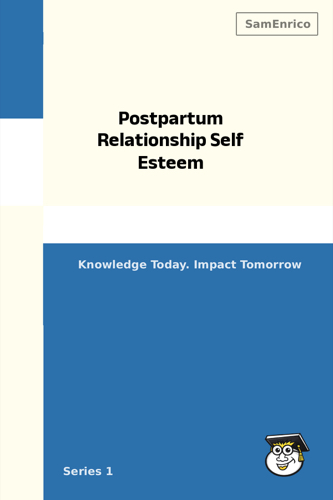
Non-FictionSelf-HelpPostpartum
Postpartum Relationship Self Esteem eBook
Navigate intimacy and identity shifts after baby.
Navigate intimacy and identity shifts after baby.
Formats
Free sample
Chapter 1: The Crash Narrative--–- The baby is three weeks old. You haven't slept more than ninety consecutive minutes since before the birth. Your nipples hurt, your scar itches, and you just cried into a cold cup of coffee because the grocery delivery forgot the bread. Your partner walks into the kitchen, looks at your face, and asks, "Are you okay?" And something inside you splits open. Because you want to scream, No, I am not okay.
I am drowning. But what comes out is a tight, flat, "I'm fine." Then you both go back to the baby. And the distance between you grows by another inch.This is not a failure of love. This is the crash. And almost every new parent experiences it.
But almost no one talks about it.Welcome to the fourth trimester.The Fantasy We Were Sold Before we get into the messy, bloody, sleep-deprived reality of early parenthood, we need to name the monster. And the monster is not your partner. It is not your baby. It is the cultural fantasy of the "instant family"—the idea that a baby completes a relationship, that love multiplies, that joy is seamless, and that any struggle is a sign of personal failure.Look at the media you consumed before giving birth. Pregnancy announcements feature radiant mothers cradling bellies while fathers gaze at them with adoring, tearful eyes.
Baby product commercials show clean homes, quiet infants, and parents who still have time for sex. Social media influencers post "day in the life" videos where the baby naps on schedule, the mother wears makeup, and the couple shares a knowing smile over takeout dinner. Birth announcements on Instagram declare "Our hearts have doubled in size" and "We didn't know love until you."Nowhere in these images is there a woman crying in a shower because she hasn't peed alone in three days. Nowhere is there a father who feels useless because the baby only wants the breast. Nowhere is there a couple who hasn't touched each other in weeks except to pass a screaming infant back and forth like a hot potato.Here is what the fantasy promises: that the baby will fit into your life without requiring you to burn your old life down.
That you will be tired but happy. That your relationship will deepen because you created something beautiful together. That sex will return when you're ready, and it will feel the same as before. That you will be a mother now, but you will also still be you.And here is what actually happens: the baby does not fit. Your life is not a house with an extra room; it is a demolition site.
You are not tired but happy; you are exhausted and sometimes miserable and occasionally joyful in ways that confuse you. Your relationship does not automatically deepen; it cracks under pressure you never anticipated. Sex does not feel the same, and it may not return for months. And you are not still you. You are someone new, and you do not know her yet.The fantasy is not malicious.
It is cultural—baked into every pregnancy app, every birth plan template, every well-meaning relative who says "You were made for this." But the fantasy is also a lie. And believing the lie is the first thing that destroys your postpartum relationship self-esteem. Because when reality collides with fantasy, you assume the problem is you. You think, "Everyone else is handling this. Everyone else is happy.
What is wrong with me?"Nothing is wrong with you. The fantasy was wrong.The Fourth Trimester: Survival, Not Romance The first twelve weeks after birth have a name in medical and parenting literature: the fourth trimester. This term acknowledges a biological reality that our culture ignores. Human infants are born significantly more helpless than other mammals because our large brains require early delivery to fit through the birth canal. A newborn is, in many ways, a fetus who happens to be on the outside.
They need constant holding, frequent feeding, and cannot regulate their own temperature, sleep cycles, or emotions.The fourth trimester is not a romantic period of bonding and bliss. It is a survival period. The goal is not to have date nights, reconnect sexually, or feel like yourself again. The goal is to keep the baby alive, keep yourself alive, and keep your relationship from exploding. That is it.
Anything beyond that is a bonus.Let me say that again, more slowly: For the first twelve weeks postpartum, your only jobs are to feed the baby, sleep when you can, heal your body, and not file for divorce. That is success. That is winning.But because we have been sold the instant family fantasy, most parents enter the fourth trimester expecting something else entirely. They expect to feel overwhelming love immediately. They expect their partner to intuitively know what they need.
They expect to figure out breastfeeding on the first try. They expect to still want sex at six weeks. They expect to post a beautiful "one month old" photo on Instagram with a caption about how their hearts have exploded.When these expectations crash against reality, the result is shame. And shame is the single most destructive force in postpartum relationships. Shame tells you that you are failing.
Shame tells you that everyone else is doing better. Shame tells you not to talk about what is really happening, because if you admit that you yelled at your partner for loading the dishwasher incorrectly, or that you fantasize about running away, or that you sometimes don't like your baby, you will be judged as a bad mother.Shame is a liar. And in this book, we are going to starve it of oxygen.The Grief You Didn't Know You Were Allowed to Feel Here is a sentence that may feel dangerous to read aloud: You are allowed to grieve your old life.Not because you don't love your baby. You do. Not because you regret becoming a parent.
You probably don't. But because something important died when your baby was born. And pretending it didn't happen is not strength; it is denial.What died? Spontaneity died. You used to decide, at 7 PM on a Friday, to go out for dinner.
Now you need to calculate feeding schedules, diaper changes, nap windows, and whether the restaurant has a changing table. Spontaneous sex died. You used to reach for each other in the middle of the night or on a lazy Sunday morning. Now there is a baby in the bed, or a baby monitor glowing in the dark, or a body that is too touched out to tolerate another hand on it. Uninterrupted sleep died.
You knew this one was coming, but you didn't know that the cumulative effect of fragmented sleep would feel like dementia. Carefree identity died. You used to be a person who did things—went to yoga, called a friend, stared at a wall—without considering how it would affect a small, dependent human. Now every decision filters through the baby.These are losses. Real losses.
And grief is the appropriate response to loss. But our culture does not give you permission to grieve a baby.…
This is the end of the free sample. Get the eBook to keep going. Buy now
About this book
Details
- Author
- Sullivan Rita
- Publisher
- SamEnrico
- Language
- English
- Genre
- Non-Fiction, Self-Help, Postpartum
- Released
- 2026-06-08
- Pages (approx.)
- 126
- Available as
- eBook, Audiobook

Read better in the ZLOADR app
Your eBooks on your phone or tablet. Sign in with your SamEnrico account and start reading.
More by Sullivan Rita
 Vehicle Dream Symbolism HandbookSullivan Rita$11.99
 Assertiveness Training PrimerSullivan Rita$11.99
 OKRs for First Time Home BuyerSullivan Rita$11.99
 After the Relapse A Compassionate ReturnSullivan Rita$11.99
 Kali’s Shadow: The Dark Goddess of Time and DestructionSullivan Rita$11.99
 Blockchain Crop Insurance GuideSullivan Rita$12.99
 OSHA Heat Injury Prevention GuideSullivan Rita$12.99
 Understanding Illum SyndromeSullivan Rita$17.99
 How to Start a Mountain Hiking - Recreational BusinessSullivan Rita$11.99
 Southern Yellow Pine HarvestingSullivan Rita$11.99
You may also like
 Hong Kong Handover 1997Dunn Johnnie$11.99
 Zumba For Postnatal Recovery CourseNeal Christian$11.99
 Zumba for BeginnersLadner Nikia$11.99
 YouTube Comment Mining GuideHumes Pandora$12.99
 Worry Box MeditationCarlin Rudy$11.99
 Workplace Stress MeditationNguyen Lynn$11.99
 Workplace Stress and Sleep RepairHawley Ivory$11.99
 Workplace Perfectionism CureDelaney Jeffry$11.99
 Workplace Injustice Anger GuideWallen Isabelle$11.99
 Work Addiction and Burnout LinkGreenwood Ester$11.99
 Women in Yoga and WellnessBeattie Galina$11.99
 Women in Stand Up ComedyChun Evangeline$11.99