
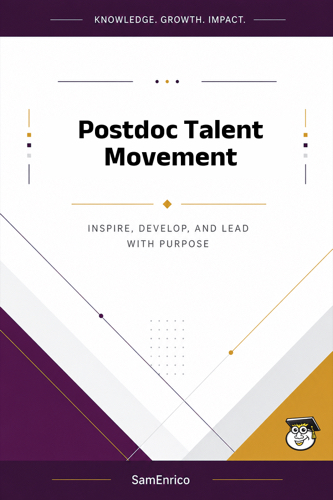
Non-FictionForecast & OutlookPostdoctoral
Postdoc Talent Movement eBook
Forecasts where early-career researchers will loca
Forecasts where early-career researchers will locate.
Formats
Free sample
Chapter 1: The Default Collapses--–- For nearly seven decades, the United States operated as the undisputed gravitational center of the global scientific enterprise. If you were a young researcher with a freshly minted Ph D and ambitions of a tenure-track faculty position, the calculation was simple: you went to America. You applied for an H-1B visa, you found a lab at Harvard, Stanford, or the NIH, and you spent two to five years as a postdoctoral fellow, publishing as rapidly as possible, hoping to secure one of the vanishingly few permanent positions that remained. The system was not fair, but it was predictable. And predictability, for early-career researchers navigating the precarious years between doctorate and independence, mattered more than almost anything else.That era is over.Between 2024 and 2026, something fundamental shifted in the landscape of global science.
It was not a single event but a convergence of forces—policy changes, funding instability, political rhetoric, and rising costs—that collectively dismantled the assumption that the United States would always be the default destination for the world's most promising postdocs. Surveys conducted across twenty major research universities found that over seventy-five percent of current postdoctoral fellows were actively considering leaving the country within the next three years. Among international postdocs—those who had already made one international move to reach the US—the figure climbed to eighty-four percent. These were not idle complaints or abstract frustrations. They were concrete intentions backed by concrete actions: applications to Canadian permanent residency programs surged by two hundred percent year over year.
German research fellowship applications from US-based postdocs tripled. Australian universities reported a fifty percent increase in expressions of interest from American postdoc labor markets.This chapter tells the story of that collapse. But it tells it with a crucial qualification that distinguishes this book from alarmist narratives about American decline. The United States is not collapsing as a scientific superpower. It is, rather, transitioning from a default destination to one of several competitive options.
And crucially, this decline applies primarily to what we will call, throughout this book, the middle-tier postdoc—the talented but not stratospherically elite researcher who constitutes the vast majority of the global postdoctoral workforce. The super-movers, the top five percent of researchers who move between three or more countries before their first faculty job, remain stubbornly concentrated in American institutions. They receive targeted recruitment, expedited visas, and salaries in the top decile. They are, in a very real sense, insulated from the forces driving everyone else away.The collapse of the default, then, is a story of stratification. It is a story about how the American scientific enterprise is becoming more exclusive, more expensive, and more precarious for everyone except the very few.
And it is a story about where everyone else is going instead.The Historical Magnet: How America Won the Postdoc Lottery To understand why the collapse matters, we must first understand how the coupling worked. From the end of World War II until approximately 2015, the United States operated what economists call a "monopsony" in global postdoctoral talent—not quite a monopoly, because other countries certainly hosted researchers, but a market where a single buyer (the American research enterprise) had such overwhelming purchasing power that it set the terms for everyone else.Several factors created this dominance. First, funding. The National Institutes of Health budget grew from $1 billion in 1970 to over $40 billion in the early 2020s, adjusted for inflation. The National Science Foundation, the Department of Energy, the Department of Defense, and a dozen other agencies collectively poured tens of billions annually into university research.
No other country came close. Germany's Max Planck Society, for all its prestige, operated on a fraction of that scale. China's research budget, though growing rapidly, remained concentrated in applied fields and state-directed priorities. For a postdoc, being in America meant access to more grants, more equipment, more collaborators, and more opportunities to publish in high-impact journals.Second, prestige. The global hierarchy of universities has been remarkably stable for half a century.
The top twenty universities in virtually every ranking system are dominated by American institutions. Harvard, Stanford, MIT, Caltech, Princeton, Columbia, Yale, the University of California system—these names carry weight on tenure-track search committees from Seoul to Santiago. A postdoc at a middling American university might still struggle to find a faculty position. But a postdoc at a top-twenty American university had a credential that opened doors worldwide. The asymmetry was brutal but real: a postdoc from an American elite institution could get a faculty job in Germany or Australia or Singapore.
The reverse was rarely true.Third, immigration pathways. The H-1B visa system, for all its flaws, provided a relatively predictable (if slow) mechanism for international postdocs to remain in the country for up to six years. The EB-1 and EB-2 green card categories offered pathways to permanent residency for researchers with exceptional publications or advanced degrees. And the Optional Practical Training (OPT) program allowed international graduates of American Ph D programs to work for up to three years after graduation without additional visa sponsorship. These pathways were not generous by Canadian or Australian standards, but they were functional.
For a researcher from India or China or Iran, the American visa system was a gauntlet worth running because the payoff—a green card, a faculty position, American salary levels—was so substantial.Fourth, critical mass. The United States simply had more researchers, more labs, more seminars, more conferences, and more journals than any other country. This created a network effect: postdocs went to America because that was where the other postdocs were. Collaboration, mentorship, and serendipitous discovery all benefited from density. To be a postdoc in a mid-sized American city with three research universities was to be embedded in a scientific community larger than the entire research enterprise of many countries.For decades, these four factors—funding, prestige, immigration pathways, and critical mass—reinforced one another.
A postdoc came to America for funding, stayed for prestige, navigated the visa system because the critical mass made it worthwhile, and eventually became part of the machine that attracted the next cohort. The system was self-perpetuating. And it made the United States, for all its flaws, the undisputed center of the postdoctoral universe.The Push Factors: Why 75 Percent Are Looking for the Exit The self-perpetuating machine began to break down in the late 2010s, and the breakdown accelerated dramatically between 2020 and 2026. The causes are multiple and mutually reinforcing. They did not emerge from a single policy or event.
Rather, they represent a systemic decay that had been building for years before reaching a tipping point.Funding Instability The most immediate push factor, cited by seventy-eight percent of postdocs considering leaving, is the unpredictability of research funding. The NIH budget, historically a reliable escalator, has entered a period of flat funding and political uncertainty. In 2025, a series of continuing resolutions and threatened government shutdowns delayed grant reviews by up to nine months. Principal investigators who had previously supported postdocs on multi-year grants suddenly found themselves unable to guarantee funding beyond six months. Postdocs whose positions depended on soft money—which is to say, nearly all of them—faced the prospect of mid-contract termination or…
This is the end of the free sample. Get the eBook to keep going. Buy now
About this book
Details
- Author
- Yeager Cathie
- Publisher
- SamEnrico
- Language
- English
- Genre
- Non-Fiction, Forecast & Outlook, Postdoctoral
- Released
- 2026-06-10
- Pages (approx.)
- 147
- Available as
- eBook, Audiobook

Read better in the ZLOADR app
Your eBooks on your phone or tablet. Sign in with your SamEnrico account and start reading.
More by Yeager Cathie
 Engineering School Burnout GuideYeager Cathie$11.99
 Research Proposal for Soros FellowshipYeager Cathie$11.99
 Versioning Strategy GuideYeager Cathie$11.99
 Theodore Roosevelt BadlandsYeager Cathie$11.99
 Evolutionary Phobia OriginsYeager Cathie$11.99
 Self Esteem for Aging MusiciansYeager Cathie$11.99
 Archery Stillness HypnosisYeager Cathie$11.99
 The Storm of Lepanto: Christian and Muslim Navies Collide (1571)Yeager Cathie$11.99
 The Silk Road’s Forgotten Queen: How a 7th-Century Empress Reshaped Global TradeYeager Cathie$11.99
 How to Start a Computer Games Design Business (Beginners Guide)Yeager Cathie$11.99
 Growing DisanthusYeager Cathie$11.99
 Cooperative Loan Guarantee FundsYeager Cathie$12.99
You may also like
 Hong Kong Handover 1997Dunn Johnnie$11.99
 Zumba For Postnatal Recovery CourseNeal Christian$11.99
 Zumba for BeginnersLadner Nikia$11.99
 YouTube Comment Mining GuideHumes Pandora$12.99
 Worry Box MeditationCarlin Rudy$11.99
 Workplace Stress MeditationNguyen Lynn$11.99
 Workplace Stress and Sleep RepairHawley Ivory$11.99
 Workplace Perfectionism CureDelaney Jeffry$11.99
 Workplace Injustice Anger GuideWallen Isabelle$11.99
 Work Addiction and Burnout LinkGreenwood Ester$11.99
 Women in Yoga and WellnessBeattie Galina$11.99
 Women in Stand Up ComedyChun Evangeline$11.99