
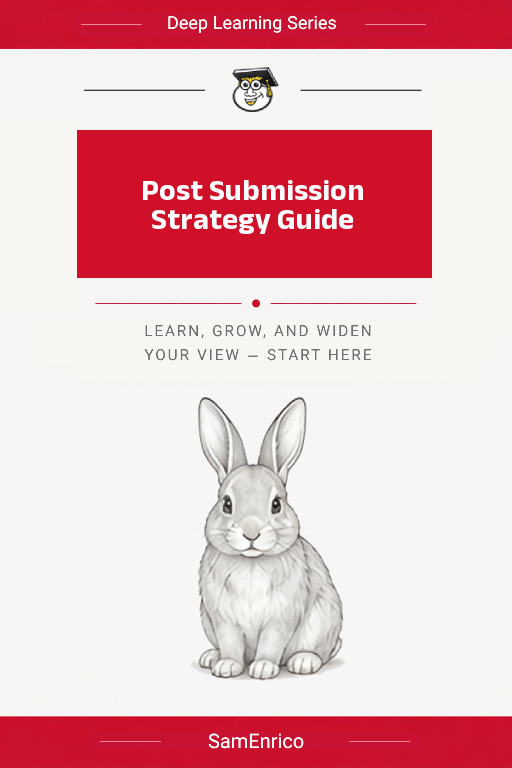
Non-FictionStartup GuideAccelerator Strategy
Post Submission Strategy Guide eBook
Navigate follow up requests and reference calls af
Navigate follow up requests and reference calls after submitting your YC application, including cohort prep and alternative accelerator timelines for African founders.
Formats
Free sample
Chapter 1: The Velocity Shift...--The interview ended seventeen minutes ago. You are still sitting in the same chair, staring at the blank wall where your laptop screen was. Your heart is pounding—not from nerves anymore, but from the strange emptiness that follows an event you spent weeks preparing for. The YC partners smiled. They asked hard questions.
They nodded at some answers and raised eyebrows at others. And now they have moved on to the next interview. By dinner tonight, they will have spoken to fifteen other founders. By tomorrow night, thirty. By the end of the week, your pitch will be a ghost in their memory, overwritten by Saa S metrics, biotech breakthroughs, and fintech pivot stories.Unless you give them a reason to remember you.This chapter introduces the single most leveraged action you can take in the entire post-submission journey: the Velocity Email.
It is not a thank-you note. It is not a "checking in" message. It is a demonstration of execution velocity delivered within twenty-four hours of your interview. It is the difference between being forgotten and being unforgettable.Most founders send nothing. The ones who send something usually send a generic "thank you for your time" email that adds zero value and consumes thirty seconds of an investor's attention.
The top one percent of founders do something different. They listen. They process. They fix. And they prove it—all before the investor has finished their dinner.This chapter will teach you exactly how to join that top one percent.The Forgotten Art of the Immediate Follow-Up There is a myth in startup culture that the work ends when you hit submit.
You have polished the application. You have rehearsed the pitch. You have answered the questions. Now you wait.This myth has destroyed more opportunities than bad metrics ever have.The truth is that the interview is not the finish line—it is the starting gun. And the race is measured not in weeks but in hours.
Within twenty-four hours of your interview, YC partners have already forgotten the specifics of your pitch. They remember the outliers: the ones who made them laugh, the ones who made them angry, and the ones who made them think. Everyone else blurs together.But there is a second category they remember: the ones who emailed them twenty-four hours later with proof that they were already executing on feedback.Consider two founders. Founder A sends a polite thank-you email. Founder B sends an email that says: "During the interview, you questioned whether our customer acquisition cost could scale.
We just ran a new analysis on our last thirty customers. The CAC actually drops by 22% when we acquire in cohorts. Here is the spreadsheet. Would love your quick take."Who do you think gets the follow-up meeting?The Velocity Email is not about sucking up. It is about demonstrating a trait that investors value above almost all others: the ability to receive feedback, process it, and act on it faster than anyone expected.
In a world where most founders defend their assumptions, you are showing that you update them.The Psychology of Investor Memory To understand why the Velocity Email works, you must first understand how investors actually think. They are not evaluating you against a perfect standard. They are evaluating you against the nine other companies they saw that day.Investor memory operates on a curve of novelty. The most memorable companies are not necessarily the best—they are the ones that break a pattern. If every founder says "we have a viral loop," the one who says "our viral loop broke last week and here is how we fixed it" becomes unforgettable.The Velocity Email exploits this psychological reality.
By sending a follow-up that demonstrates action on specific feedback, you achieve three things simultaneously:First, you show that you were listening. Investors have an almost supernatural ability to detect founders who are waiting for their turn to talk rather than absorbing feedback. When you reference a specific objection in your follow-up, you prove that you were present, not performing.Second, you show that you can process feedback without defensiveness. Most founders argue. They explain why the objection is wrong, why the numbers are misleading, why the investor just doesn't understand their market.
You are doing the opposite: you are saying "you raised a valid point, and we acted on it."Third, you show execution velocity. This is the rarest trait of all. Many founders can listen. Some can process. Very few can act within twenty-four hours.
When you do, you signal that your startup operates at a different speed than everyone else.A partner at a top venture firm once told me: "I don't care if the fix is perfect. I care that they tried. A founder who sends me a flawed analysis within twenty-four hours is more valuable than a founder who sends me a perfect analysis in two weeks. Speed is a feature."The Exact Structure of a Velocity Email The Velocity Email follows a five-part structure that has been tested on thousands of investor communications. Each part serves a specific psychological purpose.
Skipping any part reduces the effectiveness of the whole.Part One: Gratitude (One sentence)This is the only conventional element of the email. You thank the investor for their time. Keep it brief. Do not gush. Do not apologize for taking their time.
A simple "Thank you for the conversation earlier today" is sufficient.The gratitude serves a social function: it acknowledges that the investor gave you something valuable (attention) and you recognize it. But it is not the point of the email. Never let gratitude become the point.Part Two: The Objection You Heard (One sentence)This is where you demonstrate listening. State the specific concern the investor raised, using their words as much as possible. Do not paraphrase in a way that softens the objection.
Do not add "but" at the end of the sentence.Examples:"You asked whether our customer acquisition cost would scale beyond our first hundred users.""You raised a concern about our retention curve in months three through six.""You noted that our go-to-market strategy seemed dependent on a single channel."By restating the objection neutrally, you show that you heard it without defensiveness. You are not arguing. You are acknowledging.Part Three: What You Fixed (One to two sentences)This is the core of the email. Describe what you did in response to the objection. Be specific.
Use numbers where possible. Do not say "we looked into it" or "we thought about it." Say what you actually changed.Examples:"We pulled our last thirty customers and recalculated CAC by acquisition cohort.""We analyzed retention for users who joined in our first month versus our third month.""We launched a test on a second channel yesterday and have early data."Notice that none of these require a finished product. You are not claiming to have solved the problem perfectly. You are claiming to have acted. The action itself is the signal.Part Four: Proof (Attachment or link)This is where you provide evidence.
Do not just claim you did something—show it. A screenshot of a spreadsheet. A link to a live dashboard. A…
This is the end of the free sample. Get the eBook to keep going. Buy now
About this book
Details
- Author
- Browning Devin
- Publisher
- SamEnrico
- Language
- English
- Genre
- Non-Fiction, Startup Guide, Accelerator Strategy
- Released
- 2026-05-30
- Pages (approx.)
- 139
- Available as
- eBook, Audiobook

Read better in the ZLOADR app
Your eBooks on your phone or tablet. Sign in with your SamEnrico account and start reading.
More by Browning Devin
 Antwerp Heist Recutting ScandalBrowning Devin$11.99
 The Safe Takeout Container GuideBrowning Devin$11.99
 The Silk Road ExpeditionBrowning Devin$11.99
 Menopause Hormone Therapy GuideBrowning Devin$11.99
 Stress and Appetite Changes GuideBrowning Devin$11.99
 The Forbidden Crown: The Secret Love of King Farouk and Barbara HuttonBrowning Devin$11.99
 The Curse of the Black Pharaoh’s ShadowBrowning Devin$11.99
 Understanding Fetal Cytomegalovirus SyndromeBrowning Devin$17.99
 Small Business Sales ManagerBrowning Devin$11.99
 Email Conflict ResolutionBrowning Devin$12.99
 How to Become a Circus LaborerBrowning Devin$11.99
You may also like
 Hong Kong Handover 1997Dunn Johnnie$11.99
 Zumba For Postnatal Recovery CourseNeal Christian$11.99
 Zumba for BeginnersLadner Nikia$11.99
 YouTube Comment Mining GuideHumes Pandora$12.99
 Worry Box MeditationCarlin Rudy$11.99
 Workplace Stress MeditationNguyen Lynn$11.99
 Workplace Stress and Sleep RepairHawley Ivory$11.99
 Workplace Perfectionism CureDelaney Jeffry$11.99
 Workplace Injustice Anger GuideWallen Isabelle$11.99
 Work Addiction and Burnout LinkGreenwood Ester$11.99
 Women in Yoga and WellnessBeattie Galina$11.99
 Women in Stand Up ComedyChun Evangeline$11.99