
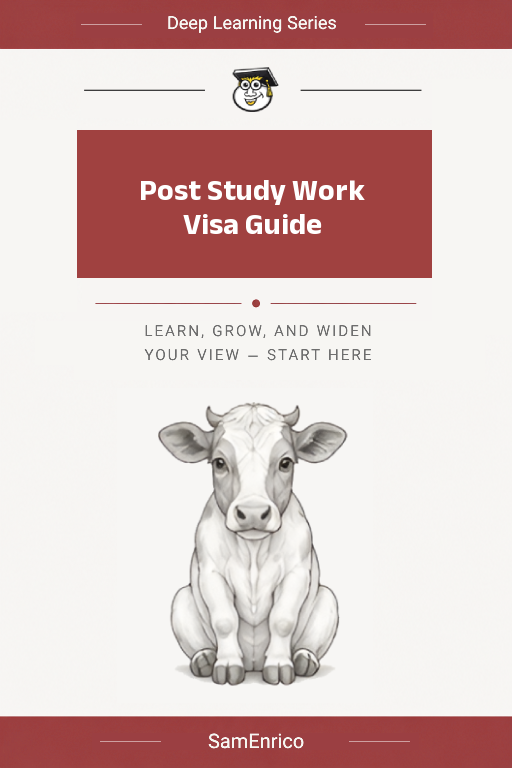
Non-FictionStudent's ShortcutPost-Study
Post Study Work Visa Guide eBook
Compare UK Graduate Route (2 years), US OPT (1-3 y
Compare UK Graduate Route (2 years), US OPT (1-3 years), and Australia Temporary Graduate (2-6 years).
Formats
Free sample
Chapter 1: The Three Doors--–- You are standing in a narrow corridor. Behind you is the country where you were born, the currency you understand, the visa you never had to think about. Ahead of you are three doors. Each one leads to a different version of your future.The first door is painted red, white, and blue. Behind it, a three-year runway, salaries that can reach six figures before you turn twenty-six, and a technological economy that has no equal.
But there is also a lottery – a game of chance that will decide, with no regard for your talent or hard work, whether you get to stay.The second door is red, white, and blue too, but in a different order. Behind it, no sponsor required. You can walk through, start a company, freelance for five different clients, or pour coffee while you search for your dream job. The door swings open easily. But at the end of the corridor, there is a second door you cannot see yet – one that requires a salary that most people your age will never reach.The third door has a kangaroo on it.
Behind it, a points system so transparent you can calculate your future before you land. Two years become three, become four, become six if you are willing to live where the koalas outnumber the humans. But if you are over thirty-five, that door is already locked. You do not get to knock.This book is about choosing which door to open. More importantly, it is about understanding what waits on the other side – not just the welcome mat, but the trapdoor hidden under the rug.Most guides to post-study work visas make a catastrophic error.
They assume you want the same thing as everyone else. They assume that "best" means longest duration, or highest salary, or easiest application process. They present charts comparing the United States, the United Kingdom, and Australia as if you are buying a used car – line up the specs, pick the one with the most features, drive away.That is not how immigration works.Immigration is a series of trade-offs. Every advantage comes with a disadvantage buried in the fine print. The country that gives you the longest work rights also gives you the strictest rules about what kind of job you can hold.
The country that lets you in without a sponsor also makes it hardest to convert that temporary visa into permanent residence. The country with the clearest path to a passport also has an age limit that will eliminate you entirely if you started graduate school at thirty-two.This chapter is not a summary of the three visas. You will get those in Chapters 3, 4, and 5. This chapter is about something more important: understanding your own goals well enough to know which trade-offs you are willing to accept.Before we talk about the rules of each country, we need to talk about the three models that govern them.The Three Immigration Models Every country that offers a post-study work visa is solving the same problem. They want to attract talented international graduates without creating a permanent underclass of temporary workers or a flood of unskilled migrants.
The three major English-speaking destinations have each arrived at a different solution.The United States uses what I call the High Risk, High Reward model.The US offers the longest potential work period of any country – thirty-six months for STEM graduates. During that time, you can earn salaries that are simply not available elsewhere. A software engineer in San Francisco or New York will out-earn their counterpart in London or Sydney by forty to sixty percent. The technology sector is larger, more innovative, and more willing to sponsor visas than any other country.But there is a catch, and it is a brutal one.At the end of your OPT period, you must transition to an H-1B work visa. The H-1B is a lottery.
Each year, approximately 85,000 visas are awarded to over 400,000 applicants. That is a success rate of twenty to twenty-five percent. Your talent does not matter. Your employer's reputation does not matter. Your salary does not matter.
A computer randomly selects who stays and who goes.And that is only the first lottery. For Indian-born nationals – who make up the largest share of international STEM students – the green card backlog exceeds ten years. Even if you win the H-1B lottery, you may spend a decade unable to change jobs freely, unable to be promoted without paperwork, unable to fully settle into the country you have called home since you were twenty-two.The US model is for people who are willing to gamble. It is for people who believe that three years of American salary and American experience is worth the very real risk of having to leave at the end. It is for people who have a backup plan – Canada, Europe, or a return home – and the emotional resilience to activate it.The United Kingdom uses what I call the Low Barrier, Short Window model.The UK Graduate Route requires no sponsor.
You do not need a job offer to apply. You do not need to prove that your job is related to your degree. You can work as a freelance graphic designer, start a tech company in your flat, or take a barista job while you look for something better. The door opens wide and fast.But the window is short – two years for most graduates, with a proposed reduction to eighteen months starting in 2027. And at the end of that window, the second door is very hard to open.To transition to a Skilled Worker visa, you need a sponsor and a salary that meets the higher of £38,700 or the "going rate" for your occupation.
For most graduates, that is a significant stretch. The average salary for a graduate in London is approximately £32,000. The threshold is nearly twenty percent higher.Worse, the time you spend on the Graduate Route does not count toward the five years required for Indefinite Leave to Remain (permanent residency). You could work for two years, find a sponsor, and then start the five-year clock from zero. If you start your Skilled Worker visa at twenty-seven, you will be thirty-two before you can apply for permanent residency – assuming you never have a gap in employment or a salary below the threshold.The UK model is for people who want international work experience more than they want permanent settlement.
It is for people who are comfortable returning home after two or three years with a foreign degree and foreign experience on their CV. It is for entrepreneurs who want to test a business idea without the overhead of investor visas. It is not for people who are desperate to stay at any cost.Australia uses what I call the Points-Driven model.Australia does not ask you to win a lottery. It does not require a sponsor. Instead, it asks you to accumulate points – for your age, your English ability, your work experience, your education level.
If you have enough points, you can apply for permanent residency directly from your temporary graduate visa.The durations are generous. Two years…
This is the end of the free sample. Get the eBook to keep going. Buy now
About this book
Details
- Author
- Starkey Kittie
- Publisher
- SamEnrico
- Language
- English
- Genre
- Non-Fiction, Student's Shortcut, Post-Study
- Released
- 2026-06-01
- Pages (approx.)
- 125
- Available as
- eBook, Audiobook

Read better in the ZLOADR app
Your eBooks on your phone or tablet. Sign in with your SamEnrico account and start reading.
More by Starkey Kittie
 Summer Break Schedule PlanStarkey Kittie$11.99
 Stigma of MDD ExplainedStarkey Kittie$11.99
 Self Esteem For High PerformersStarkey Kittie$11.99
 Pregnancy Withdrawal ManagementStarkey Kittie$11.99
 Anger Management For WomenStarkey Kittie$11.99
 Online Whiteboard CollaborationStarkey Kittie$11.99
 Vitamin B12 VeganStarkey Kittie$11.99
 Blue Zone Friends Circle GuideStarkey Kittie$11.99
 The Rape of Nanking: Japan's Darkest Hour (1937-1938)Starkey Kittie$11.99
 The Royal Court of the Racket: The Lost Tennis Masters of Medieval AfricaStarkey Kittie$11.99
 How to Produce Toaster and Toaster OvensStarkey Kittie$11.99
 How to Produce Hvac EquipmentStarkey Kittie$11.99
You may also like
 Hong Kong Handover 1997Dunn Johnnie$11.99
 Zumba For Postnatal Recovery CourseNeal Christian$11.99
 Zumba for BeginnersLadner Nikia$11.99
 YouTube Comment Mining GuideHumes Pandora$12.99
 Worry Box MeditationCarlin Rudy$11.99
 Workplace Stress MeditationNguyen Lynn$11.99
 Workplace Stress and Sleep RepairHawley Ivory$11.99
 Workplace Perfectionism CureDelaney Jeffry$11.99
 Workplace Injustice Anger GuideWallen Isabelle$11.99
 Work Addiction and Burnout LinkGreenwood Ester$11.99
 Women in Yoga and WellnessBeattie Galina$11.99
 Women in Stand Up ComedyChun Evangeline$11.99