
Non-FictionBusiness BriefPost Purchase
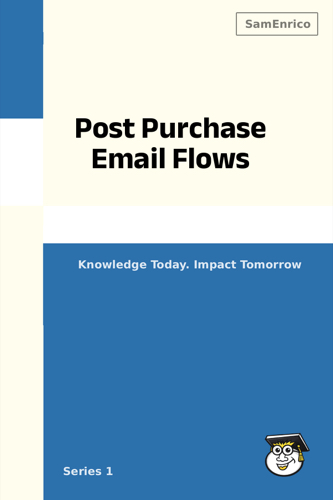
Post Purchase Email Flows eBook
Thank customers cross sell and request reviews aft
Thank customers cross sell and request reviews after sales.
Formats
Free sample
Chapter 1: The 7-Minute Window--–- Every e-commerce founder knows the feeling. A customer clicks “Place Order.” The dopamine hits. Revenue goes up. Another acquisition cost justified. Another email sent to the CEO celebrating the win.
Then the founder closes their laptop, moves on to the next problem, and never thinks about that customer again until they either return (rare) or churn (likely).–- This is the single most expensive mistake in modern retail. And almost every brand makes it.–- The moment after a purchase is not the finish line. It is the starting block for everything that matters: loyalty, advocacy, lifetime value, and the difference between a brand that survives and a brand that scales. Yet the vast majority of companies treat the post-purchase experience as an afterthought—a shipping confirmation, a tracking number, a sterile receipt, and silence until the next discount lands in an inbox.–- This chapter reveals why those first seven minutes after a customer clicks “buy” are the most valuable window in your entire marketing ecosystem. We will explore the psychology of buyer's remorse, the data behind post-purchase engagement, and the foundational shift required to turn transactional receipts into relationship-building machines.
By the end of this chapter, you will never send a boring confirmation email again.The Paradox That Launched a Thousand Lost Customers–- Let us start with a scenario that plays out millions of times every day.–- Sarah buys a $120 weighted blanket from an Instagram ad. The website was beautiful. The reviews were convincing. The discount code made her feel smart. She clicks “Place Order,” receives a confirmation screen, and closes the browser.
In the next thirty seconds, three things happen inside her brain.–- First, she feels a small spike of excitement. She imagines sleeping better, waking up refreshed, and finally solving her insomnia. This is the reward anticipation phase, driven by dopamine.–- Second, almost immediately, doubt creeps in. Did she really need this? Was $120 too much?
What if it arrives and feels cheap? What if the return process is a nightmare? This is buyer's remorse—a psychological defense mechanism where the brain second-guesses decisions to protect against perceived risk.–- Third, Sarah opens her email to look for the confirmation. She finds it. It is a gray, text-heavy block of legalese: order number, billing address, shipping method, a promise to notify her when the item ships.
No excitement. No reassurance. No personality. Just data.–- In that moment, the brand loses Sarah.–- Not forever. But for the crucial seven minutes when her emotional state was most receptive to influence, the brand said nothing.
The confirmation email did not make her feel smart. It did not show her other happy customers. It did not preview the unboxing experience. It did nothing except fulfill a legal obligation.–- This is the paradox: the moment of highest customer engagement—immediately after a sale—is the most neglected asset in e-commerce. Brands spend fortunes on ads, influencers, and landing pages to earn that click, then disappear exactly when the customer is most open to listening.The Neuroscience of the 7-Minute Window–- Research in consumer psychology reveals a consistent pattern: the first five to ten minutes after a purchase decision are neurologically distinct from any other period in the customer journey.
During this window, the brain is actively seeking confirmation that the decision was correct.–- This is not speculation. Functional MRI studies show that immediately after a purchase, the anterior cingulate cortex (the region associated with conflict monitoring and error detection) becomes highly active. The brain is literally scanning for evidence that the purchase was a mistake. Simultaneously, the nucleus accumbens (the reward center) is still firing from the anticipation of the product’s benefits.–- The result is a neurological tug-of-war. The customer wants to feel good about their purchase, but their brain is primed to detect any signal that they made an error.
In this state, a single negative cue—a delayed confirmation, a confusing email, no communication at all—can tip the balance toward regret. Conversely, a single positive cue—social proof, reassurance, an exciting preview—can solidify satisfaction and increase the likelihood of repurchase by as much as 28 percent.–- This is why the 7-minute window matters more than any other post-purchase touchpoint. The customer is not just open to your message. They are actively seeking it.The Data That Changes Everything–- Let us move from neuroscience to numbers. The data on post-purchase email performance is so striking that it should force every marketer to rethink their priorities.–- Post-purchase emails generate open rates that average 217 percent higher than standard marketing campaigns.
This is not a marginal improvement. This is a fundamental difference in customer behavior. While a typical promotional email struggles to reach 20 percent opens, a well-timed post-purchase confirmation routinely exceeds 50, 60, or even 70 percent.–- Why? Because the customer has a stake. They just gave you money.
They want to know that their transaction was received, that their product is coming, and that they made a wise choice. This is not marketing noise. This is personally relevant information.–- The click-through rates are even more dramatic. Post-purchase emails achieve click rates that average 500 percent higher than standard campaigns. When a customer clicks a link in a confirmation email, they are not browsing idly.
They are signaling intent. They want to see the product, learn about its features, or explore accessories.–- Yet most brands treat this engagement as an accident. They send the bare minimum required by law and move on, leaving hundreds of thousands of dollars in potential revenue on the table.–- Consider this benchmark: brands that implement a structured post-purchase email flow—thank you, education, cross-sell, review request—see an average increase in customer lifetime value of 27 percent within 90 days. That is not a typo. Nearly one-third more revenue from the same customers, simply by communicating better after the sale.–- For a brand spending $100,000 per month on acquisition, improving post-purchase retention by 27 percent is equivalent to adding $27,000 in monthly revenue without increasing ad spend.
Over a year, that is $324,000 in pure profit.The Three Pillars of Post-Purchase Success–- Throughout this book, we will build a complete system based on three interconnected pillars. Each pillar addresses a specific customer need in the post-purchase journey, and each generates measurable business results.–- Pillar One: Gratitude. The customer needs to feel appreciated. Not with a robotic “thank you for your purchase,” but with specific, timely, and emotionally resonant acknowledgment that their decision was wise and valued. Gratitude eliminates buyer's remorse, builds emotional attachment, and sets the foundation for everything that follows.–- Pillar Two: Growth.
The customer needs to discover the full value of their purchase. This happens through strategic cross-selling (accessories that enhance the main product), educational content (tips that prevent frustration), and refill reminders (consumables that run out). Growth flows generate direct revenue while simultaneously improving the customer's experience with the product.–- Pillar Three: Trust. The customer needs to see that other people like them have succeeded with this product. Trust is built through review requests (social proof), user-generated content (authentic validation), and recovery flows (handling problems before they escalate).…
This is the end of the free sample. Get the eBook to keep going. Buy now
About this book
Details
- Author
- Polanco Ofelia
- Publisher
- SamEnrico
- Language
- English
- Genre
- Non-Fiction, Business Brief, Post Purchase
- Released
- 2026-06-06
- Pages (approx.)
- 121
- Available as
- eBook, Audiobook

Read better in the ZLOADR app
Your eBooks on your phone or tablet. Sign in with your SamEnrico account and start reading.
More by Polanco Ofelia
 Flying Dream Interpretation CoursePolanco Ofelia$11.99
 Austrian Klimaaktiv ProgramPolanco Ofelia$11.99
 Self Esteem After InfidelityPolanco Ofelia$11.99
 The Timbuktu Manuscripts: Africa's Hidden Treasure of KnowledgePolanco Ofelia$11.99
 The Last Whisper: How Ancient Sheep Herders Predicted Climate CollapsePolanco Ofelia$11.99
 Ultimate Handbook Guide to Tyumen : (Russia) Travel GuidePolanco Ofelia$11.99
 Understanding Hypothalamic DysfunctionPolanco Ofelia$17.99
 AI Tutor Chatbots GuidePolanco Ofelia$12.99
 Sublease And Assignment PrimerPolanco Ofelia$12.99
 Ghost HunterPolanco Ofelia$11.99
You may also like
 Hong Kong Handover 1997Dunn Johnnie$11.99
 Zumba For Postnatal Recovery CourseNeal Christian$11.99
 Zumba for BeginnersLadner Nikia$11.99
 YouTube Comment Mining GuideHumes Pandora$12.99
 Worry Box MeditationCarlin Rudy$11.99
 Workplace Stress MeditationNguyen Lynn$11.99
 Workplace Stress and Sleep RepairHawley Ivory$11.99
 Workplace Perfectionism CureDelaney Jeffry$11.99
 Workplace Injustice Anger GuideWallen Isabelle$11.99
 Work Addiction and Burnout LinkGreenwood Ester$11.99
 Women in Yoga and WellnessBeattie Galina$11.99
 Women in Stand Up ComedyChun Evangeline$11.99